The radian per metre (rad/m) is a unit of angular spatial frequency, measuring how rapidly a phase changes along a distance. It appears in physics when describing waves, such as light or sound, where the phase of the wave oscillates as you move through space. The unit combines the radian (a dimensionless angle) with inverse length, giving a measure of how many radians of phase accumulate per meter of travel.
History
The concept of angular wavenumber emerged in the 19th century with the mathematical description of wave phenomena, particularly in the work of physicists like Augustin-Jean Fresnel and later in the development of quantum mechanics by Erwin Schrödinger in the 1920s.
How it works
For a wave described by a function like sin(kx), the parameter k is the angular wavenumber, measured in rad/m. It relates to wavelength λ by k = 2π/λ. A larger k means the wave oscillates more rapidly in space — shorter wavelength, tighter spacing of peaks and troughs. In optics, this quantity appears in the phase matching condition for nonlinear processes, and in solid-state physics it defines the periodicity of electron waves in a crystal lattice.
In practice
Radian per metre is used in designing diffraction gratings, in fiber-optic communication to characterize signal dispersion, and in crystallography to index X-ray diffraction patterns from periodic structures.
Fun fact
In quantum mechanics, the wavenumber k is directly proportional to momentum via Planck's constant, so a particle's momentum is literally encoded in the spatial frequency of its wavefunction.
Systems:SIThe radian per metre is defined as the angle in radians per unit length in metres, derived from the SI base units.
Radio waves from a distant pulsar travel through the interstellar medium, encountering invisible magnetic structures the size of the distance from the Sun to Earth. One such structure is a current sheet, where the magnetic field abruptly changes direction, like a compass needle flipping from north to south.
Picture a lighthouse on the shore at night. Its lamp is off almost all the time, but once every few days, for a split second, it blazes so brightly that the light is visible beyond the horizon.
Imagine a string stretched between two tuning pegs. The slightest touch makes it vibrate, and from the pitch you can guess exactly how it was plucked. Physicists at the University of Arizona have stretched a similar string — not on a musical instrument, but on a silicon membrane just a hundred nanometers thick.
When designing smartphone antennas, engineers need a reference — something like a tuning fork for adjusting musical instruments. As Maxwell showed, radio waves and light are of the same nature, and the new antenna module uses 5G millimeter waves traveling at the speed of light.
Fast radio bursts — millisecond radio pulses arriving from distant galaxies — long remained a puzzle. Their colossal energy, compressed into instants, pointed to cataclysms on neutron stars, perhaps pulsars or magnetars.
In quantum field theory, there is a long-standing mystery: infrared divergences. Usually they are seen as an annoying technical nuisance that must be carefully 'papered over' in calculations. But what if this is not a bug, but a feature?
Hydrogen is the simplest atom: one proton and one electron. You'd think there's nothing left to study. But it's precisely on hydrogen that physicists test the most delicate laws of the microcosm. The electron in an atom can occupy different energy levels, like steps on a ladder.
A distant lighthouse flashes for an instant brighter than an entire galaxy. This is a fast radio burst — a mysterious signal from deep space. Some repeat, and astronomers have noticed a peculiarity: these bursts show rapid changes in polarization — a property indicating how the radio wave is twisted in space.
An ordinary camera captures light reflected from objects and builds a picture from it. But if the object is hidden behind an obstacle or does not reflect light, radio waves come to the rescue: they pass through walls and fog, and a computer reconstructs the image from scattered signals.
Radio pulsar J1574+4703 behaves like a finicky lighthouse. Instead of shining steadily, it turns its radio beam on in short flashes and then falls silent for long stretches. Objects like this are called 'rotating radio transients', or RRATs for short.
A tiny defect in a diamond crystal works like a sensitive antenna. When a magnetic field oscillates nearby, this defect, a nitrogen vacancy, responds by glowing. Previously, to hear the signal, you had to accumulate many repeated measurements, like listening to a whisper with your ear pressed against a door. Now a single short "look" suffices.
Diamonds sometimes have a defect: instead of two adjacent carbon atoms, there is one nitrogen atom and an empty spot. This defect acts like a tiny antenna that responds to magnetic fields. Scientists aimed a laser and microwaves at such a diamond, and the defect started spitting out electrons.
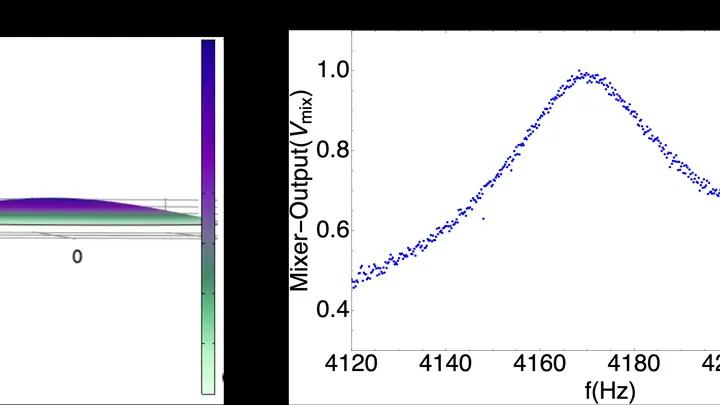
A thin film, clamped between two metal posts, trembles at the slightest nudge. Its movements are picked up by a microwave resonator — a cavity where radio waves bounce around like sound in an empty room. When the membrane shifts, the cavity's response changes.
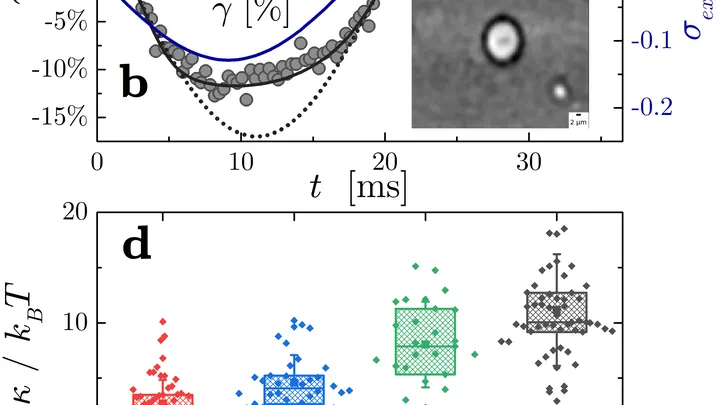
A microscopic gel bead or a tiny oil droplet squeezes through a narrow channel whose walls rhythmically contract and relax. The particle flattens and then recovers its shape, and by how quickly it does so, you can infer its internal elasticity and viscosity.
The RATAN-600 radio telescope is a ring of hundreds of aluminum panels on a mountainside in Karachay-Cherkessia. In the spring of 2018, its mirror caught radio waves from sixteen red dwarfs — small, dim, but very long-lived stars.