The Rydberg constant is a fundamental physical constant that determines the wavelengths of light emitted or absorbed by hydrogen atoms. It appears in the Rydberg formula, which predicts the spectral lines of hydrogen with extraordinary precision. Because hydrogen is the simplest atom, this constant serves as a cornerstone for testing quantum electrodynamics and for defining the SI unit of length through atomic transitions.
History
The constant was empirically derived by Swedish physicist Johannes Rydberg in 1888, who noticed a pattern in the spectral lines of hydrogen and other elements. Later, Niels Bohr's 1913 model of the atom provided a theoretical derivation, linking the constant to more fundamental quantities.
How it works
The Rydberg constant emerges from the quantum mechanical description of the hydrogen atom. In the Bohr model, the energy levels of the electron are proportional to 1/n², and the constant sets the overall energy scale. More precisely, it combines fundamental constants: the electron mass, charge, Planck's constant, and the speed of light. When an electron jumps between energy levels, the emitted photon's wavelength is inversely proportional to the difference of the inverse squares of the principal quantum numbers, with the Rydberg constant as the proportionality factor.
In practice
It is used to calibrate atomic clocks and to define the meter in the International System of Units, as well as in spectroscopy for identifying elements in stars and laboratories.
Fun fact
The Rydberg constant is known to a relative uncertainty of about 1.9 × 10⁻¹², making it the most precisely measured fundamental constant in physics.
Two dancers on stage must move in perfect sync, but if one hesitates, the whole routine is ruined. That's roughly how quantum computers with neutral atoms work: two atoms are entangled by putting them into a Rydberg state (as huge as a balloon compared to an ordinary atom), and then you wait for them to 'dance' their part.
Water is not just a wet substance. On a picosecond scale, it resembles a dance floor where molecules continuously break and form bonds with each other. Usually, this dance is described by one main movement — collective relaxation, as if the whole crowd simultaneously slows down after the music stops.
A neutral-atom quantum computer is like a library where books not only need to be read but also quickly returned to the shelf. Slow readout of results is like a sluggish librarian holding up the entire queue. Scientists have found a way to speed up this process by adding helpers.
A conventional antenna array is like a choir: many voices singing in unison, with the sound amplified in only one direction. To catch a signal from another side, you have to rearrange the whole choir. Now imagine a single voice that can change its timbre so that the sound itself focuses in the desired direction.
A conventional radio receiver compares the incoming wave with a reference to extract information from it. Rubidium atoms can do this differently: they themselves act as both antenna and detector. But until now, they required an additional radio signal to set a reference point.
The new scheme does without it.
Dark matter is an invisible mass holding galaxies together. Its nature remains unknown, but one likely candidate is the axion — an ultra-light particle that barely interacts with matter. To catch it, physicists built a hybrid trap.
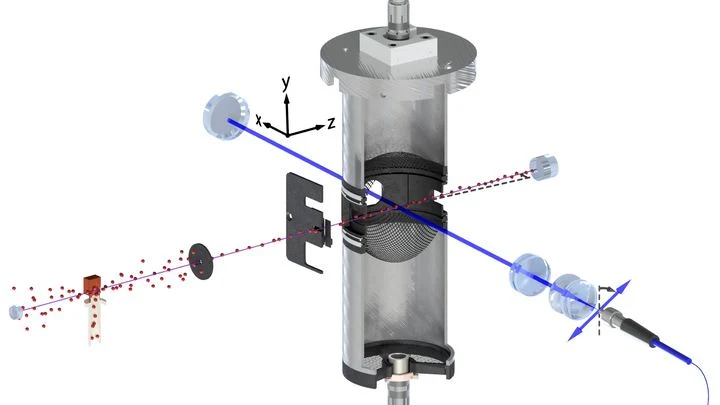
The hydrogen atom is like a tiny clock, ticking with a precision engineers can only dream of. When an electron jumps between orbits, it absorbs or emits light at a strictly defined frequency: that's the 'tick.' In the new work, physicists caught one such transition, between the 2S and 6P states, and measured its frequency with an…
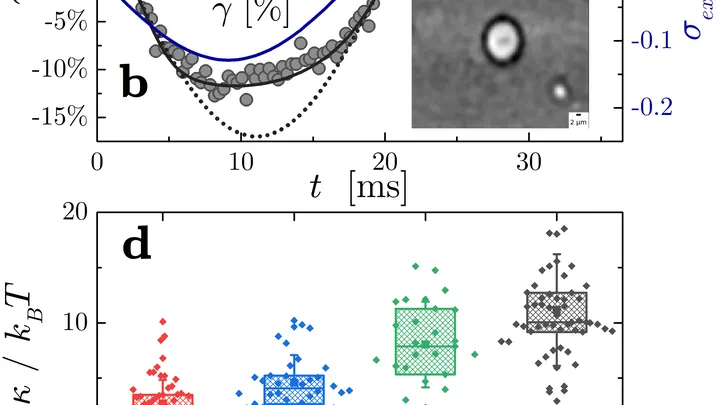
A microscopic gel bead or a tiny oil droplet squeezes through a narrow channel whose walls rhythmically contract and relax. The particle flattens and then recovers its shape, and by how quickly it does so, you can infer its internal elasticity and viscosity.
The antiproton is a mirror twin of the proton: same mass, but negative charge. When it approaches an atomic nucleus, the particles can annihilate, turning into radiation.