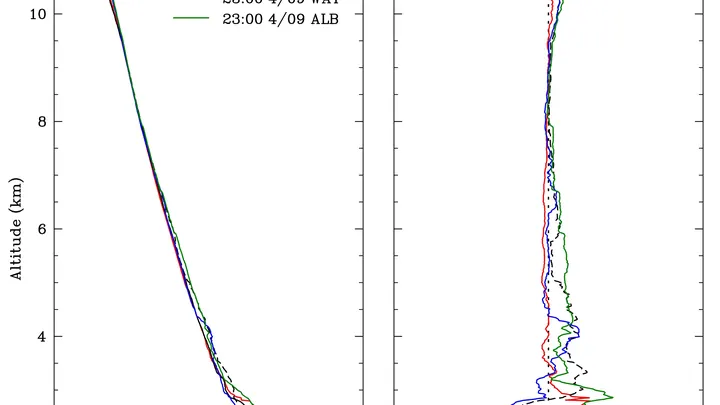
A radiosonde is a small, expendable instrument package carried aloft by a weather balloon. It measures temperature, humidity, and air pressure at successive altitudes, and it transmits those readings by radio back to a ground station. As the balloon rises through the atmosphere, the radiosonde provides a vertical snapshot of conditions — a profile — that reveals how these variables change from the surface up to about 30 kilometers, well into the stratosphere.
History
The first practical radiosondes were developed independently in the 1930s by Pavel Molchanov in the Soviet Union and by researchers in France and the United States, with regular operational use beginning around that decade.
How it works
The instrument contains sensors for temperature, humidity, and pressure, along with a radio transmitter and a small battery. As the balloon ascends, the sensors sample the air continuously, and the transmitter sends the data to a receiver on the ground. The balloon expands as it rises because external pressure drops, and when it eventually bursts, a small parachute slows the radiosonde's descent; most units are never recovered, though some are returned by finders for a reward.
In practice
Radiosondes are launched twice daily from hundreds of stations worldwide, forming the backbone of weather forecasting and climate monitoring; they also calibrate satellite measurements of the atmosphere.
Fun fact
A single radiosonde flight can cost less than a few hundred dollars, yet it provides data that helps predict weather for millions of people.
Picture a guitar string stretched between two frets. When you pluck it, a standing wave forms: some points on the string oscillate strongly, while others, the nodes, remain almost still. The chromosphere, a layer of the solar atmosphere sandwiched between the photosphere and the corona, behaves in much the same way.
Miners took canaries underground not for their songs. The bird would fall off its perch before the miner noticed carbon monoxide. In ultrahigh vacuum, the canary's role is played by a cloud of one hundred thousand lithium or rubidium atoms.
Every second, thousands of passenger aircraft in the sky transmit radio signals: that's how air traffic controllers track where each flight is. These signals don't travel in a straight line: air of varying humidity bends them like a lens. If you can measure that bending, you can work out where the air is drier and where it's more humid.
An ordinary flashlight shines in all directions, and after just a couple of dozen meters its beam fades so much it barely lights a wall. The atmosphere scatters light, and wind and heat currents distort it even more. But if you lay an invisible pipe for light right in the air, the beam will travel through it like water through a hose.
The Moon is an airless sphere of dense rocky grit called regolith. When fast particles from space slam into it, muons are born in the soil — unstable relatives of electrons, but two hundred times heavier. Most fly downward and fade away in the depths. But those that pop upward into the vacuum can travel tens of kilometers before decaying.
Deep underground, in the thickness of granite, detectors catch rare visitors from space — muons. These particles are born high in the atmosphere when cosmic rays slam into air nuclei. They make it to the underground lab thanks to their enormous speed, close to the speed of light.
A pebble the size of a grape enters the atmosphere almost tangentially and skims across the sky without falling. That's exactly what happened to a meteoroid weighing about 45 grams. It came in at such a shallow angle that it traveled 164 kilometers at an altitude of 92 kilometers — where the air is a million times thinner than at the surface.
Strike a diamond and it rings, but sound lives inside it even without a strike. Waves of compression and rarefaction constantly ripple through it, like the ripples a stone makes on water. Except this ripple is the thermal jitter of the atoms themselves, and it can be detected with a laser.
A gas bubble in water sings loudly — this is Minnaert resonance: the heavy liquid prevents the bubble from compressing quickly, forcing it to vibrate. In air, there's no such effect: air is too light. But if you dress the bubble in a soft silicone shell, like rubber, it plays the role of the water mass. You get an 'elasto-bubble'.
In underground laboratories where dark matter or neutrinoless double beta decay is sought, detectors are surrounded by silence. But even in this silence, radioactive dust quietly settles on their walls. One source is radon, an invisible gas that seeps from rocks. Its short-lived progeny stick to surfaces and spoil measurements.
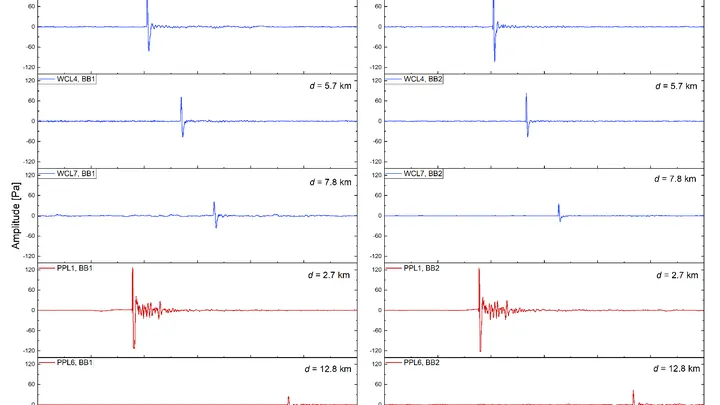
The same explosion can sound different: it all depends on which way the wind is blowing. In 2024, researchers set off charges equivalent to ten tons of TNT twice and recorded the sound with a network of 31 microphones spread over a radius of 23 kilometers. The source was identical, but the acoustic pictures turned out to be quite different.
A thin film of silicon nitride is stretched over a frame like the skin of a drum. The slightest nudge from gas molecules makes it tremble. A laser beam delivered through a glass fiber picks up that trembling and turns it into a pressure reading. The whole setup fits in a pocket, not on an optical table.
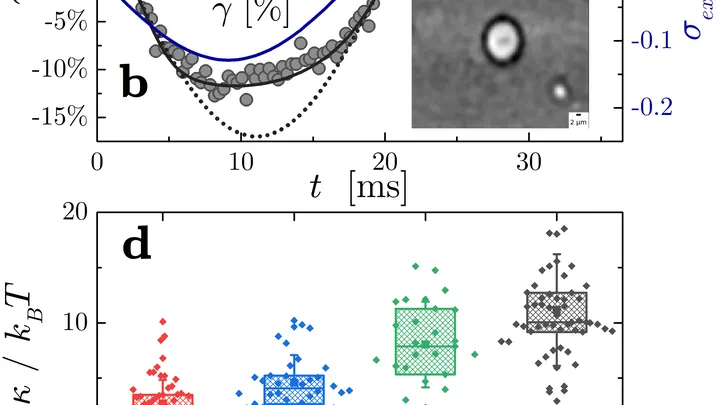
A microscopic gel bead or a tiny oil droplet squeezes through a narrow channel whose walls rhythmically contract and relax. The particle flattens and then recovers its shape, and by how quickly it does so, you can infer its internal elasticity and viscosity.
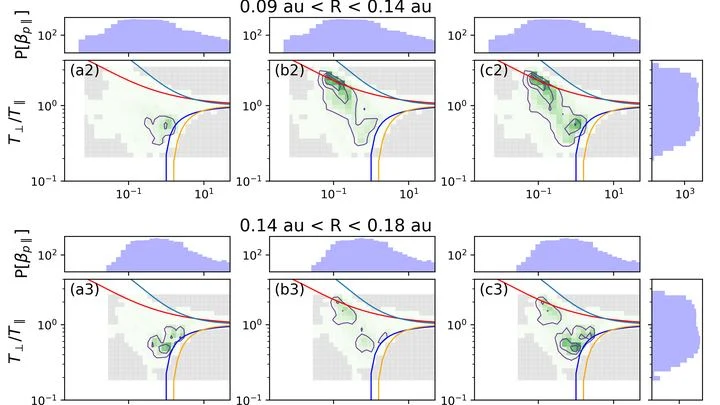
The solar wind isn't a calm stream but a bubbling soup of charged particles. Diving close to the Sun, the Parker probe picked up two types of stirring waves. Left-handed ones, like a whisk in a chef's hand, whip up the material when the temperature differs along and across the flow.
For 36 days, tropical cyclone Freddy raged over the Indian Ocean, the longest-lived cyclone on record. Meteorologists tracked it from satellites, aircraft, and ground stations. But one detail eluded all instruments: the precise air density deep within the vortex. And that density determines where the cyclone will turn tomorrow.