A Schrödinger's Cat You Can Hold in Your Palm express
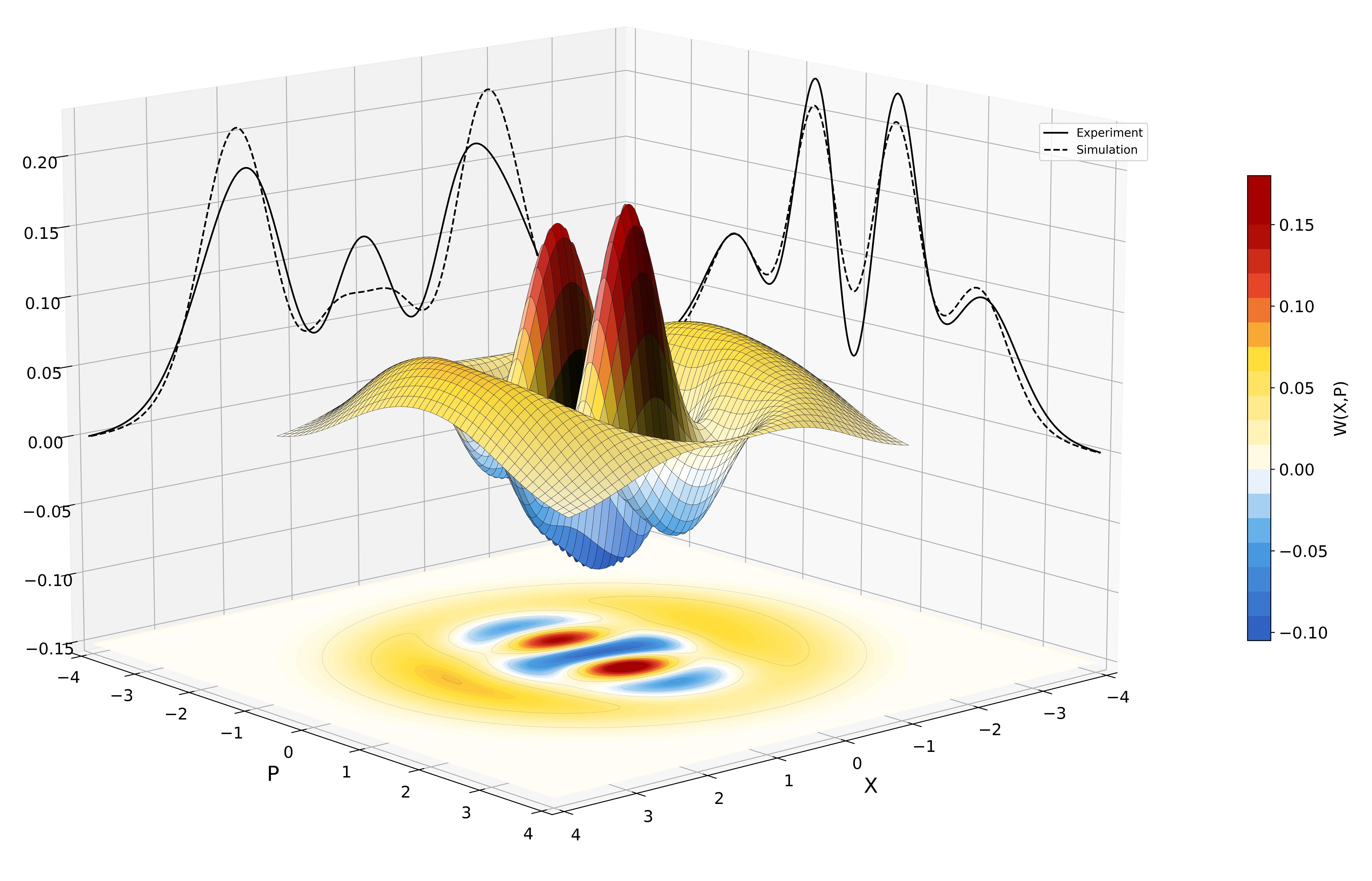
Schrödinger's cat usually hides in thought experiments — alive and dead at the same time. This time, it was caught in the lab: a light pulse was made to be in two opposite states at once, like a coin hovering in the air, heads and tails at the same time.
To do this, they took two individual photons — particles of light that can be counted one by one, like apples in a basket. One photon was, so to speak, 'single,' the other 'double.' They mixed them on a half-silvered mirror, which randomly transmits or reflects light. When the right signal flashed at the output, the pulse was in a 'cat' state — a mixture of two opposite waves.
Why does this matter? Quantum computers make errors from the slightest noise, like an orchestra thrown off by a cough in the audience. 'Cat' states are the basis of codes that allow errors to be detected and corrected without destroying the computation. Now such 'cats' can be made large and repeated many times.
The coin suspended in midair has finally become not just a thought experiment but a working tool.
Original abstract
as written by the authors arXiv:2601.09672
The generation of non-Gaussian quantum states is a key requirement for universal continuous-variable quantum information processing. We report the experimental generation of large-amplitude squeezed coherent-state superpositions (squeezed cat states) on free-space optical pulses, reaching an amplitude of $$\alpha = 2.47$$, which, to our knowledge, exceeds all previously reported values. Our protocol relies on the controlled mixing of the Fock states $$|1\rangle$$ and $$|2\rangle$$ through a tunable beam splitter, followed by heralding via homodyne detection. The resulting state displays three well-resolved negative regions in its Wigner function and achieves a fidelity of $$0.53$$ with the target state $$\propto \hat{S}(z)(|\alpha\rangle - |-\alpha\rangle)$$, with $$\alpha = 2.47$$ and squeezing parameter $$z = 0.56$$. These results constitute a significant milestone for temporal breeding protocols and for the iterative generation of optical GKP states, opening new perspectives for scalable and fault-tolerant photonic quantum architectures.
The resulting 'cat' is so large that its negative regions on a special map (the Wigner function) can be seen without a microscope: they appear as three distinct dips.