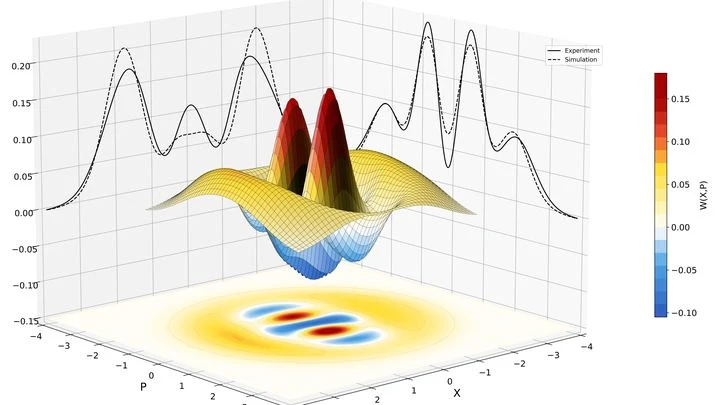
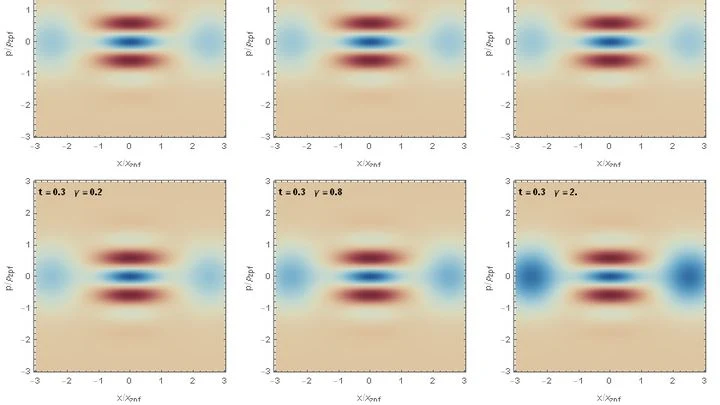
A Schrödinger cat state is a quantum superposition of a macroscopic object existing in two distinct states simultaneously, named after Erwin Schrödinger's famous thought experiment. It challenges the boundary between the quantum and classical worlds, probing whether large-scale objects can exhibit quantum behavior. These states are crucial for testing the fundamental limits of quantum mechanics and for developing quantum technologies that require coherent control over complex systems.
History
Erwin Schrödinger introduced the concept in 1935 as a critique of the Copenhagen interpretation, highlighting the absurdity of a cat being both alive and dead. Experimental realizations began in the late 20th century with photons and atoms, and have since advanced to mechanical systems, such as the 'mechanical Schrödinger cat' demonstrated in 2023.
How it works
In a Schrödinger cat state, a system is prepared in a superposition of two macroscopically distinguishable states, such as a particle being in two locations at once or a mechanical oscillator vibrating in two different phases. This is achieved by entangling the macroscopic object with a quantum bit (qubit) and then measuring the qubit, which leaves the object in a superposition. The challenge is maintaining this fragile state against decoherence, which rapidly destroys superpositions due to interactions with the environment.
In practice
Schrödinger cat states are used in quantum computing and quantum communication, where they enable error correction and enhance the sensitivity of quantum sensors. They are also being explored for testing gravitational effects on quantum superpositions.
Fun fact
In 2023, researchers created a Schrödinger cat state in a mechanical oscillator made of billions of atoms, making it the largest object ever placed in a quantum superposition.
At low temperatures, many materials become superconductors — current flows without resistance. But how exactly does this happen if electrons were initially trapped in an insulator? Half a century ago, Philip Anderson suggested that the answer lies in a special quantum dance of particles.
In a noisy hall, an interpreter tries to catch every word, but rustles and echoes muddle the meaning. That's roughly how conventional computer methods handle complex quantum systems: the more particles and the stronger their correlations, the faster calculations drown in interference.
The Josephson junction is a bridge made of superconductor, separated by an ultra-thin insulating layer. Current flows through it even without voltage. But when the current becomes too large, the bridge starts to oscillate, and even steps, Shapiro steps, appear on the voltage graph. Between these steps hide invisible gaps where the system behaves strangely.
A black hole's horizon is not a wall but rather a one-way membrane. Anything that crosses it disappears forever. Stephen Hawking showed that this boundary should glow faintly, emitting particles. But catching such radiation from a real black hole is impossible: it's too far and too dim.
Physicists have found a workaround: build a "toy" black hole out of magnetic atoms.
Photographing hummingbird wings with an ordinary camera gives a blurry smudge. For a sharp picture, you take many rapid shots from different angles and piece them together: that's how a quantum 'snapshot' is made. In the lab, scientists 'feel' the vibrations of a tiny mirror with a laser beam.
An ordinary magnet is like a compass: its needle points north. But a quantum compass can look in both directions at once. If a magnet floating in a vacuum is gently spun, its electron 'tops' synchronize so the whole piece of metal starts living by the rules of the microworld — freezes in a superposition, like a split pointer.
Even at absolute rest, atoms emit a faint noise — unavoidable quantum jitter. In the debates between Einstein and Bohr, this noise, like an unceasing whisper, blurs the interference fringes from an atomic slit. Overcoming this limit was considered impossible.
A long chain of atoms, each a tiny magnet. They talk to each other and to a common field, like musicians in an orchestra who hear both the conductor and their neighbors. When the external field changes, the orchestra either plays out of sync or all instruments come in together: that's a quantum phase transition.
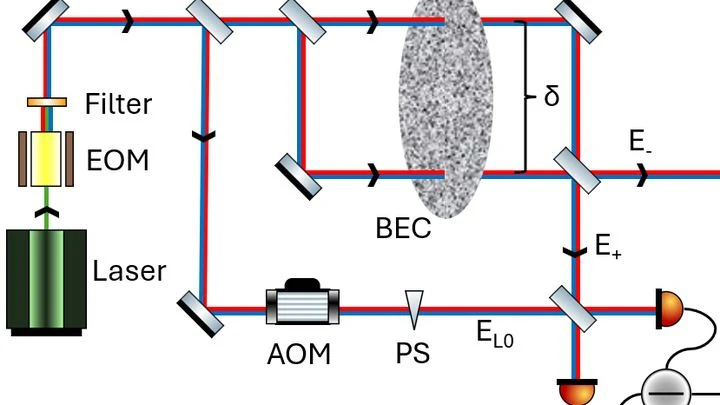
Physicists have proposed an experiment: a laser beam acts as a quantum detector and splits into two beam-ears. Each ear is directed through a tiny cloud of ultracold atoms — in this state, atoms merge into a single wave.
An orchestra where every musician plays their own part, yet together they weave a complex melody: that's what a cloud of atoms looks like when their spins (intrinsic rotations, like tiny tops) oscillate in sync. Usually, these tops behave independently.
In a football stadium, the crowd's emotions arise from the chatter of individual fans. If mood could be both joyful and sorrowful at once, you'd have a quantum superposition. But the murmur of thousands of voices instantly forces that blend into a single definite state.
A massive nanodiamond inside a quantum interferometer splits in two, pulling itself into two realities. Its gravity — tiny, almost imperceptible — stirs the quantum field of the vacuum, giving rise to coherent clouds of gravitons. These are the gravitational shadows cast by each position of the mass.
A pot of water boils, and molecules break into a chaotic dance. You cannot stop that moment or freeze the dance, but in the quantum world there is a workaround: you can create a 'double' of the system that stores all the information about its thermal state.
A quantum computer is like an orchestra where each musician plays their own part. If the conductor slips up, the music falls apart. In digital quantum simulations, the conductor's role is played by a sequence of simple operations, and errors accumulate like wrong notes.
A laser beam inside a special crystal spontaneously turns into a “Schrödinger’s cat”—a mixture of two states. Erwin Schrödinger dreamed up this paradox for an atom, but now physicists see it happen with an entire stream of photons.
Light is like a company of soldiers on a parade ground.
Physicists took 28 quantum tops, particles with intrinsic spin, and ran a cyclic process on a quantum computer predicted by Werner Heisenberg nearly a century ago. At first, each top spun however it pleased.
Schrödinger's cat, according to quantum rules, can be both alive and dead at once. But a table can't pull that off. When a massive object tries to be in two places, its mass curves spacetime so drastically that instead of two points, a single deep depression forms, and the object rolls into it.
There is always noise in the microworld. Even in absolute emptiness, something trembles, and these quantum fluctuations interfere with precise measurements. But noise can be "squeezed," like a balloon: if you squeeze it from the sides, one part gets thinner while the other bulges.
A photon is like a car in a multi-story parking lot, where each floor is its frequency (color). Usually it gets stuck on one level, but scientists added an elevator — a programmable modulator that moves the photon between floors on command.
A pendulum swings both left and right at the same time. In the atomic world, such a 'double' state is called a Schrödinger's cat: a particle exists in two states simultaneously, like the cat in the thought experiment — both alive and dead.
Scientists have found a way to assemble such states from many atoms using short light pulses.
Light trapped in a tiny cavity is like a pendulum that gets pushed harder and harder. At first, it swings smoothly and predictably, like an ordinary clock. But if you push it hard enough, the motion becomes strange: the pendulum seems to be in two extreme positions at once.
Schrödinger's cat usually hides in thought experiments — alive and dead at the same time. This time, it was caught in the lab: a light pulse was made to be in two opposite states at once, like a coin hovering in the air, heads and tails at the same time.
Ice cubes in a glass melt, and the water mixes on its own. Many quantum systems behave this way: particles exchange energy, and after a while, order disappears. But if you add a spoonful of honey to the glass, mixing slows down, and in intense cold, the water freezes into glass — without a crystal lattice, but also without flow.
In the world of atoms, any external influence can turn a neat order into chaos. Usually, energy losses only increase entropy — a measure of disorder. But physicists discovered the opposite: sometimes losses help the system maintain stability.
A quantum particle can be in two places at once, but large objects never are. Is it noise that creates chaos and increases entropy? Or does nature itself forbid quantum tricks in the macroworld?
One hypothesis suggests that quantum 'fuzziness' disappears on its own, and the heavier the object, the faster it goes.
Picture an orchestra of 120 musicians playing in perfect unison — one false note and the harmony crumbles. That's the metaphor for a record-breaking quantum ensemble. Physicists have for the first time entangled 120 superconducting qubits, the building blocks of future computers.
In the lab, time usually ticks on the wall: hands, digits, a frequency standard. But for the Universe, there are no external clocks. The Wheeler–DeWitt equation, the main law of quantum gravity, contains no time at all, and all fundamental theories lack an inbuilt arrow of time.
The resonator vibrates at 100 megahertz, and its mechanical damping is only 15 hertz. That is like a bell that rings for thousands of years after a single strike. Next to it sits a qubit, a quantum two-level element that decays in milliseconds. It is this contrast in lifetimes that opens the door to Schrödinger's cat.