Schrödinger's cat is a thought experiment proposed by Erwin Schrödinger in 1935 to illustrate the counterintuitive nature of quantum superposition. In the original scenario, a cat in a sealed box is coupled to a radioactive atom that may or may not trigger a poison release. Until the box is opened, quantum mechanics describes the atom as being in a superposition of decayed and not decayed states, which would imply the cat is simultaneously alive and dead. The thought experiment was designed to highlight the absurdity of applying quantum superposition to macroscopic objects.
History
Erwin Schrödinger introduced the thought experiment in 1935 in a paper discussing the Einstein-Podolsky-Rosen paradox. The first experimental realization of a 'mechanical Schrödinger's cat' was achieved in 2010 by Andrew Cleland and colleagues at UCSB, using a microscopic mechanical resonator.
How it works
In modern experiments, the 'cat' is not a real animal but a macroscopic mechanical resonator—a tiny vibrating drum or cantilever—that is placed in a superposition of two distinct vibrational states. By coupling the resonator to a superconducting qubit or a photon, researchers can prepare and verify the superposition. The resonator's large mass (compared to atoms) makes it a testbed for exploring how quantum effects fade at macroscopic scales, a question central to understanding the boundary between quantum and classical physics.
In 2010, researchers at UCSB created a mechanical resonator in a superposition of two states, each involving the motion of about 10 trillion atoms—the largest object to exhibit quantum superposition at that time.
In a noisy hall, an interpreter tries to catch every word, but rustles and echoes muddle the meaning. That's roughly how conventional computer methods handle complex quantum systems: the more particles and the stronger their correlations, the faster calculations drown in interference.
The Josephson junction is a bridge made of superconductor, separated by an ultra-thin insulating layer. Current flows through it even without voltage. But when the current becomes too large, the bridge starts to oscillate, and even steps, Shapiro steps, appear on the voltage graph. Between these steps hide invisible gaps where the system behaves strangely.
A black hole's horizon is not a wall but rather a one-way membrane. Anything that crosses it disappears forever. Stephen Hawking showed that this boundary should glow faintly, emitting particles. But catching such radiation from a real black hole is impossible: it's too far and too dim.
Physicists have found a workaround: build a "toy" black hole out of magnetic atoms.
Even at absolute rest, atoms emit a faint noise — unavoidable quantum jitter. In the debates between Einstein and Bohr, this noise, like an unceasing whisper, blurs the interference fringes from an atomic slit. Overcoming this limit was considered impossible.
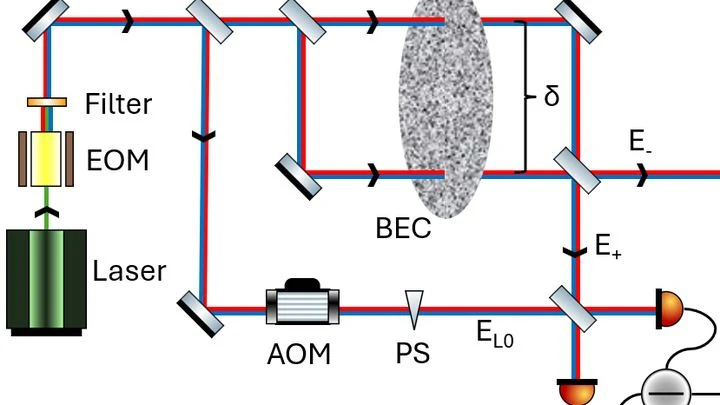
Physicists have proposed an experiment: a laser beam acts as a quantum detector and splits into two beam-ears. Each ear is directed through a tiny cloud of ultracold atoms — in this state, atoms merge into a single wave.
The deepest equations of physics, like the Wheeler–DeWitt equation, contain no time. Past and future are scrambled within them, like frames on a film reel with no arrow indicating which way to play it. This symmetry is not a flaw but a feature.
An orchestra where every musician plays their own part, yet together they weave a complex melody: that's what a cloud of atoms looks like when their spins (intrinsic rotations, like tiny tops) oscillate in sync. Usually, these tops behave independently.
In a football stadium, the crowd's emotions arise from the chatter of individual fans. If mood could be both joyful and sorrowful at once, you'd have a quantum superposition. But the murmur of thousands of voices instantly forces that blend into a single definite state.
A massive nanodiamond inside a quantum interferometer splits in two, pulling itself into two realities. Its gravity — tiny, almost imperceptible — stirs the quantum field of the vacuum, giving rise to coherent clouds of gravitons. These are the gravitational shadows cast by each position of the mass.
A laser beam inside a special crystal spontaneously turns into a “Schrödinger’s cat”—a mixture of two states. Erwin Schrödinger dreamed up this paradox for an atom, but now physicists see it happen with an entire stream of photons.
Light is like a company of soldiers on a parade ground.
Schrödinger's cat, according to quantum rules, can be both alive and dead at once. But a table can't pull that off. When a massive object tries to be in two places, its mass curves spacetime so drastically that instead of two points, a single deep depression forms, and the object rolls into it.
A pendulum swings both left and right at the same time. In the atomic world, such a 'double' state is called a Schrödinger's cat: a particle exists in two states simultaneously, like the cat in the thought experiment — both alive and dead.
Scientists have found a way to assemble such states from many atoms using short light pulses.
A quantum particle can be in two places at once, but large objects never are. Is it noise that creates chaos and increases entropy? Or does nature itself forbid quantum tricks in the macroworld?
One hypothesis suggests that quantum 'fuzziness' disappears on its own, and the heavier the object, the faster it goes.
Picture an orchestra of 120 musicians playing in perfect unison — one false note and the harmony crumbles. That's the metaphor for a record-breaking quantum ensemble. Physicists have for the first time entangled 120 superconducting qubits, the building blocks of future computers.
On an ordinary optical table, amid lasers and mirrors, a cloud of a hundred strontium-87 atoms begins to live by the laws of curved spacetime. Half a second later, its quantum interference fades: gravitational time dilation destroys the superposition.
In the lab, time usually ticks on the wall: hands, digits, a frequency standard. But for the Universe, there are no external clocks. The Wheeler–DeWitt equation, the main law of quantum gravity, contains no time at all, and all fundamental theories lack an inbuilt arrow of time.
The resonator vibrates at 100 megahertz, and its mechanical damping is only 15 hertz. That is like a bell that rings for thousands of years after a single strike. Next to it sits a qubit, a quantum two-level element that decays in milliseconds. It is this contrast in lifetimes that opens the door to Schrödinger's cat.