Macroscopic superposition is the hypothetical quantum state in which an object large enough to be seen with the naked eye exists in multiple places or states at once, much like the famous Schrödinger's cat thought experiment. In the quantum world, particles like electrons and photons routinely exist in superpositions, but this behavior is never observed in everyday objects. Understanding why this is the case, and whether it is even possible, is a central question in quantum mechanics and the search for a theory that unifies quantum physics with gravity.
History
The idea dates back to Erwin Schrödinger's 1935 thought experiment, but serious experimental proposals for macroscopic superpositions emerged in the late 20th century, with pioneers like Anthony Leggett discussing the feasibility of 'quantum mechanics at the macroscopic level'.
How it works
In quantum mechanics, a system is described by a wavefunction that can be a sum of different possibilities. For a macroscopic object, this would mean the entire object's center-of-mass is in a superposition of two locations. However, interactions with the environment, a process called decoherence, rapidly destroy such superpositions. The challenge is to isolate the object from its environment long enough to observe the superposition, or to find a mechanism, such as gravity-induced collapse, that prevents it from forming in the first place.
In practice
Experiments aiming to create macroscopic superpositions are at the forefront of quantum technology, with potential applications in ultra-sensitive sensors and quantum computing, as well as tests of the fundamental limits of quantum mechanics.
Fun fact
Current experiments are pushing the boundaries by attempting to place tiny crystals or dust grains, containing billions of atoms, into a superposition of two locations, which would be the largest objects ever to exhibit quantum behavior.
A layered cake of molybdenum disulfide MoS2 sits on the lab bench. It is prepared in the usual way: adhesive tape peels off the top layers to obtain a thin sample. But beneath the tape remains an invisible cavity where the atomic floors are no longer pressed together. It is there that electrons begin to behave differently than in the crystal bulk.
In a hall with a thousand spectators, applause blends into a general noise, but if someone falls out of rhythm — a ripple runs through the crowd. The quantum world works similarly: atoms in a trap can behave as a single whole, or they can fall apart into independent individuals.
The Josephson junction is a bridge made of superconductor, separated by an ultra-thin insulating layer. Current flows through it even without voltage. But when the current becomes too large, the bridge starts to oscillate, and even steps, Shapiro steps, appear on the voltage graph. Between these steps hide invisible gaps where the system behaves strangely.
An atomic nucleus is not just a ball of protons and neutrons. It has a shape, and that shape can change. The tin-116 nucleus was long considered almost perfectly spherical: it has 50 protons — a 'magic' number that usually gives a nucleus spherical symmetry. But a new ultra-precise measurement showed otherwise.
Photographing hummingbird wings with an ordinary camera gives a blurry smudge. For a sharp picture, you take many rapid shots from different angles and piece them together: that's how a quantum 'snapshot' is made. In the lab, scientists 'feel' the vibrations of a tiny mirror with a laser beam.
Quantum entanglement — a phenomenon where the states of two or more particles become interconnected regardless of the distance between them — usually links intrinsic properties such as spin or polarization. However, a new experiment has for the first time realized entanglement of the positions of two atoms in space.
A magnetic field holds a tiny particle in mid-air, like an invisible dance partner. A special tuning of the field creates a trap with two "positions." In the ordinary world, a dancer occupies only one, but in the quantum world — both at once. Physicists have learned to achieve this for dust grains weighing trillionths of a gram.
In mathematics there is a sieve that sifts not dust, but infinity itself. It’s called a Q-space: here any subset turns out to be a Gδ set — a countable intersection of open sets, as if sifted through an unimaginably fine mesh.
An ordinary magnet is like a compass: its needle points north. But a quantum compass can look in both directions at once. If a magnet floating in a vacuum is gently spun, its electron 'tops' synchronize so the whole piece of metal starts living by the rules of the microworld — freezes in a superposition, like a split pointer.
An eternal Universe where the measure of disorder (энтропия) grows is, for most of its time, a homogeneous void. In it, complex structures occasionally assemble by chance, such as fleeting consciousnesses — ‘мозги Больцмана’.
An orchestra where every musician plays their own part, yet together they weave a complex melody: that's what a cloud of atoms looks like when their spins (intrinsic rotations, like tiny tops) oscillate in sync. Usually, these tops behave independently.
In a football stadium, the crowd's emotions arise from the chatter of individual fans. If mood could be both joyful and sorrowful at once, you'd have a quantum superposition. But the murmur of thousands of voices instantly forces that blend into a single definite state.
A massive nanodiamond inside a quantum interferometer splits in two, pulling itself into two realities. Its gravity — tiny, almost imperceptible — stirs the quantum field of the vacuum, giving rise to coherent clouds of gravitons. These are the gravitational shadows cast by each position of the mass.
A flashlight beam in a dark room can hold a dust mote almost still: that's how optical tweezers work. But light doesn't just push the particle; it also jostles it with random kicks. Each absorbed photon strikes it like an invisible hammer. The authors of the new study have devised a light trap of a special shape.
Schrödinger's cat, according to quantum rules, can be both alive and dead at once. But a table can't pull that off. When a massive object tries to be in two places, its mass curves spacetime so drastically that instead of two points, a single deep depression forms, and the object rolls into it.
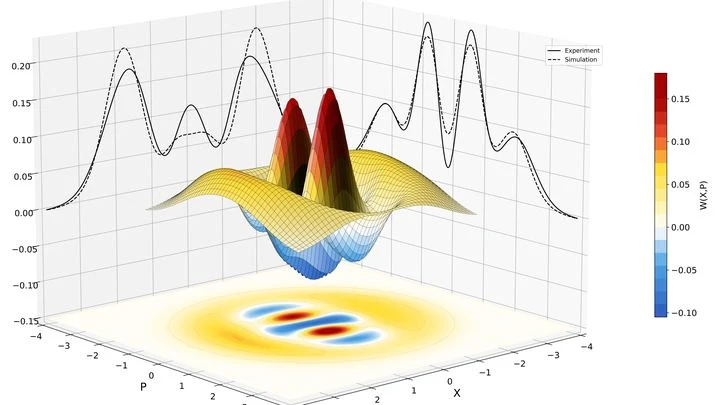
Schrödinger's cat usually hides in thought experiments — alive and dead at the same time. This time, it was caught in the lab: a light pulse was made to be in two opposite states at once, like a coin hovering in the air, heads and tails at the same time.
Creating light with an exact number of photons is like stamping exactly 100,000 flawless coins. Until now, physicists could only control dozens of particles. The 'optical lathe' technology breaks this barrier: virtual lenses, like milling cutters, eliminate 'blurriness' and ensure each bunch contains exactly the specified number of photons. Counting becomes perfect.
A quantum particle can be in two places at once, but large objects never are. Is it noise that creates chaos and increases entropy? Or does nature itself forbid quantum tricks in the macroworld?
One hypothesis suggests that quantum 'fuzziness' disappears on its own, and the heavier the object, the faster it goes.
According to one physical hypothesis, our voluminous world might be a projection from a flat surface. From such a Universe, tiny closed bubbles — baby universes — sometimes pinch off. For a long time, they were thought to be empty, devoid of internal diversity.
It turned out that the information inside them is scattered, like shards of a broken mirror.
On an ordinary optical table, amid lasers and mirrors, a cloud of a hundred strontium-87 atoms begins to live by the laws of curved spacetime. Half a second later, its quantum interference fades: gravitational time dilation destroys the superposition.
The resonator vibrates at 100 megahertz, and its mechanical damping is only 15 hertz. That is like a bell that rings for thousands of years after a single strike. Next to it sits a qubit, a quantum two-level element that decays in milliseconds. It is this contrast in lifetimes that opens the door to Schrödinger's cat.