The theoretical foundations were laid in the 1970s and 1980s, with the first experimental demonstrations of single-photon emission from a quantum dot in 2000 and squeezed light from solid-state systems in the 1980s.
How it works
Solid-state sources typically exploit quantum confinement in semiconductor quantum dots, where an excited electron-hole pair recombines to emit exactly one photon at a time. Alternatively, spontaneous parametric down-conversion in nonlinear crystals splits a pump photon into two entangled photons. Squeezed light is generated by driving a nonlinear optical cavity with a strong laser, producing states where the uncertainty in one quadrature is reduced below the quantum limit at the expense of the other.
A gas target is like a funnel: the steeper its walls, the stronger the flow. But in this funnel, it is not water that flows, but ultraviolet light, born when a powerful laser pulse passes through a cloud of argon. The efficiency of this conversion is usually minuscule, about 0.001%: out of a thousand laser photons, only one turns into useful ultraviolet.
A spinning top whirls so fast that the air around it starts to rotate in unison. A black hole behaves in much the same way: if it spins, it can transfer its energy to particles that happen to be nearby. This process is called superradiance: it's like an echo in the mountains, but instead of sound, new particles are born.
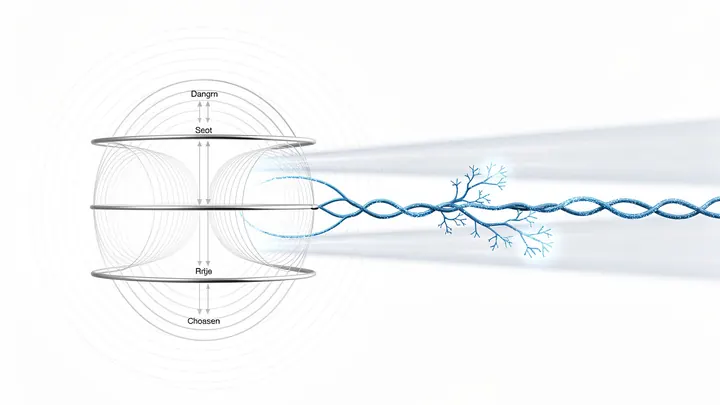
Imagine a green beam that, passing through an ingenious optical setup, twists into a three-dimensional funnel of light — an optical vortex. At its heart, like in the eye of a hurricane, the intensity drops to zero. It is there that photons disappear.
In very dim light, photons arrive one by one, like drops from a leaky faucet — never in pairs. This effect, predicted by Roy Glauber and confirmed by Leonard Mandel, directly proves that light is made of particles.
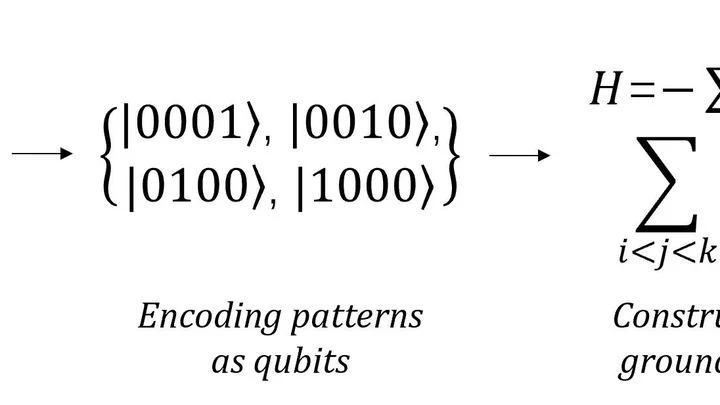
Conventional neural networks learn from thousands of examples, burning hours and gigawatts. Physicists have found a quantum workaround. As early as Max Planck showed the discreteness of energy, today this allows generation without training.
A typical photon source can be likened to a club entrance with a single bouncer. He tries to let people in one at a time, but occasionally couples sneak past. Physicists call this the purity problem: photons must arrive strictly solo, otherwise quantum computing breaks down.
An orchestra where every musician plays their own part, yet together they weave a complex melody: that's what a cloud of atoms looks like when their spins (intrinsic rotations, like tiny tops) oscillate in sync. Usually, these tops behave independently.
Two laser beams of different colors strike a crystal, and inside it, triplets of light particles are occasionally born, like three coins popping out of the same vending machine slot. For the first time, this process has been made efficient enough: 11.6 triplets per second.
The beams were green and invisible infrared.
A laser beam inside a special crystal spontaneously turns into a “Schrödinger’s cat”—a mixture of two states. Erwin Schrödinger dreamed up this paradox for an atom, but now physicists see it happen with an entire stream of photons.
Light is like a company of soldiers on a parade ground.
Laser light is like a perfectly aligned row of soldiers on parade: all waves oscillate in the same plane. Such light is called polarized. In a new study, physicists have for the first time produced polarized gamma rays by colliding electrons with a powerful laser pulse.
Modern X-ray light sources are like an orchestra without a conductor: electrons in the beam fly every which way, and the radiation comes out blurry. The new idea is to make electrons line up in neat rows with a spacing of a few nanometers. Then the light they emit becomes coherent, like a laser beam.
Sunlight is a turbulent stream carrying inseparable pairs of droplets. That’s what quantum entanglement looks like: two particles are so connected that a fluctuation in one instantly resonates in the other. In the past, creating such pairs required a 'calm pool' — a perfectly tuned laser beam.
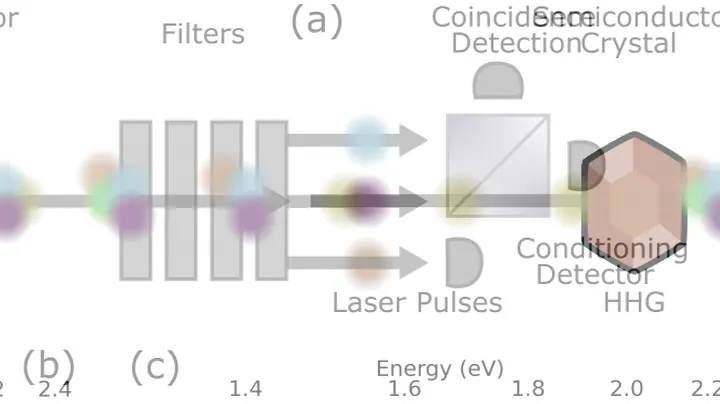
A powerful laser strikes a semiconductor, and it responds with light at many frequencies, like a string sounding a chorus of overtones. Previously, this was used in spectroscopy to observe ultrafast processes. But now physicists have noticed: the overtones are not independent; they behave as if connected by invisible threads.
Light from an ordinary bulb is a stream of individual photons, like drops from a faucet. But there is also light where photons come in pairs, like twins walking together. Such grouped light has long been desired for measuring distances and imaging objects hidden around corners. But sources of this light were either too dim, or their flashes too short for ordinary detectors to catch.
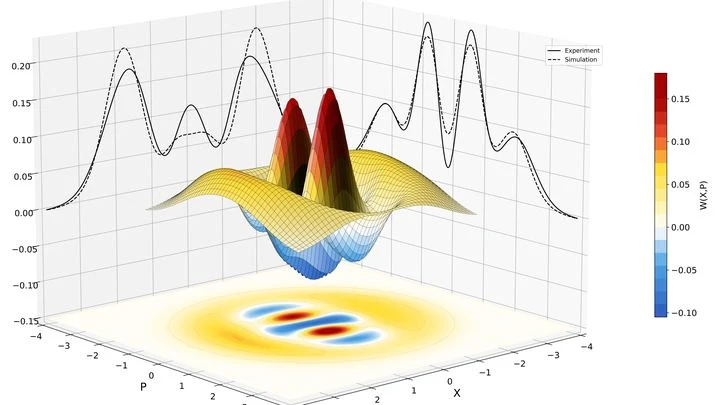
Schrödinger's cat usually hides in thought experiments — alive and dead at the same time. This time, it was caught in the lab: a light pulse was made to be in two opposite states at once, like a coin hovering in the air, heads and tails at the same time.
Creating light with an exact number of photons is like stamping exactly 100,000 flawless coins. Until now, physicists could only control dozens of particles. The 'optical lathe' technology breaks this barrier: virtual lenses, like milling cutters, eliminate 'blurriness' and ensure each bunch contains exactly the specified number of photons. Counting becomes perfect.
Spontaneous emission was long considered fickle: a quantum dot emits a photon, obeying only probability. The Purcell effect allowed amplifying it by placing the emitter in a resonator, but that only changed the rate, not the spectral shape.
Spontaneous emission, the very process that lights up lamps and stars, has long been considered a pesky noise in quantum physics. This cacophony of random photons ruthlessly destroys fragile quantum entanglement, like radio static drowning out a distant melody.