How to Find the 'Dial' in the Ocean for Rain Forecasting ✛
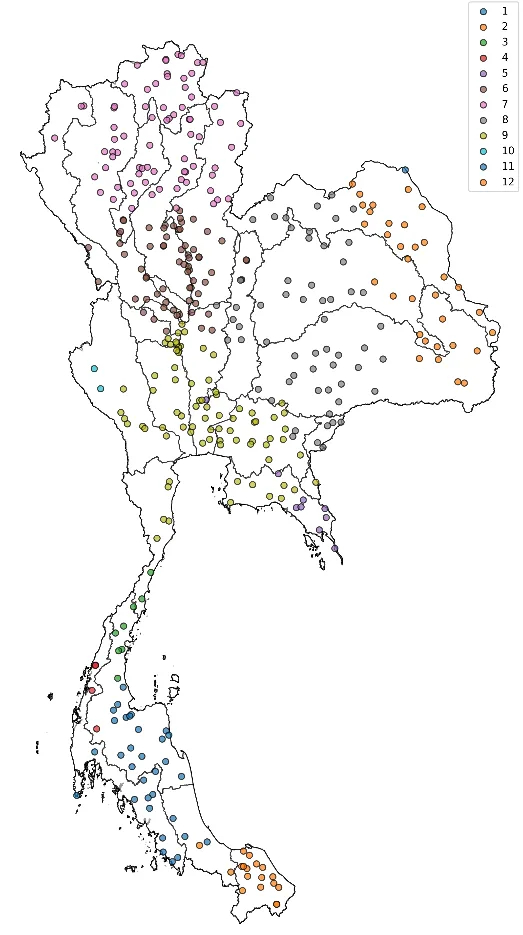
Imagine tuning a radio and slowly turning the dial to pick up a station. A reinforcement learning agent does the same, except instead of a dial, it has two rectangles in the ocean that it can shift and stretch. Its goal is to find a pair of regions such that the temperature difference between them best predicts rains in Thailand.
Initially, the regions were chosen based on old data, and the link with rains was weak. The agent tried thousands of combinations, and the link strengthened severalfold. The found regions shifted hundreds of kilometers from the original ones. When this new signal was added to a memory-based neural network, the one-year-ahead forecast error decreased in almost all groups of weather stations. Only in one region was there no improvement.
Now forecasters can use this index to better plan water for agriculture and reservoirs. Previously, it was unclear which parts of the ocean to listen to, but now the agent has found the right frequency, and the signal is clearer.
The reinforcement learning agent explored thousands of combinations of rectangles in the ocean to find a pair of regions whose temperature difference best predicts rainfall. The optimal regions turned out to be shifted by hundreds of kilometers from the original ones proposed in previous studies.