Monsoon Receiver: How a Neural Network Finds Ocean Signals of Future Rains ✛
Tuning an old radio receiver requires patience: you slowly turn the dial, catch a crackle, turn it again, until a voice emerges through the static. In much the same way, a reinforcement learning agent searched the ocean for two patches whose temperature difference best predicts rains in Thailand. It had two knobs: shifting a rectangle and changing its size. The reward was the strength of the link between the temperature difference and rainfall during the northeast monsoon season, the winter wind that brings rains to Southeast Asia.
Initially, the regions were taken from previous studies, but the link with rains was weak, like a barely audible signal. The agent tried thousands of location and size combinations, and gradually the correlation rose from 0.052 to 0.497 according to the objective function, which averages the squared correlations for monsoon onset and retreat. The optimal patches shifted hundreds of kilometers from the original ones. Now the temperature difference between them reflects the local monsoon mechanism rather than global currents.
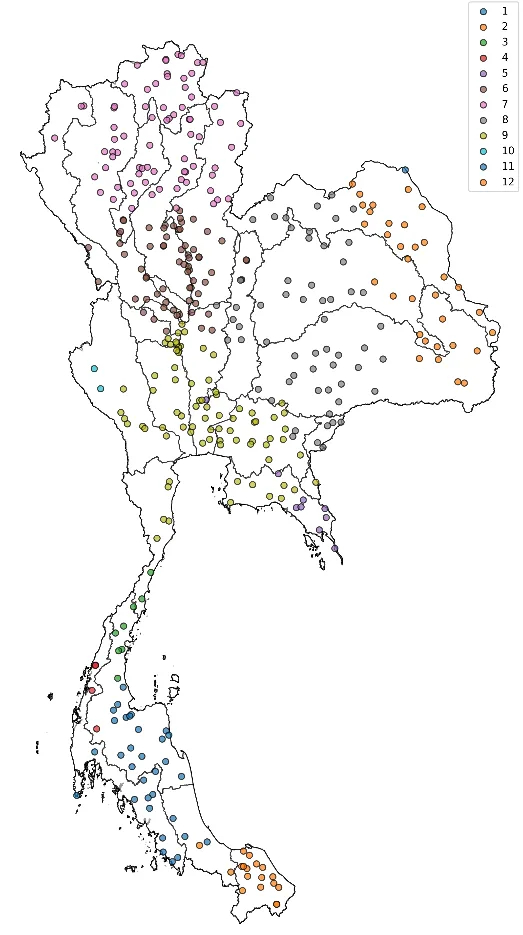
When the index was added to the memory-based neural network, the one-year-ahead forecast error decreased in 11 out of 12 groups of weather stations. In southern Thailand, the index's correlation with rainfall at monsoon onset reached -0.720, and in the north during retreat it was -0.738. The negative correlation means that the warmer the water in one region relative to the other, the less rain in the corresponding season, or vice versa. Only in one cluster was there no improvement, reminding us that even a well-tuned receiver does not always pick up all stations.
Before this work, it was unclear which ocean patches to listen to in order to predict rains in Thailand, and whether a local index could outperform global ones. Now the found regions provide a strong signal that improves the yearly forecast. The practical benefit is direct: reservoir management and agricultural planning require accurate long-term rainfall forecasts. The agent, like a radio enthusiast, found the right frequency, and now forecasters can include this index in their systems without manually trying thousands of options.
The reinforcement learning agent explored thousands of combinations of rectangles in the ocean to find a pair of regions whose temperature difference best predicts rainfall. The optimal regions turned out to be shifted by hundreds of kilometers from the original ones proposed in previous studies.