A Monsoon Index from the Sea: How Reinforcement Learning Improves Rainfall Forecasts in Thailand ✛
Context
This work stands apart among studies linking large-scale climate patterns to regional rainfall. Neighboring articles use global indices and machine learning to forecast droughts, El Niño, solar flares, and space weather. In contrast, this work focuses on a local monsoon index specific to Thailand and applies reinforcement learning to optimize geographic regions, which is absent in neighboring studies.
Methods
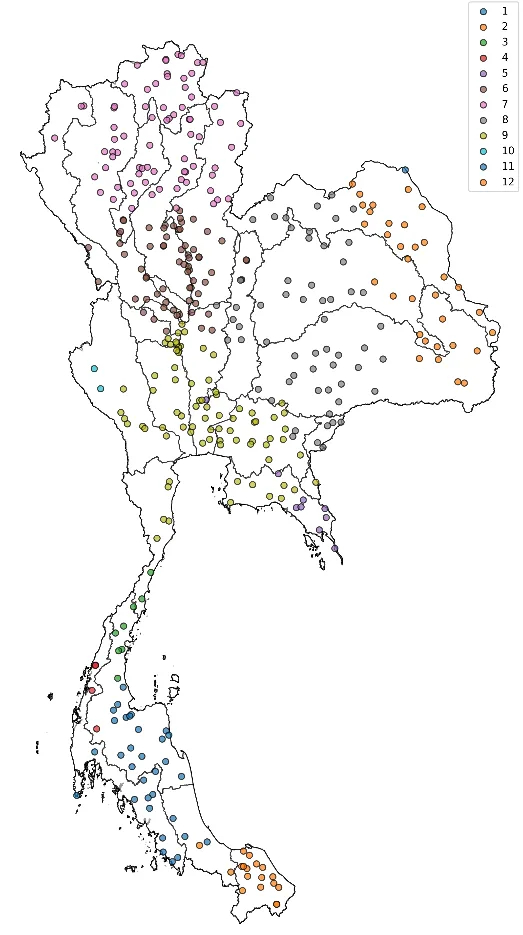
The author used sea surface temperature data (OISST) from 1982 to 2024 and rainfall from 74 stations of the Thai Meteorological Department (for training) and 384 stations of the Hydro-Informatics Institute (for testing). Stations were grouped into 12 clusters using hierarchical clustering with PCA. Then, a Deep Q-Network agent with a discrete action space (shifting and resizing rectangles) optimized two ocean regions A and B, maximizing an objective function based on the squared correlation between the index (SST difference) and rainfall during the onset (October–March) and retreat (April–September) periods of the northeast monsoon. The ocean fraction in each region had to be at least 80%. The best regions were then used to compute the index, which was added to an LSTM model with a 24-month input window and a 12-month forecast horizon.
Results
The optimized index achieved an objective function Q=0.497 (versus 0.052 for the original regions), with correlations up to -0.720 during the monsoon onset in the south and up to -0.738 during retreat in the north. When the index was added to the LSTM, the RMSE error decreased in most clusters: for example, in cluster 1 from 99.79 to 94.54 mm/month, and in cluster 12 from 59.24 to 52.38 mm/month. Only in cluster 8 was there no improvement (59.81 versus 59.91).
Implications
This work differs from neighboring studies by introducing a local index optimized specifically for Thailand rather than relying on global teleconnections. It is the first attempt to use reinforcement learning to find optimal regions for computing a monsoon index. The result shows that local patterns can substantially improve forecasts even when global indices are already included.
Future development
In the future, spatiotemporal models such as Convolution-LSTM, graph neural networks, or neural operators could be used to account for the spatial structure of rainfall and potentially improve forecasts. The approach could also be extended to other regions with monsoon climates.
Impact
This work could influence hydrological planning, reservoir management, and agricultural planning in Thailand, where accurate long-term rainfall forecasts are critical.
Next steps
The next step is to apply spatiotemporal models with the new index and validate on independent data. It is also worth investigating how robust the index is to climate change.
Key open problems
This work directly addresses the problem of representing local climate processes in forecasting models, which remains open in hydrometeorology. It also touches on the question of how to automatically discover significant predictors from large datasets.
The knowledge machine's view
This section is addressed to the author of the paper and their colleagues. Neighbouring works were found by meaning-based search across our archive, not by word overlap. We do not review: we show the field around the work.
What the work does
The author proposed a local index for Thailand's northeast monsoon, computed as the SST difference between two optimized regions identified by a deep reinforcement learning agent (Deep Q-Network). The index was added to an LSTM model to forecast rainfall 12 months ahead across 12 station clusters. The optimized index achieved the objective function Q=0.497, and adding it to the model reduced RMSE in most clusters, especially in southern Thailand.
Where its strength is
The strength of this work is that it introduces a local index specific to Thailand and applies reinforcement learning for the first time to find the optimal geographical regions for its calculation. This allows accounting for local monsoon circulations that might be missed when using only global indices.
Where it could go next
- It might be interesting to see how the proposed index interacts with global indices, such as El Niño, in a unified forecast model. Nearby in the archive there is an analysis of work where El Niño is predicted a year and a half ahead; combining local and global indices could improve forecasts at different horizons.based on: El Niño Can Be Predicted a Year and a Half in Advance arXiv:2601.12251
- Nearby there is an approach for forecasting drought months ahead using a neural network that reads weather backward. Perhaps a similar approach with backward reading of SST and rainfall time series could improve forecasts or reveal additional predictors for the monsoon index.based on: How a neural network, reading weather backwards, warns of drought months in advance arXiv:2607.00331
- The archive contains work where cosmic rain (cosmic rays) is used to improve hurricane forecasts. One could test whether cosmic ray flux adds information to the monsoon index for rainfall prediction in Thailand, especially during extreme events.based on: Muons as a Thermometer for Cyclones arXiv:2509.04627
Worth trying
- Try including not only the index but also its lagged values or nonlinear transformations (e.g., square or absolute value) in the LSTM model to account for possible nonlinear relationships with rainfall.
- Test the robustness of the identified regions to changes in the training period, for example, train the agent on the first half of the data and validate on the second half to assess the stability of the optimization.
- Compare the proposed index with other local indices if they exist, or with simple alternatives (e.g., SST differences in fixed regions chosen by experts), to demonstrate the benefit of optimization.
Why this may matter
If a local index optimized via reinforcement learning indeed improves rainfall forecasts, it could serve as a template for other regions with monsoon climates. Such an approach could help build more accurate early warning systems for droughts and floods, which is important for agriculture and water resource management.
Nearby works in our archive
- El Niño Can Be Predicted a Year and a Half in Advancesimilarity 0.55
- How a neural network, reading weather backwards, warns of drought months in advancesimilarity 0.54
- Space Weather by the Seasonssimilarity 0.50
- Weather forecast on a single GPUsimilarity 0.49
- How Stratospheric Weather Alters Particle Counters Deep Undergroundsimilarity 0.48
- Cloud Spices: How a Neural Network Improves Climatesimilarity 0.47
- Muons as a Thermometer for Cyclonessimilarity 0.47
The archive is sparse around this work: the closest review is only 0.55, against a usual 0.64. It looks like few have drilled nearby.
The reinforcement learning agent explored thousands of combinations of rectangles in the ocean to find a pair of regions whose temperature difference best predicts rainfall. The optimal regions turned out to be shifted by hundreds of kilometers from the original ones proposed in previous studies.
Key numbers
- objective function Q: 0.497 (versus 0.052 for the original regions)
- maximum correlation: -0.738 (cluster 5, monsoon retreat)
- RMSE reduction in cluster 1: from 99.79 to 94.54 mm/month
- number of station clusters: 12
- forecast horizon: 12 months