Organic Chemistry Around a Young Planet express
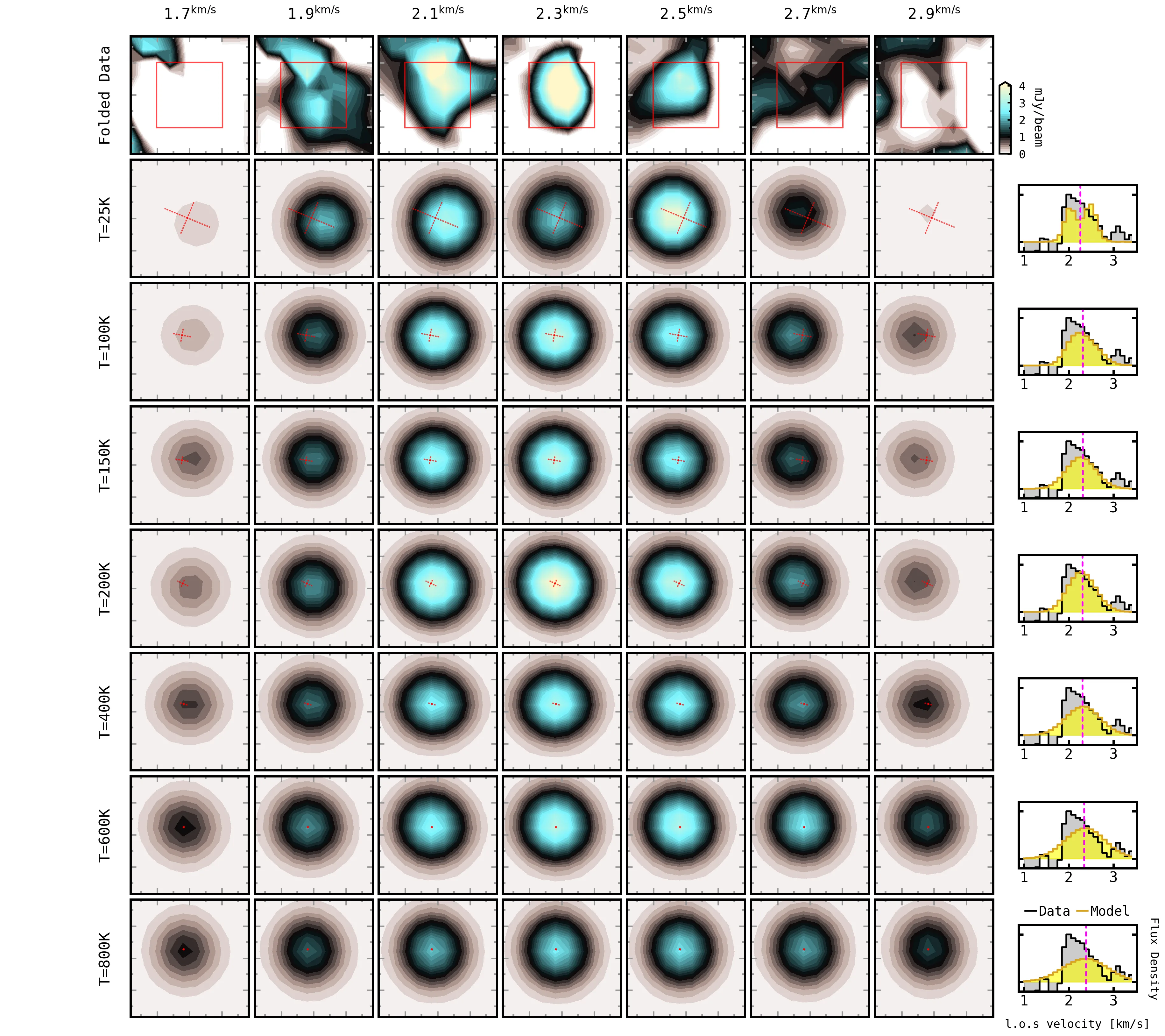
Around the star HD 163296, 330 light-years away, a dense ring of gas and dust is swirling. Astronomers have spotted a small but bright patch of hydrogen cyanide and ethynyl molecules within it. It hangs at a distance of 88 astronomical units from the star — farther than Pluto is from the Sun.
The heat from a forming planet hidden in that patch melts the icy dust. The frozen molecules evaporate and start to glow, like steam over a hot pot. That's how chemistry gives away an invisible planet.
The patch coincides with a spot where earlier observations had detected disturbances in gas motion — the signature of planet P94. Now it also has a chemical portrait. Its mass is estimated at less than 1.8 Jupiter masses, and the gas temperature in its vicinity is above 150 Kelvin, like a freezer, but in reverse.
Original abstract
as written by the authors arXiv:2601.10631
Atacama Large Millimeter/submillimeter Array observations suggest that the disc of HD 163296 is being actively shaped by embedded, yet unseen protoplanets, as indicated by numerous gas and dust substructures consistent with planet-disc interaction models. We report the first detection of simple organic molecules, HCN and C2H, tracing a candidate circumplanetary disc (CPD) in the HD 163296 system, located at an orbital radius of $$R=88\pm7$$ au and azimuth $$\phi=46\pm3^\circ$$ (or $$R=0.75''$$, $$\rm{{PA}}=350^\circ$$ in projected sky coordinates), and originating near the midplane of the circumstellar disc. The signature is localised but spectrally resolved, and it overlaps with a previously reported planet candidate, P94, identified through kinematic perturbations traced by CO lines. We propose a scenario in which the observed chemical anomalies arise from increased heating driven by the forming planet and ongoing accretion through its CPD, facilitating the thermal desorption of species that would otherwise remain frozen out in the disc midplane, and potentially triggering the activation barriers of chemical reactions that lead to enhanced molecular production. Based on a first-order dynamical analysis of the HCN spectrum from the CPD--isolated with a 7$$\sigma$$ significance--we infer an upper limit on the planet mass of 1.8 $$M_{\rm Jup}$$, consistent with predictions from CO kinematics and constraints from direct imaging studies. By comparing the CPD sizes derived from our models with theoretical expectations where the CPD radius corresponds to roughly one-third of the planet's Hill radius, we favor CPD gas temperatures $$T > 150$$ K, planet masses $$M_{\rm p} < 1.0$$ $$M_{\rm Jup}$$, and CPD radii $$R_{\rm CPD} < 2$$ au.
The radius of the disk around the planet is only 2 astronomical units: that's like the orbit of Mars, but made of gas and dust.
In the series 'The Expanse', the asteroid belt teems with organic molecules that are mined for colonies — similar to what we see in the disk of HD 163296.