Spiral-Twisted Light Now Reads Computer Chips express
Light doesn't always travel in a straight line. Its wave can be twisted into a spiral, like a stream of water from a rapidly rotating hose. This twist is called orbital angular momentum, and it can hide information: each turn acts as a separate communication channel. The problem was that only bulky setups of lenses and mirrors could recognize these twists.
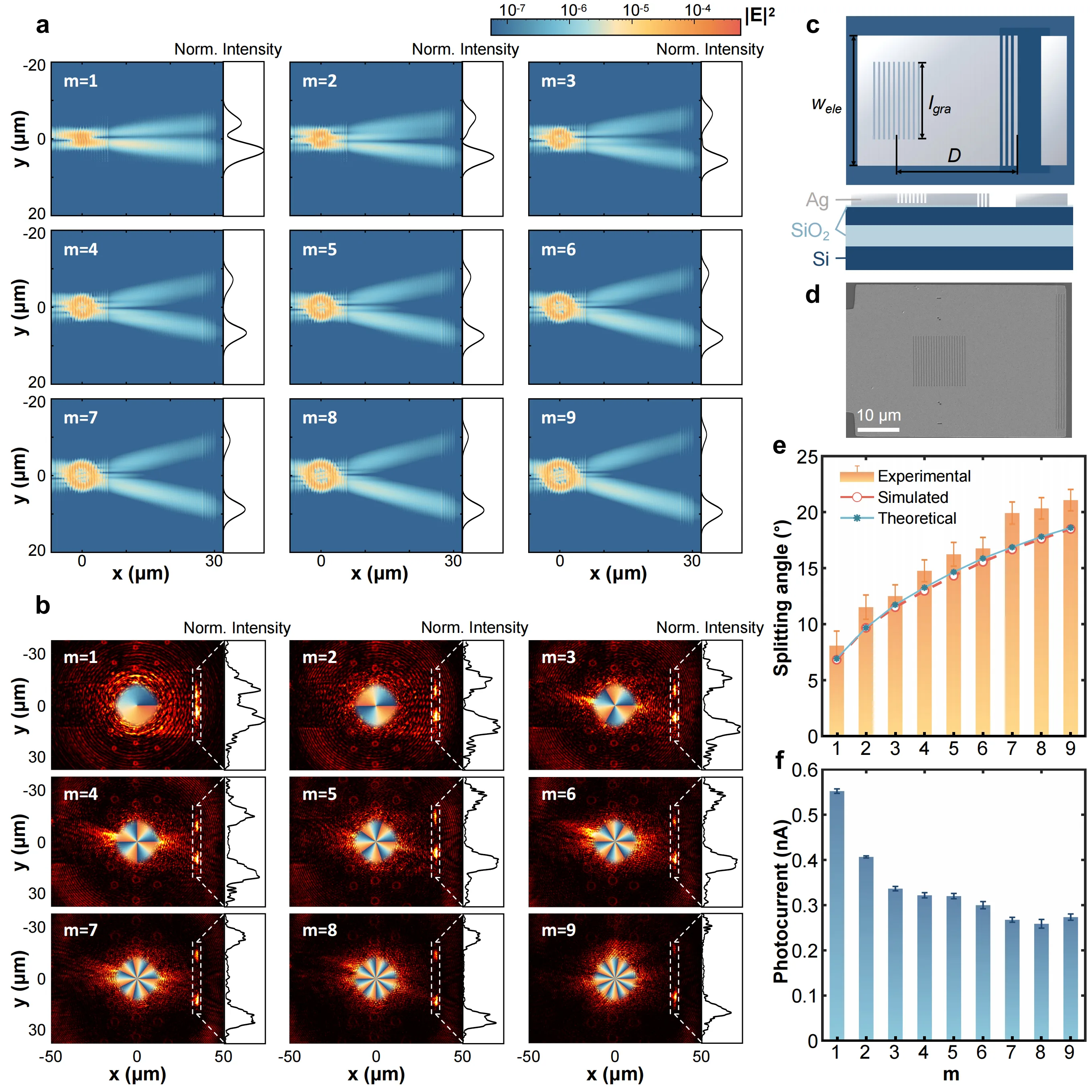
Engineers have assembled a silicon photodetector the size of a grain that does it on its own. Its electrodes are patterned with microscopic metal combs — plasmonic gratings. When twisted light hits them, it converts into surface waves that spread at different angles depending on the number of twists. These waves then generate an electric current, and from its strength the chip figures out how strongly the light was twisted.
Adding a transparent lens directly onto the chip's surface improved resolution even further. And by splitting the electrode into two halves, they taught the sensor to tell left-handed from right-handed twists. All of this uses standard silicon technology, just like ordinary computer chips, so this detector can be easily integrated into any optoelectronic board.
Now optical fiber can carry dozens of twisted beams simultaneously, each with its own data stream. At the receiving end sits a tiny silicon plate, and it sorts out all these spirals, turning them into clear electrical signals. No bulky lenses, no alignment. Ordinary light, like water from a hose, can now be twisted and untangled right on a chip.
Orbital angular momentum of light was first achieved in 1992 by passing a laser beam through a special plate that acts like a spiral staircase for light.
In the series 'Star Trek', data transmission uses phase modulators, but the idea of twisted light is closer to the 'warp streams' from Alastair Reynolds' books.