Terahertz Pulse Switches Magnetic Order Without Heating express
An ordinary magnet can be imagined as a row of soldiers all facing the same direction. An antiferromagnet is arranged differently: neighboring 'soldiers' face opposite directions, but the row as a whole remains ordered. Flipping such a row is difficult: it doesn't respond to weak external fields.
The researchers proposed using not the magnetic field of the pulse itself, but its rapid change. This change creates a force that acts on the antiferromagnet's 'row' and makes it flip. In computer simulations, this method showed reliable switching without excessive heating or parasitic currents.
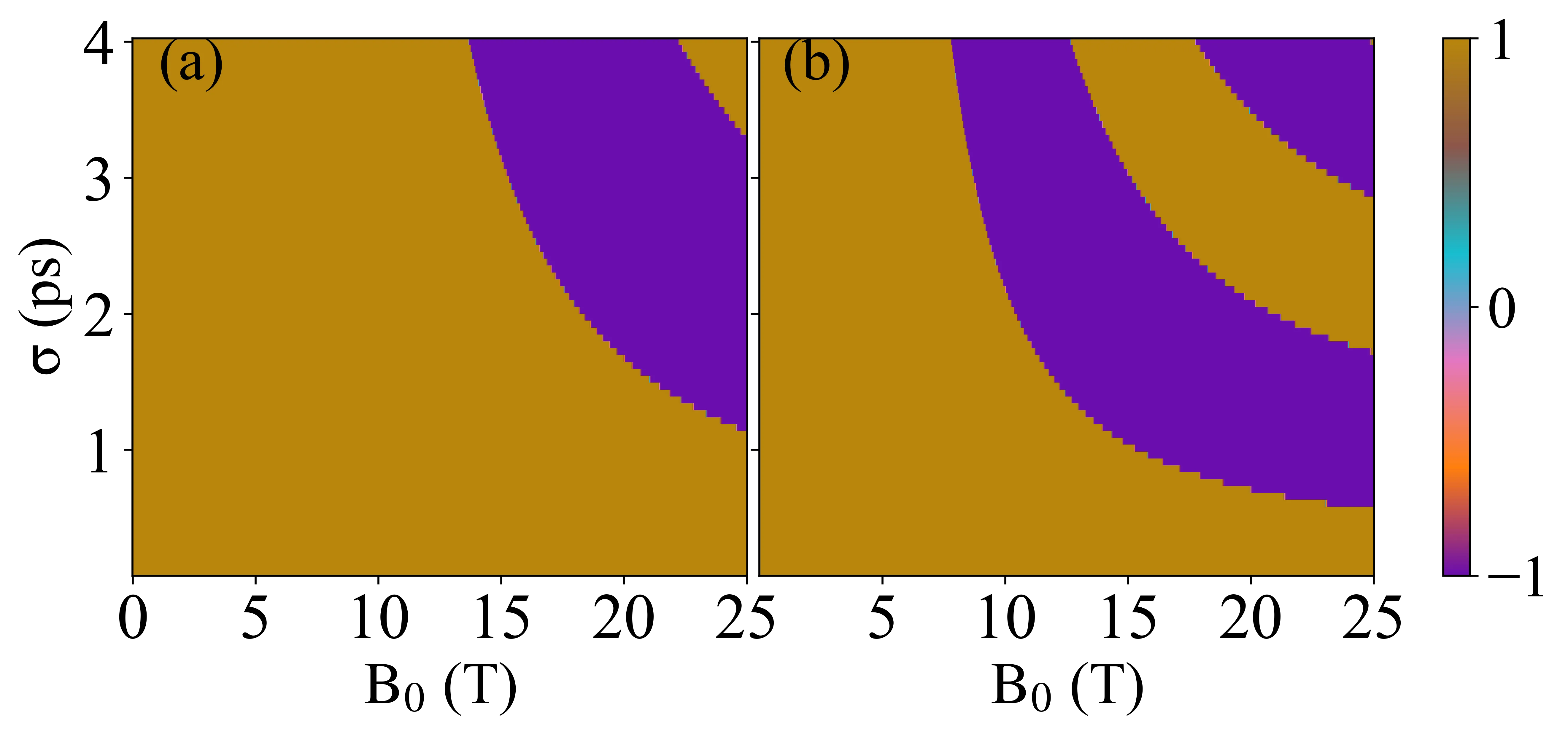
The authors calculated the parameter regions where switching is guaranteed. It turned out that for antiferromagnets these regions are fully deterministic — the outcome does not depend on random fluctuations. This makes the method promising for precise control of magnetic states in next-generation devices.
Switching magnetic order with a terahertz pulse is a step toward faster and more energy-efficient electronics. Perhaps soon information will be written not by electric current, but by short flashes of light.
Original abstract
as written by the authors arXiv:2601.15192
Control of magnetic order in antiferromagnets is a central challenge in the development of next-generation spintronic devices. Here, we propose and analyze magnetization switching driven by the field-derivative torque, a torque that originates from the time-derivative of an applied THz pulse acting on the staggered order parameter. Using atomistic spin simulations, we show that the field-derivative torque couples efficiently to the N\'eel vector, enabling deterministic switching without net spin accumulation. Further, we show that using the circularly polarised THz pulse, the FDT-induced magnetization switching reduces the required THz magnetic field by two-fold. To this end, we compute the switching and non-switching areas as a function of THz pulse width, THz magnetic field, and damping of the antiferromagnetic material. We find that the switching and non-switching areas are completely deterministic in antiferromagnets. Moreover, the switching area increases by about 55% when the FDT is considered.
Terahertz radiation lies between microwaves and infrared light. It passes through clothing and paper, but not through metal, so it is used in security scanners.
In Arthur C. Clarke's novel 'The Light of Other Days,' 'wormholes' are used for observation, but controlling magnetic order with light could be the basis for devices from 'Star Trek,' where information is stored in quantum states.