How a Drop with Nanoparticles Cracks on Glass express
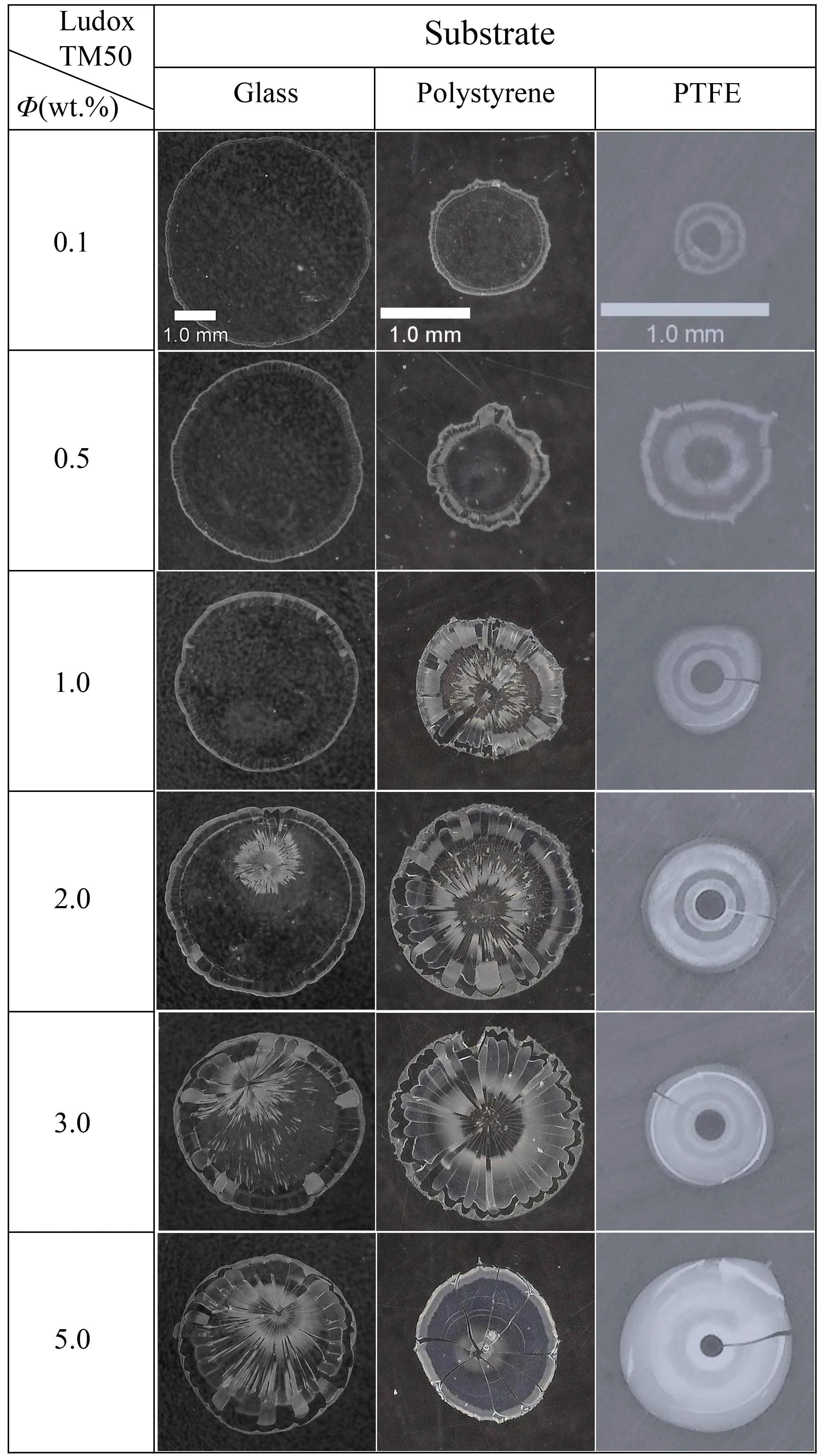
A coffee drop on a table dries and leaves a ring — coffee particles gather at the edge. But if charged nanoparticles float in the drop, the picture becomes richer: the deposit cracks like mud in a dried-up puddle. Physicists studied how the particle charge and the surface on which the drop dries change these cracks.
In experiments, they used two types of silica nanoparticles: one negatively charged, the other positively charged. Drops with them were dried on glass, polystyrene, and Teflon — surfaces with different wettability. Negatively charged particles always produced radial cracks radiating from the center like wheel spokes. Positively charged ones gave jagged, random lines. At high particle concentrations, the deposit became thick and peeled off the substrate, especially on glass, which is well-wetted.
Measurements showed that the distance between cracks and their length change with particle concentration according to a power law, just as the area of a square grows with its side length. This means the pattern can be predicted in advance. Such knowledge is useful in manufacturing coatings and printing electronics, where it matters how an ink drop with nanoparticles dries.
Original abstract
as written by the authors arXiv:2601.17655
The drying of colloidal suspensions leads to complex deposition patterns, accompanied by instabilities such as cracking and delamination. In this study, we experimentally investigate the coupled influence of particle surface charge and substrate wettability on the evaporation dynamics, final deposition morphology, and crack patterns of sessile droplets containing silica nanoparticles. We examine the dynamics of two types of colloids, namely the negatively charged colloidal silica nanoparticles (Ludox TM50) and the positively charged silica nanoparticle (Ludox CL30), at concentrations ranging from 0.1 to 5.0 weight percentages, deposited on glass, polystyrene, and polytetrafluoroethylene (PTFE) substrates with distinct wettability. Side and top-view imaging techniques are employed to capture the evaporation process and analyze the resulting cracks. Our results reveal that the nature of the particle charge and substrate wettability significantly affect the evaporation mode, with transitions observed between constant contact radius (CCR), constant contact angle (CCA), and mixed modes. TM50-laden droplets consistently exhibit radial cracks, whereas CL30 droplets display more randomly oriented and irregular cracks. At higher particle concentrations, TM50 suspensions form thicker deposits that undergo delamination, particularly on highly wettable substrates like glass. Quantitative analysis reveals that crack spacing and length follow power-law relationships with particle concentration. Additionally, the delamination behavior is strongly influenced by both the particle concentration and the type of substrate. We propose a mechanistic framework to explain the role of particle-substrate interactions in governing the observed cracking and delamination behaviors.
If you dry a drop with negatively charged particles on Teflon, the cracks turn out especially neat — Teflon is barely wetted, so the drop contracts uniformly.