How a Drop with Nanoparticles Cracks on Glass express
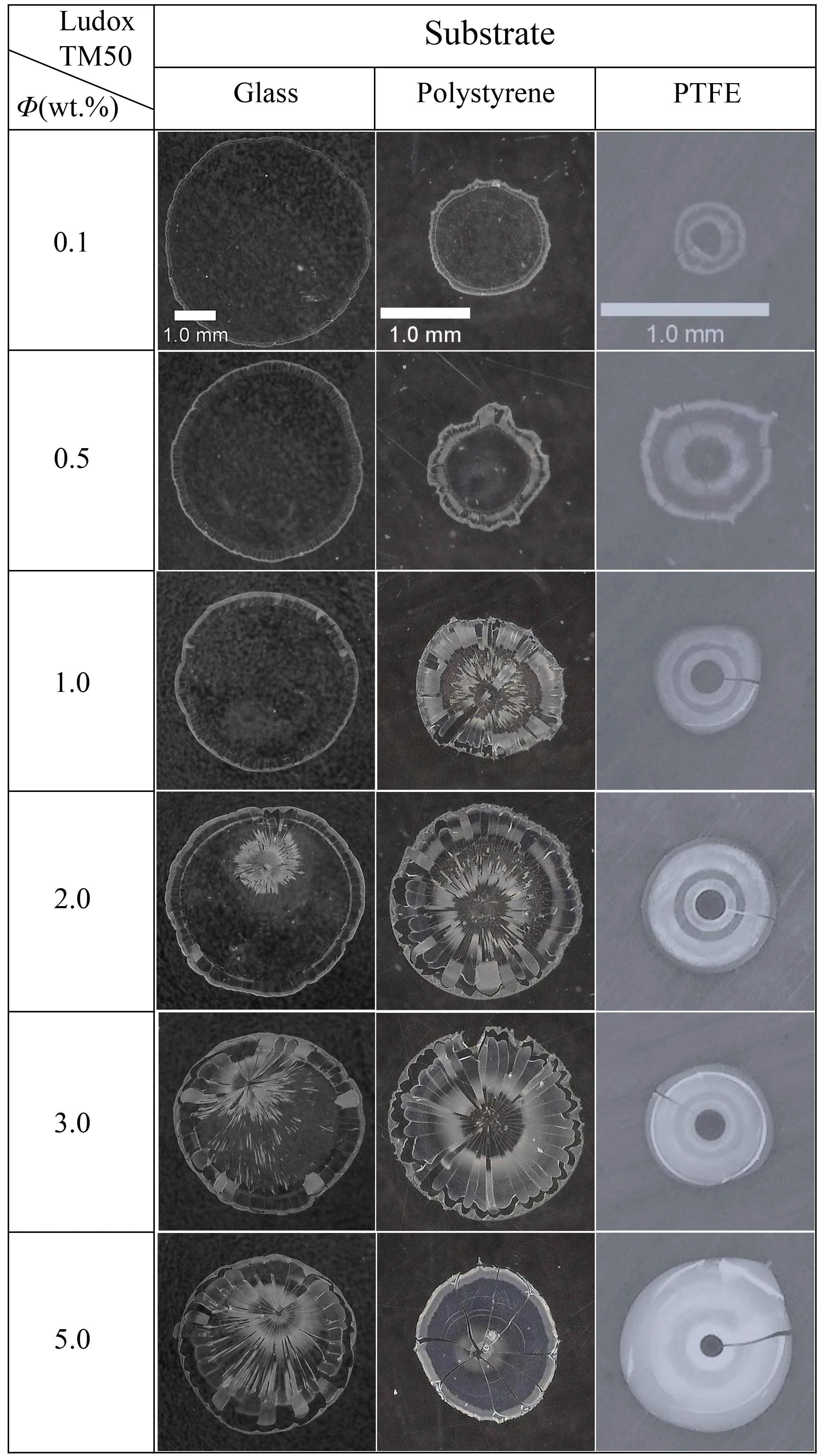
A coffee drop on a table dries and leaves a ring — coffee particles gather at the edge. But if charged nanoparticles float in the drop, the picture becomes richer: the deposit cracks like mud in a dried-up puddle. Physicists studied how the particle charge and the surface on which the drop dries change these cracks.
In experiments, they used two types of silica nanoparticles: one negatively charged, the other positively charged. Drops with them were dried on glass, polystyrene, and Teflon — surfaces with different wettability. Negatively charged particles always produced radial cracks radiating from the center like wheel spokes. Positively charged ones gave jagged, random lines. At high particle concentrations, the deposit became thick and peeled off the substrate, especially on glass, which is well-wetted.
Measurements showed that the distance between cracks and their length change with particle concentration according to a power law, just as the area of a square grows with its side length. This means the pattern can be predicted in advance. Such knowledge is useful in manufacturing coatings and printing electronics, where it matters how an ink drop with nanoparticles dries.
If you dry a drop with negatively charged particles on Teflon, the cracks turn out especially neat — Teflon is barely wetted, so the drop contracts uniformly.