Mirrors That Jitter Less express
A heated floor in a room always vibrates slightly — molecules in it are moving. The same happens to mirrors in gravitational wave detectors: heat makes their surfaces tremble finely, which hinders picking up faint signals from space.
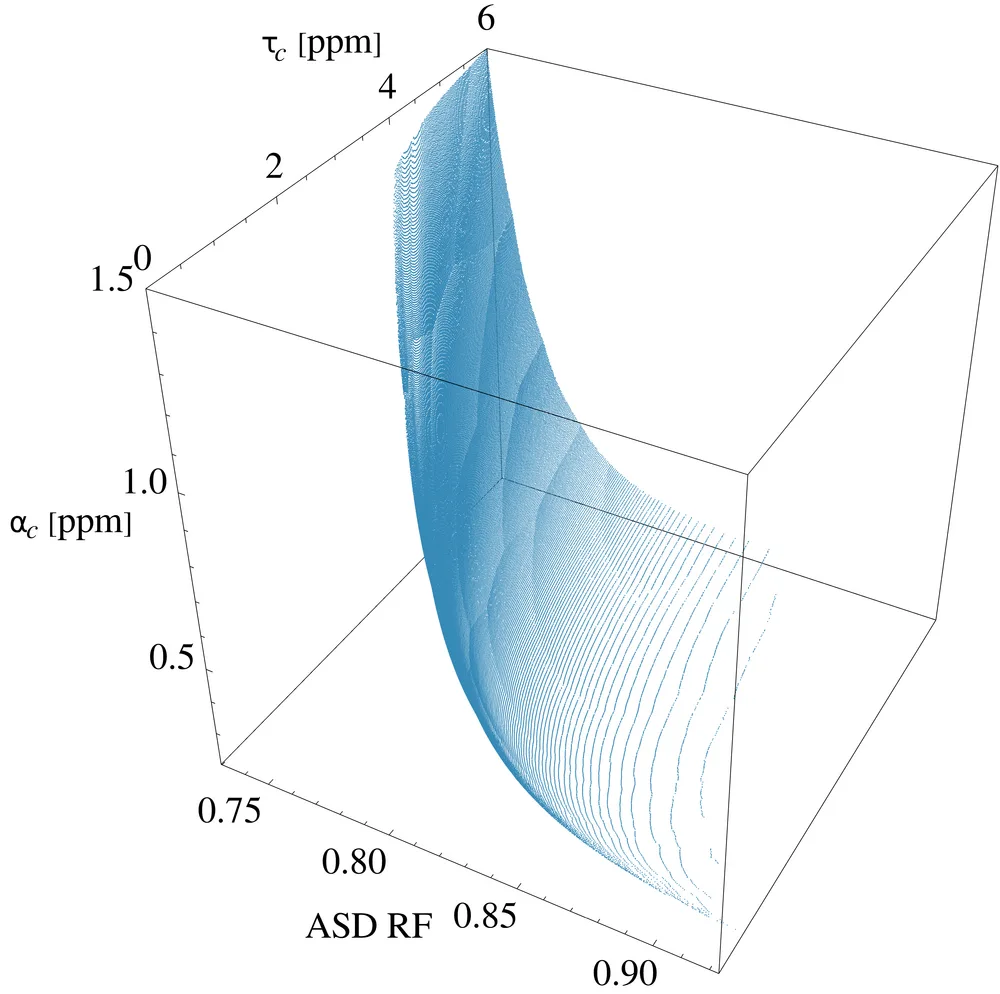
To calm the jitter, thin layers of different materials are applied to the mirror, like a layered cake. Scientists figured out how to select the composition of these layers using a computer to reduce jitter while barely losing light. They made two types of coatings. The first, made of silicon nitride, reduced jitter by a factor of 0.82 compared to old coatings, and the calculation matched reality. The second, made of a germanium-titanium mixture, barely absorbed light (less than one part per million) but jittered more than theory predicted.
The discrepancy between calculation and experiment for the second coating prompted scientists to check whether random errors in layer thickness were to blame. It turned out they weren't. So the issue lies in the manufacturing process itself, which needs further study. But the approach itself, selecting layers by computer and then testing in practice, works. Such mirrors will help gravitational wave detectors hear even quieter events in the universe.
Original abstract
as written by the authors arXiv:2601.17886
We report on the first experimental realization of multi-material dielectric mirror coatings designed through a multi-objective optimization algorithm to simultaneously minimize thermal noise and optical losses. We validate this design strategy by fabricating and characterizing two distinct ternary systems: a SiNx -based proof-of-concept and a Ti:GeO2 -based system targeting lower optical losses. The performance of the SiN x coating shows remarkable agreement with predictions, demonstrating a noise amplitude spectral density reduction of 0.82 with respect to current reference coatings, and validating our design-to-fabrication pipeline. The Ti:GeO2 -based system achieves the crucial goal of sub-ppm absorption; its measured thermal noise, however, is higher than the theoretically predicted level of 0.71, extrapolated from single-layer material characterization. A dedicated tolerance analysis confirms that this discrepancy is not attributable to random thickness errors, emphasizing that further studies of the manufacturing process are needed to fully exploit this combination of materials. This work establishes a robust methodology for producing complex, high-performance optical coatings tailored for precision experiments.
The thermal jitter of a mirror is so tiny that it's compared to the movement of the tip of an hour hand over a billion years, but for gravitational wave detectors, even that is too much.