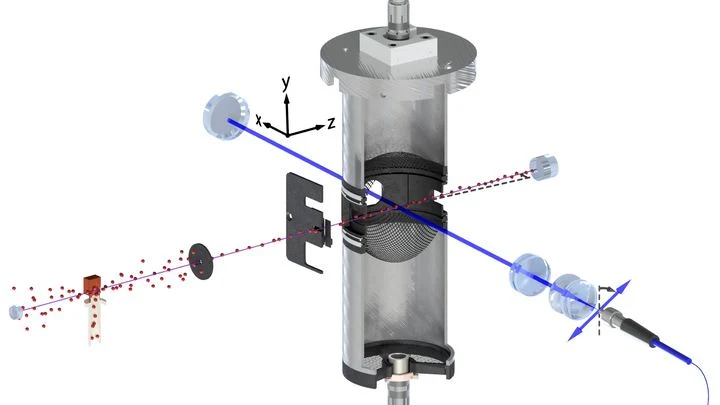
Parts per million (ppm) is a dimensionless unit expressing a ratio of one part per million, often used to quantify extremely small deviations or concentrations. In physics and engineering, it is a standard way to specify precision, stability, or error rates—for example, a clock that drifts by 1 ppm loses one second every 11.6 days. It is also used to express trace impurities in materials or tiny variations in measurements.
History
The term emerged in the early 20th century with the need for precise analytical chemistry and engineering specifications, though its exact origin is unclear.
How it works
The unit simply means the number of parts of a substance or deviation per million parts of the whole. For instance, a frequency stability of 1 ppm means the frequency varies by one millionth of its nominal value. In practice, it is calculated by dividing the absolute deviation by the reference value and multiplying by 10^6.
In practice
PPM is used to specify the accuracy of atomic clocks, the purity of semiconductor materials, and the tolerance of precision instruments like the thermometers mentioned in the corpus.
Fun fact
A measurement of 1 ppm is equivalent to one millimeter per kilometer, or one second in 11.57 days—a scale so small that it is often below human perception but critical for modern technology.
Systems:SIA dimensionless ratio equal to 10^-6, often expressed as a fraction or percentage.
A sound signal is conveniently represented as a complex number: its modulus (amplitude) reflects loudness, while its argument (phase) indicates the wave's position in time: its instantaneous shift.
Strike a tuning fork. The frequency is 440 Hz. That's the note A — the standard of sound.
In the world of numbers, there's a standard too. It's tuned not to sound, but to prime numbers. Though their distribution seems random, it obeys strict laws. All primes resonate together. There's just one value: λ∞ ≈ 0,674036.
In the basements of four European institutes stood seven devices: each can be compared to a tuning fork of unimaginable precision. But instead of sound, they emit 'ticks' made of light: oscillations of a laser locked to a specific frequency by atoms of strontium, ytterbium, or mercury.
The night sky is not all that dark. Even far from cities, it glows faintly — which hampers astronomers trying to catch weak flashes from distant cosmic rays.
The hydrogen atom is like a tiny clock, ticking with a precision engineers can only dream of. When an electron jumps between orbits, it absorbs or emits light at a strictly defined frequency: that's the 'tick.' In the new work, physicists caught one such transition, between the 2S and 6P states, and measured its frequency with an…
In 2018, the Large Hadron Collider ran a special data-taking campaign: the CMS detector captured proton collisions at breakneck speed to collect ten billion particles containing a beauty quark.
A pulsar is a dead star that spins and emits radio pulses like a lighthouse. If a pulsar has a companion, they whirl around a common center of gravity.