Globular Cluster Tonantzintla 2: A Relic of the Milky Way's Ancient Bulge express
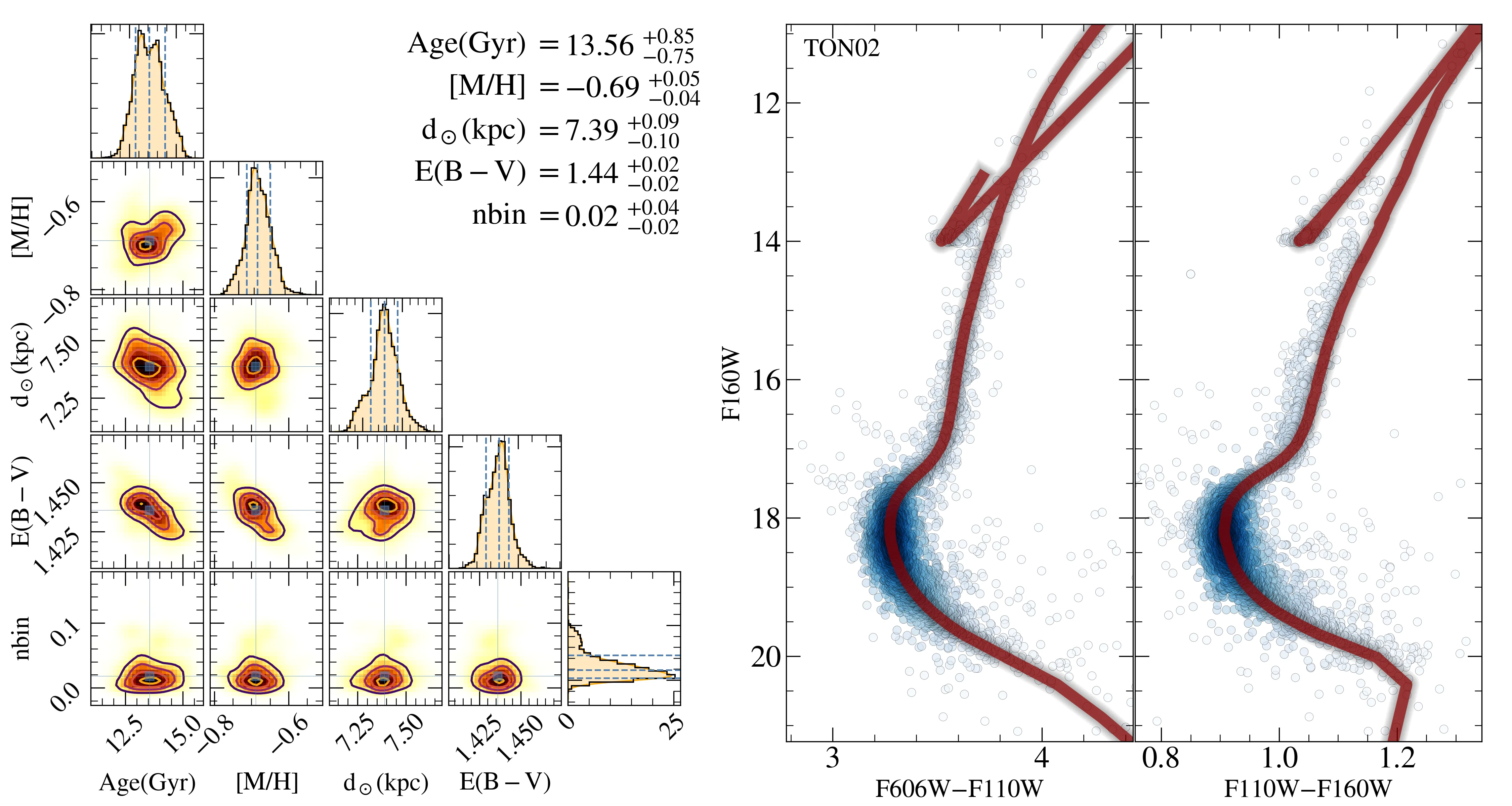
Hidden in the dense swarm of stars at the center of the Milky Way lies the globular cluster Tonantzintla 2. It went unnoticed for decades, yet it holds the key to the earliest history of our galaxy. Now astronomers have examined it with the Hubble Space Telescope and the ground-based APOGEE spectrograph, and found that it is one of the oldest stellar families in the universe.
The cluster turns out to be a contemporary of the first stars: its age is 13.58 billion years. For comparison, the universe itself is about 13.8 billion years old. That means Tonantzintla 2 was born just about 200 million years after the Big Bang — a blink of an eye in cosmic terms. Moreover, the cluster didn't drift in from somewhere else; it formed right in the heart of the future Milky Way, as indicated by the chemical analysis of seven of its stars.
This discovery pushes back the onset of star formation in the bulge — the dense central protuberance of the galaxy. Previously, it was thought that the bulge ignited its stars later. Now it's clear: the first lights in the Milky Way's core flickered on almost as soon as the universe had cooled enough for stars to form at all.
If you imagine the history of the universe as a single day, the Big Bang happened at midnight, and Tonantzintla 2 lit up its stars around 00:20. Since then, the cluster has been orbiting the galactic center like an ancient manuscript preserving the first page of its chronicle.
Original abstract
as written by the authors arXiv:2601.18567
The assembly history of the Galactic bulge is intimately tied to the formation of the proto-Milky Way, yet reconstructing this early phase is difficult because mergers and secular evolution have erased most of its original structure. Among present-day stellar systems, only globular clusters retain the ancient signatures needed to trace these primordial building blocks. Here we present the most detailed characterization to date of Tonantzintla 2, a prime candidate for a relic of the Milky Way's primordial bulge. It is a moderately metal-rich globular cluster projected onto the bulge that has remained largely unexplored despite its potential to constrain the early formation of the inner Milky Way. We derive its fundamental parameters using proper motion-corrected Hubble Space Telescope WFC3 and ACS photometry. By applying an isochrone fitting to very clean data, we obtain an age of 13.58 Gyr, a reddening E(B-V) = 1.44, a metallicity [M/H]=-0.68, and a heliocentric distance of d = 7.38 kpc. A complementary chemical-abundance analysis of seven member stars from APOGEE high-resolution spectroscopy reveals an enrichment pattern consistent with an in-situ origin. Tonantzintla 2 is among the oldest globular clusters studied in the literature, and the oldest so far analyzed in the Galactic bulge. Its age places a stringent constraint on the onset of the bulge formation, implying that star formation in the inner Galaxy began within ~0.2 Gyr of the Big Bang and that Tonantzintla 2 represents an exceptional relic of the Milky Way's earliest chemical enrichment.
Light from Tonantzintla 2's stars takes about 24,000 years to reach Earth, but the cluster itself is only 7.38 kiloparsecs away — closer than the galactic center.
In Arthur C. Clarke's novel "The City and the Stars," ancient star clusters hold the memory of early civilizations — Tonantzintla 2 could be such an archive.