Early universe metal enrichment is the process by which the first generations of stars and galaxies synthesized heavy elements (metals in astronomical parlance) and distributed them into the surrounding interstellar and intergalactic medium. The universe began with only hydrogen, helium, and trace amounts of lithium, and all heavier elements were forged in stellar interiors and supernova explosions. Understanding this process is key to explaining the chemical evolution of galaxies, the formation of planets, and the conditions that led to the diversity of elements we see today.
History
The concept of metal enrichment was developed in the mid-20th century with the realization that stars form from gas with a composition that reflects previous generations of nucleosynthesis. The first detailed models of chemical evolution were created in the 1970s, and observations of distant quasars in the 2000s provided direct evidence of early enrichment.
How it works
The first stars, known as Population III stars, were massive and metal-free, and they ended their lives in powerful supernovae that expelled newly synthesized elements like carbon, oxygen, and iron into space. These enriched clouds then cooled more efficiently, allowing the formation of lower-mass stars and eventually the first galaxies. Subsequent generations of stars continued this cycle, with each supernova adding more metals to the interstellar medium. The metals are also spread by galactic winds and outflows, enriching the intergalactic medium.
In practice
This process is crucial for interpreting observations of distant galaxies and quasars, as the metal content of their gas and stars tells us about their formation history and the epoch of reionization.
Fun fact
The iron in your blood and the calcium in your bones were produced in supernova explosions billions of years ago, making you literally a product of early universe metal enrichment.
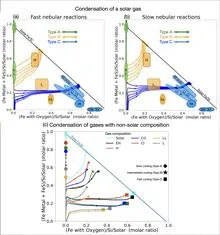
Three cabinets full of rocks. In one, metallic grains and the gray mineral enstatite; in the second, the same grains but with rusty streaks; in the third, layered clays swollen with water. All three sets were pulled from meteorites that fell to Earth: chondrites. They were born in the same gas-and-dust disk around the young Sun, yet somehow turned out so different.
In a distant galaxy, light from hot gas should reveal its composition. The James Webb Telescope split that light into a spectrum, and astronomers saw: oxygen lines too weak.
Faint galaxies scattered across the Perseus cluster are like ghosts among their bright neighbors. They are so diffuse that distant objects shine through them, and they contain hundreds of times fewer stars than our Milky Way.
In 1,433 pairs of galaxies scattered across the sky, astronomers noticed an unusual pattern. Neighbors located 'above' or 'below' a massive stellar system contain up to a quarter more oxygen than those lying in the plane of its disk.
Two cities endure a series of fires. In one, the wind carries ash far beyond the outskirts, leaving the sky clear. In the other, ash settles as a dense veil, painting sunsets crimson. Roughly the same thing, just on a galactic scale, happens with supernova explosions, the final flares of massive stars.
For thirteen billion years, light battled through cosmic emptiness. It bent around massive galaxy clusters that, as Einstein predicted, acted as giant lenses — amplifying and distorting the distant glow. In 2023, the NIRSpec instrument on the James Webb Space Telescope captured this light and spread it into spectra.
A star's age is the key to the galaxy's history. But prying that key from nature is no simple task: unlike a tree, a star doesn't grow annual rings. Yet, its atmosphere holds a chemical code — the ratio of elements that slowly shifted as generations of stars died and new ones were born.
In a giant cosmic cradle, the Tarantula Nebula, astronomers took a close look at 122 massive stars, each at least 30 times heavier than the Sun. They measured the nitrogen abundance in their atmospheres, and the picture turned out to be unexpected.
Imagine an ancient manuscript, where a new story is written over an old text. Over time, the upper layer wears thin, and lines of the past show through. That’s exactly how globular clusters, the oldest stellar systems in the Universe, are structured, like a palimpsest.
Massive stars are cosmic titans, living under the sign of indomitable energy. When such a star enters the B[e] supergiant phase, its radiation is so powerful that it would seemingly pulverize any molecule into atoms. The spectral lines, once systematized by Johann Balmer, blaze here with particular fury.
At the center of attention are tiny stellar cities: ultra-faint dwarf galaxies. They resemble sparse swarms of fireflies circling within a vast invisible cloud. This cloud is a halo of ultralight dark matter. Its particles are so light that they behave not like billiard balls but like waves.
Imagine a forest planted in a single day. At first glance, all trees look alike, but their cross sections tell different stories: some grew on clean soil, others on the ashes of ancient fires.
A living organism is a machine that constantly channels energy through itself and converts it into heat. This internal cycle is called internal entropy production (a measure of energy dissipation). But about 2.5 million years ago, our ancestors switched on a second loop — an external one. They picked up a sharpened stone, and then a burning branch.
The galaxy NGC 1277 is like an old book that no one has opened for billions of years. It formed quickly at the dawn of the Universe and has barely changed since — no collisions with neighbors, no new layers added.
Deep beneath our feet, in the scorching mantle, iron leads a double life. It can be divalent or trivalent, like a coin that lands heads or tails. Which side dominates determines how much oxygen stays in the planet's rocky shell and how much sinks into the core.
The Universe is singing. Not in the usual sense: its symphony is recorded in tiny density variations from which galaxies and ourselves grew. After the Big Bang, space was almost uniform, but quantum fluctuations during inflation left a faint pattern — slightly more matter here, slightly less there.
Elliptical galaxies are quiet stellar metropolises in retirement. By all rights, their light should be calm, reddish, like a sunset. But their spectra scream otherwise: in the far ultraviolet, these old-timers blaze like holiday lights. For three decades, astronomers have puzzled over this 'ultraviolet upturn' (UV upturn).
Putting together the Solar System is like crafting a high-end tasting menu: the recipe isn't always set in stone — sometimes the final ingredient is added while the dish is already cooking.
The Universe is a genius chef, and the Big Bang is its perfect recipe. Hydrogen rose fluffy, helium melted tender, but lithium-7 seems oversalted: theory predicts three times more than astronomers find in the oldest stars. This imbalance, the 'lithium problem,' has spoiled cosmologists' appetite for decades.
An archaeologist holds in their hands not a clay shard but an actual star — a living snapshot of the era when the universe was just learning to produce anything heavier than lithium. That is exactly the kind of find astronomers describe in a new study. They spotted four dim stars so ancient and pristine in composition that their matter is barely diluted by the 'cosmic dust' of later generations.
A magnet with only one pole — north, but no south. Split it in half, and instead of two ordinary magnets, you get two more one-pole magnets. In our world, no such particle has been found, although many theories predict their existence. These hypothetical objects are called magnetic monopoles.
The authors of the study noticed a curious connection.
In the crowded center of the galaxy, two stars orbit so close together that one strips the outer layers off the other, like wind blowing off a coat. What remains is a hot helium core, a star without a hydrogen envelope.
A chef pours hot sugar syrup onto a cold table, and it sets into crystals. That's roughly how engineers pictured metal solidification: the liquid instantly becomes a scatter of crystalline grains. But close-up imaging revealed an extra stage wedged between liquid and solid.
If you don’t stir a layered cocktail, the heavy syrup sinks to the bottom. A young planet is much the same — a seething ocean of molten rock. As it cools, minerals crystallize: some, like iron, get heavy and sink, while others float. You’d think a dense layer would pile up at the core.
A vast, dark cloud of gas stretched across the young universe. Inside it, like invisible fingers, magnetic field lines left over from the very birth of the cosmos threaded through. These fields act on charged particles, pushing them together, like a gentle breeze gathering fallen leaves into piles.
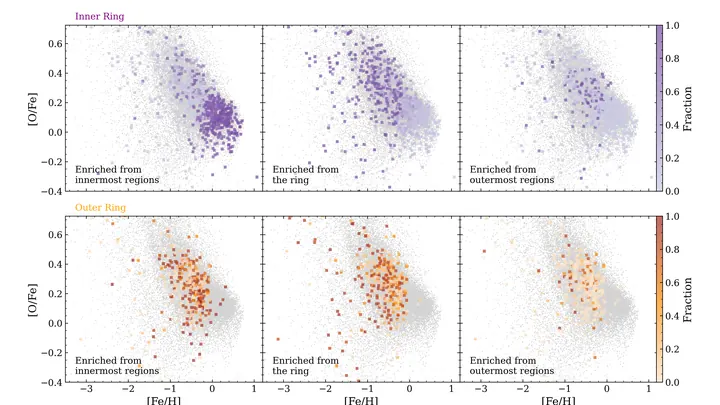
There is something wildly generous about a garden where the first flowers don't just bloom but immediately scatter their seeds far beyond the fence. Something similar was happening in the young universe.
Around small, cool, but extremely restless red dwarfs, planets the size of Earth often orbit. Such a star is like a temperamental stove that intermittently erupts flares: powerful streams of light and particles batter the planet's atmosphere, as if someone splashed fire into a simmering soup pot.
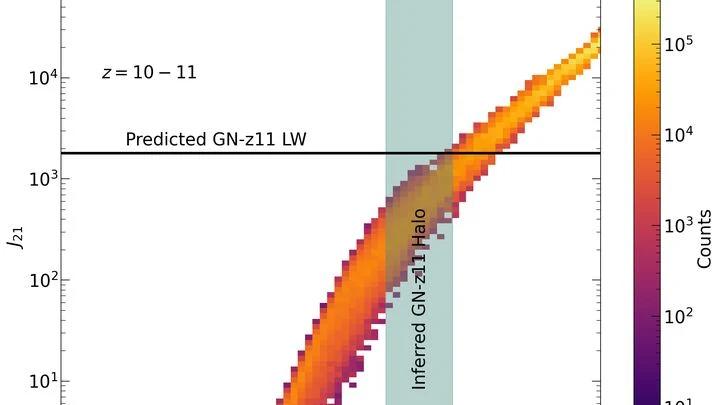
A bonfire built of pure alcohol burns hot and gives off almost no smoke. That's roughly how the first stars shone: they contained no heavy elements, only hydrogen and helium left over from the Big Bang. The James Webb Space Telescope may have caught one such "bonfire" in the galaxy GN-z11.
Neutrinos are almost elusive particles: they zip through planets without noticing atoms. So every catch is a stroke of luck. Recently, the underwater detector KM3NeT snagged a neutrino with energy millions of times greater than Earth's most powerful accelerators can produce.
At the edge of the Milky Way, there are stars that move against the general flow, like cars driving in the wrong lane. Previously, it was thought that all of them were remnants of one dwarf galaxy that our Galaxy tore apart and swallowed. But new research shows that there were several such 'oncoming' galaxies.
A star inherits the chemical makeup of its parent gas cloud, just like a child inherits genes from its parents. Astronomers turned this into a method: by measuring the fraction of carbon and other elements with spectroscopy (splitting light into colors), they construct family trees for the stars in a galaxy.
Lithium is like a thermometer dipped into a star's interior. This light element is destroyed at temperatures around 2.5 million degrees, so its abundance on the surface tells us how deeply the star's material has been mixed.
Two very small, cool stars, similar to the famous TRAPPIST-1, reside in the young Upper Scorpius star cluster. They are only 5–10 million years old — by cosmic standards, mere infants. Each is surrounded by a disk of gas and dust from which planets may eventually assemble.
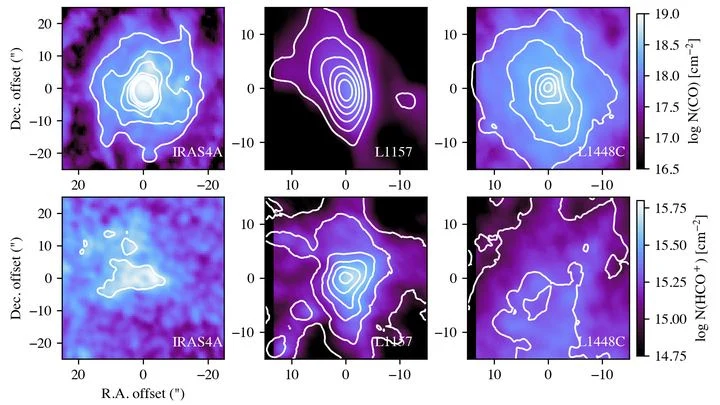
In the cold gas cloud where a star is born, chemistry sleeps. Molecules barely collide, reactions stall. But when a charged particle zips through the cloud, it knocks electrons off atoms — ionizing them. That's how active ions appear in a dormant cloud, ready to build new molecules.
In the first moments after the Big Bang, the universe was not empty and quiet but filled with hot plasma, particles, and magnetic fields. Among the particles, there may have been axions — light, nearly elusive dark matter candidates.
Ancient stars, nearly devoid of heavy elements, are like fossilized remnants of the first cosmic flashes. For a long time, the odd ratio of carbon, hydrogen, and helium in three such stars was thought to require a hypernova — an ultra-bright supernova with hundreds of times more energy than a regular one.
When a baker kneads dough, the grains of flour can tell you which mill they came from. It's the same with Earth: the composition of iron in its depths preserves a memory of where the pieces that assembled the planet were born.
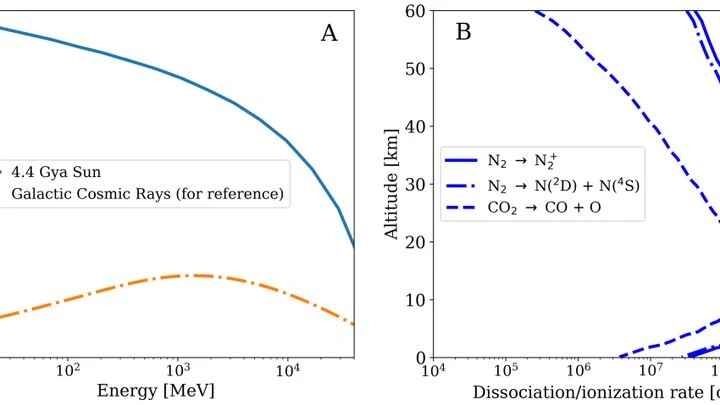
In its youth, our Sun radiated about 30% less energy than it does today: this faint young Sun paradox long troubled planetary scientists: with such a heat deficit, Earth's oceans should have frozen, yet geological evidence says otherwise.
In the mid-20th century, astronomer Vera Rubin discovered that stars on the outskirts of galaxies were moving too fast — held by an invisible mass. Thus the mystery of dark matter was born. It doesn’t emit light but reveals itself through gravity. The big question: why is there exactly as much as we see?
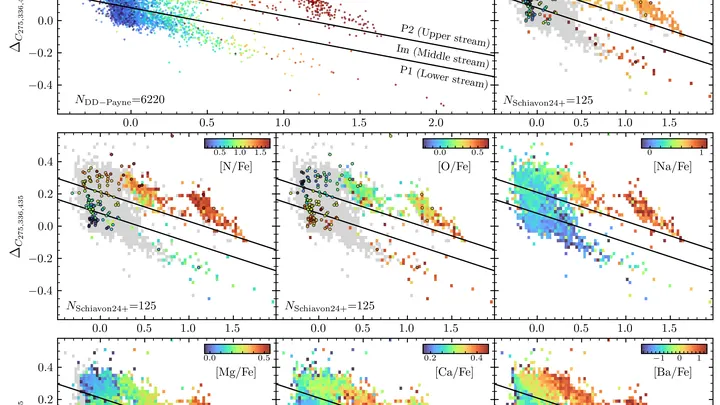
At the heart of Omega Centauri, the most massive globular cluster in our Galaxy, thousands of stars are packed so tightly that their light merges into a single glowing blob when seen from Earth. Separating this swarm into individual stars and determining the composition of each is a task akin to sorting through an overfilled anthill.