Spin Runs Through Frustration express
The magnets in this crystal behave like guests at a party where everyone wants the same chair. No one can settle down for good, and from this chaos, a special state emerges. In it, spin momentum (what makes an electron a tiny magnet) manages to travel 480 micrometers. For comparison, a human hair is about 80 micrometers thick, so the spin covers six such thicknesses in a row.
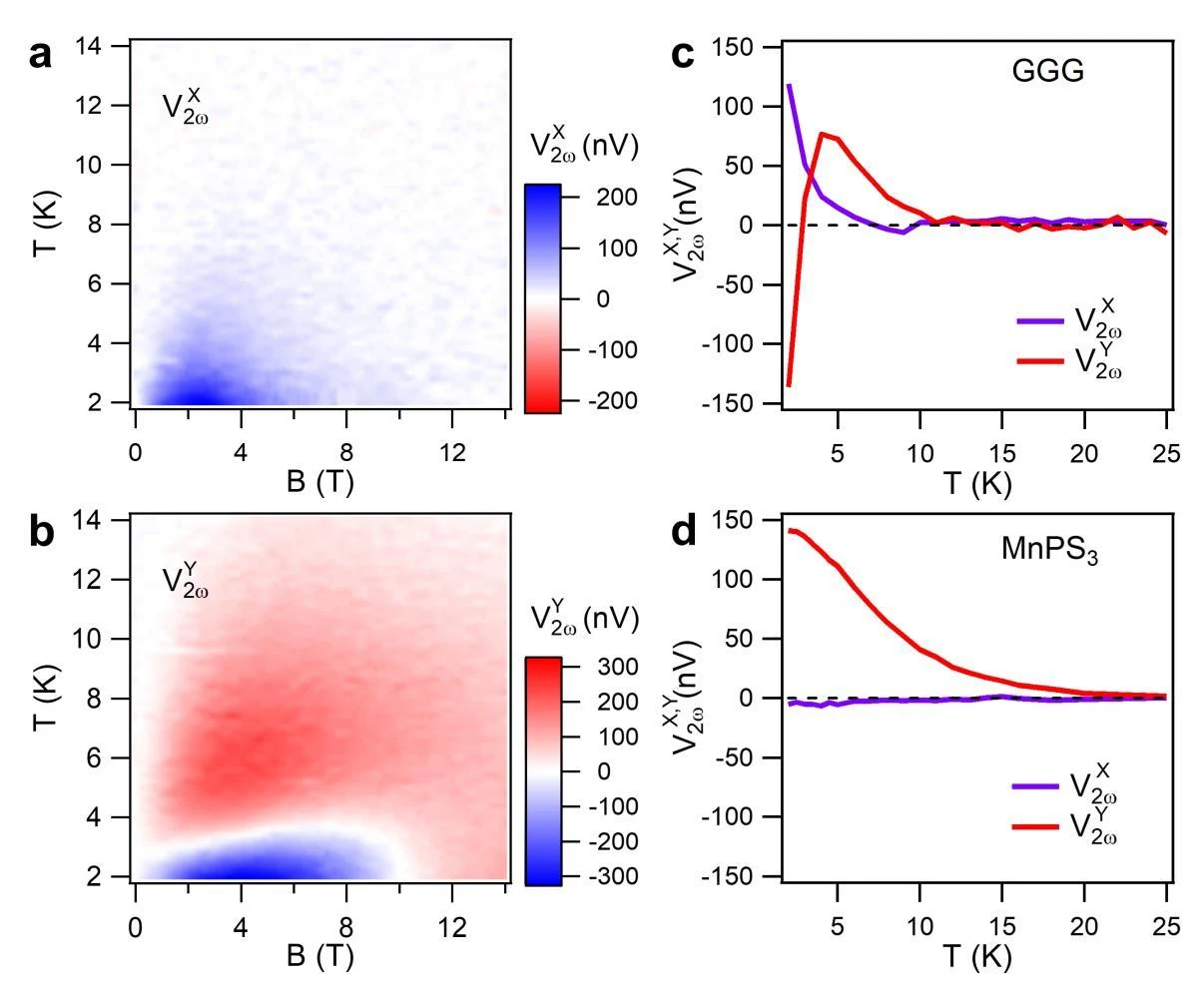
In ordered magnets, spins usually scatter quickly, like a whisper in a noisy room. Here, in gadolinium gallium garnet, the magnetic moments of gadolinium atoms don't align into a strict order but constantly fluctuate. Computer simulations showed that this state lacks the usual magnetization waves, magnons, but instead has strong correlations between neighboring spins. They pass the excitation along a chain like a relay baton, without dropping it along the way.
The discovery offers a simple electrical way to peek into entangled magnetic states. Moreover, frustrated magnets, materials where spins can't find a common order, could become excellent conduits for spin signals in future devices that don't require conventional electric current.
Original abstract
as written by the authors arXiv:2601.22802
Transport of spin angular momentum over large distance has been a long sought-after goal in the field of spintronics. While the majority of the research effort has been devoted to the spin transport properties of magnetically ordered materials, spin transport in magnetically frustrated materials has received little attention. Here, we report an anomalous state in frustrated hyperkagome magnetic insulator Gd3Ga5O12, where spin angular momenta can be transported over a long distance of 480 {\mu}m, far exceeding the transport distance of any diffusive spin current in magnetically ordered materials, to the best of our knowledge. Monte Carlo simulations reveal significant spin fluctuations, spin-spin correlations and an absence of conventional magnons in such anomalous state; while the response of the anomalous state to perturbation is found to be akin to an overdamped forced oscillator. We find close relation of such state to the correlated ``director'' state in the material. Our result provides an effective electrical technique to characterize spin-spin correlations and frustrations; it also unveils the potential of frustrated magnets as powerful channel materials for spin transport.
Gadolinium gallium garnet is used in lasers and optical fibers, and now it also turns out to be a record-holder for long-distance spin transport.