Light spreads out on a chip with a 2D material express
A light pulse, like a lump of clay, keeps its shape when passing through an ordinary material. But if you put a special layer just one atom thick in its path, the pulse starts to spread: its spectrum widens. That's exactly what the researchers did: they placed a film of molybdenum disulfide (MoS₂), a 2D material similar to graphene, onto a silicon waveguide.
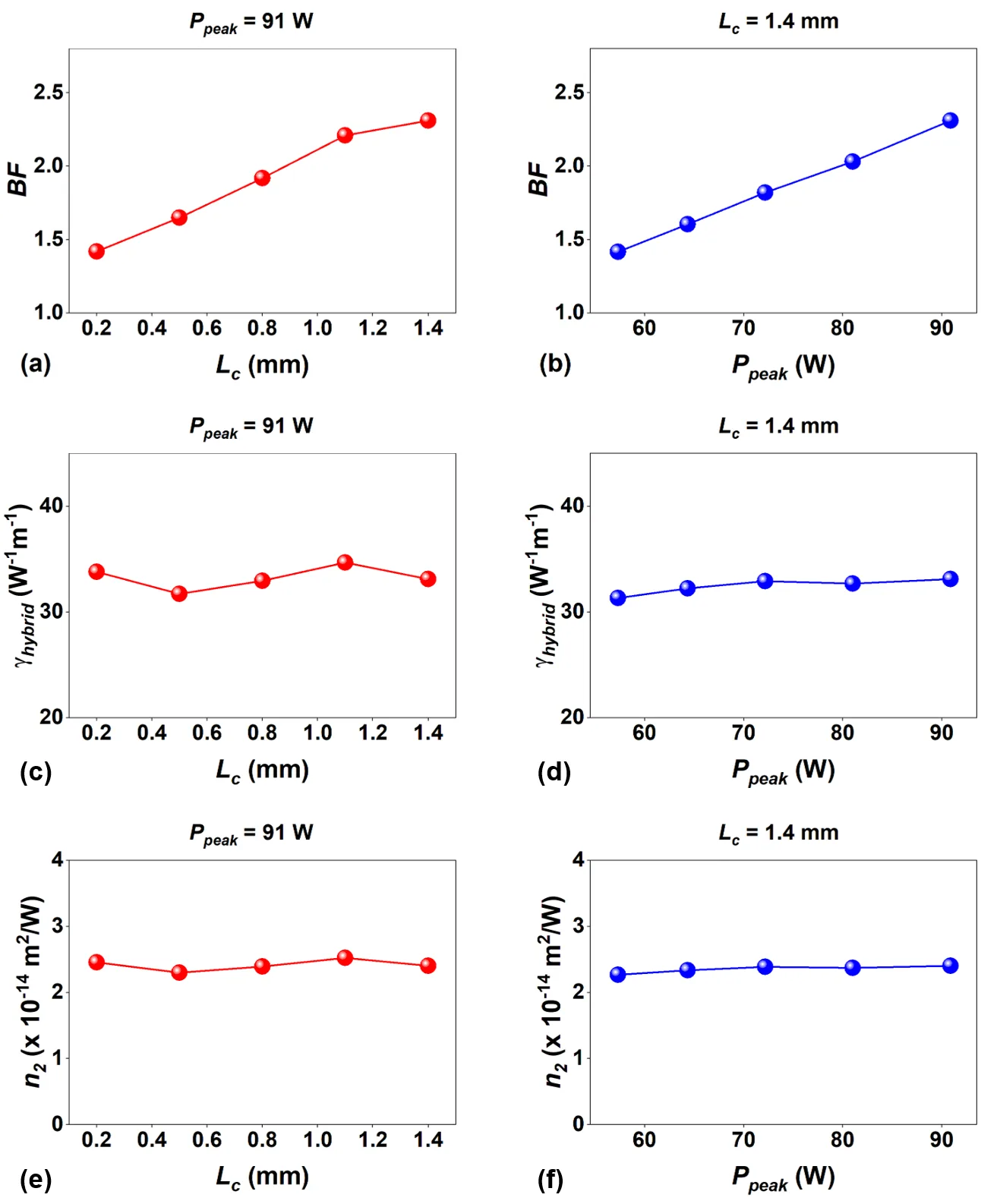
In the experiment, short laser pulses (shorter than a picosecond — a trillionth of a second) were sent through hybrid waveguides with different lengths of MoS₂ coverage. The longer the section with the 2D material, the more the spectrum broadened. For a 1.4 mm film, the broadening was 2.4 times greater than for a bare silicon waveguide. Calculations showed that the nonlinear parameter increased by about 27 times, and the Kerr coefficient of MoS₂ is nearly five orders of magnitude higher than that of silicon nitride. This means that even a tiny piece of 2D material dramatically enhances the interaction of light with matter.
Why does this matter? In optical communications and signal processing, you often need to broaden the spectrum of a pulse — for example, to generate new frequencies or compensate for distortions. Usually this requires long stretches of special fiber or powerful lasers. Here, simply adding a one-atom-thick layer to an existing chip does the job. This approach promises compact, energy-efficient devices for future photonic integrated circuits.
Molybdenum disulfide is the very molybdenite that has been used for centuries as a lubricant and even in pencil leads, and now it's amplifying light in chips.
In Neal Stephenson's novel Snow Crash, the metaverse runs on fiber optics and photonic chips — hybrid waveguides like these could speed up data transmission in such worlds.