How the Sun Tugs at Us: Testing the Universality of Free Fall express
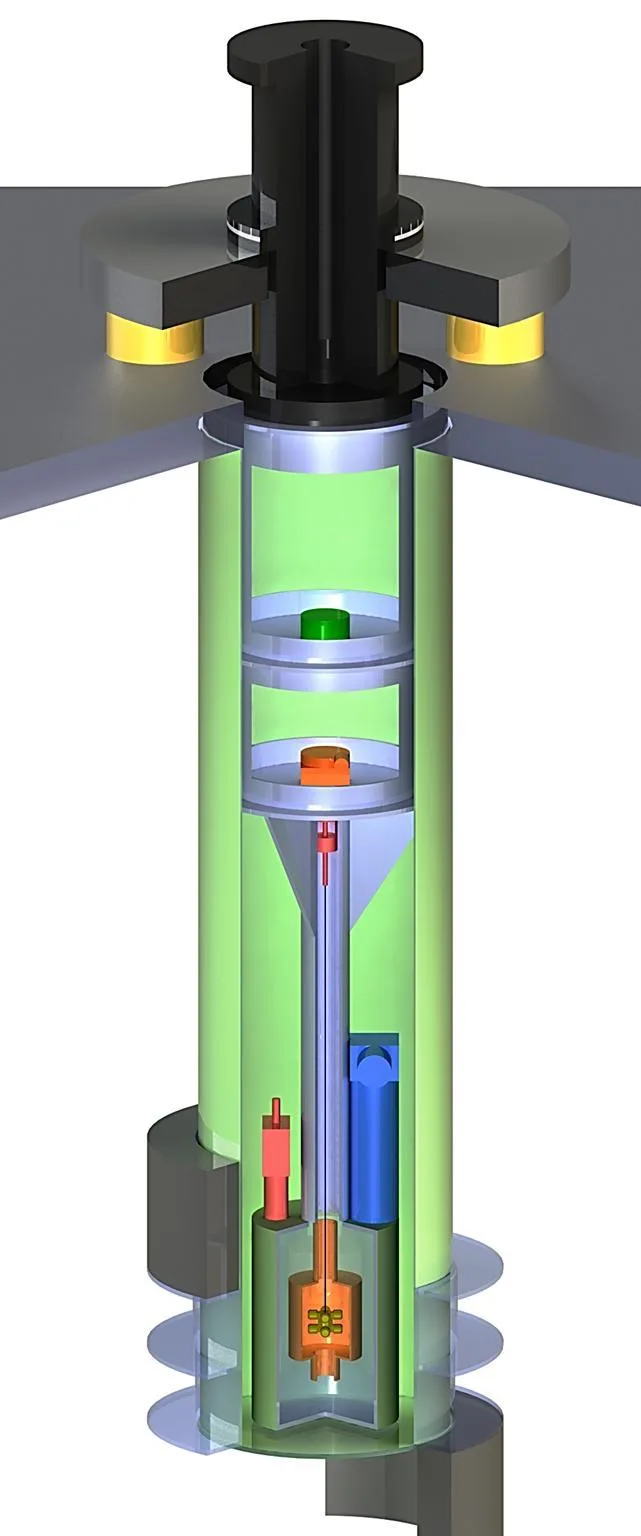
On a lab table sits an instrument that looks like a balance, but instead of pans it has two weights made of different metals — beryllium and aluminum. The balance is suspended from a thin fiber that twists if the weights are pulled differently. The whole apparatus turns to follow the Sun, like a sunflower tracking the light, but instead of light it catches the Sun's gravity.
If the Sun pulled beryllium slightly harder than aluminum, the fiber would twist. But the instrument saw no difference. This means the pull does not depend on what a body is made of — exactly as general relativity predicts. Spacetime curvature acts on everything equally, just as a pencil and a hammer fall together in an elevator when the cable snaps.
The physicists pushed the precision to the limit: if any difference in the pull existed, it would be less than two parts in a trillion. That is like spotting a difference in weight between two kilogram masses if one were lighter by the weight of a single grain of sand. Earlier experiments looked at other sources of gravity, but now the Sun itself, the most massive object nearby, has been tested. The new result is four times more precise than previous solar measurements and 20% more precise than any other torsion-balance experiment.
Original abstract
as written by the authors arXiv:2602.02815
We search for violations of the Equivalence Principle towards the Sun using a rotating torsion balance apparatus. We set 95\%-confidence limits on violations with beryllium and aluminum test bodies of $$\eta_{\odot, Be-Al} \leq 2.1 \times 10^{-13}$$. These results are a factor of four improvement of previously reported results towards the Sun and a $$\sim20\%$$ improvement on previous torsion balance tests regardless of source.
The torsion balance was first used by Henry Cavendish in 1798 to weigh the Earth. Since then, it has become the go-to instrument for probing the subtlest effects of gravity.