Bell's inequality is a mathematical statement that sets a strict limit on the correlations that can exist between measurements performed on two separated objects, under the assumption that all physical properties are predetermined by local 'hidden variables' — factors not accounted for by quantum mechanics. It provides a concrete, testable way to distinguish between the worldview of classical physics, where objects have definite properties regardless of observation, and the predictions of quantum mechanics, which allow for correlations that defy classical intuition.
History
John Bell formulated the inequality in 1964, building on the earlier Einstein-Podolsky-Rosen paradox. His work transformed a philosophical debate into an experimentally testable question.
How it works
The inequality is derived from simple assumptions: that each particle carries a set of pre-existing properties (local realism) and that information cannot travel faster than light (locality). When two entangled particles are measured in different orientations, the statistical outcomes must satisfy a certain inequality if these assumptions hold. Quantum mechanics, however, predicts violations of this inequality for certain measurement settings, meaning the correlations are stronger than any local hidden variable theory could produce. Experiments repeatedly confirm these violations, demonstrating that nature does not obey local realism.
In practice
Bell's inequality underpins quantum cryptography and quantum key distribution, where violations of the inequality are used to guarantee the security of communication channels against eavesdropping.
Fun fact
The violation of Bell's inequality has been experimentally confirmed with loophole-free tests, closing both the locality and detection loopholes simultaneously in 2015.
Two dancers on the same stage mirror each other's moves even when a curtain separates them. In the quantum world, such pairs are called entangled, and physicists have spent half a century probing how far this connection reaches. Until now, all tests with massive particles concerned their internal properties, such as spin, but not their motion itself.
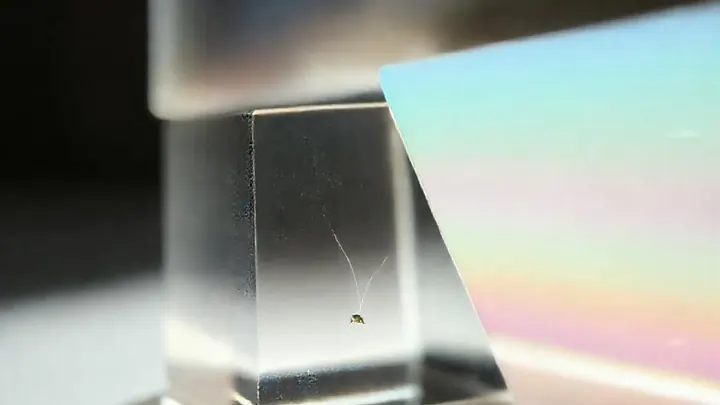
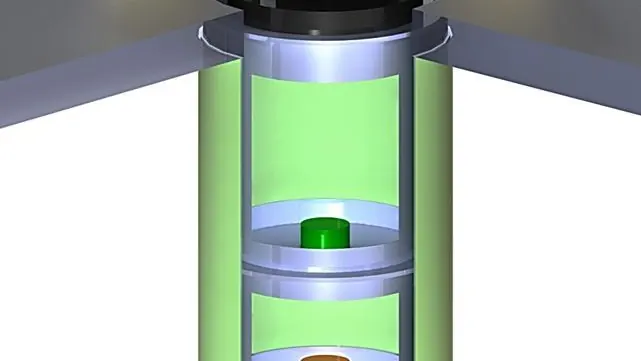
Two tiny diamonds float in a vacuum, separated by a distance that light cannot cross during the experiment. Inside each, like a frozen spark, resides an entangled spin — a quantum state linking them into a single whole. Now the diamonds begin to move, but not just any motion: each one seems to split, existing in two places at once.
Two observers, Alice and Bob, sit at opposite ends of the same lab. Between them is a source that fires off two pulses in turn. Each pulse gives birth to a wave packet flying toward its own detector. So far, this looks like an ordinary experiment with quantum particles.
Gravity in our world is curved spacetime. That's how Einstein's general theory of relativity describes it. But what happens to gravity at the level of atoms and particles, where quantum mechanics rules? This question has remained unanswered for nearly a century.
A quantum computer relies on two forces: entanglement (particles behaving as a single whole) and "magic"—a measure of how far a state is from familiar classical physics. But how these two resources relate as a many-particle system evolves in time has remained a puzzle.
The authors approached the problem through time.
The Mpemba effect is a mystery where hot вода sometimes freezes faster than warm water. Usually this is attributed to how вода loses heat and энтропию (a measure of disorder). But in a glass of water, chaos prevents a precise model.
Physicists built a quantum model: a particle in a well with two depressions separated by a barrier.
The classical Mpemba paradox — hot water freezes faster than cold — has teased scientists for centuries. Only recently has nonequilibrium statistical mechanics explained it: it’s all about boundary conditions; the system seems to seek an excuse to “hit the wall” and speed up cooling.
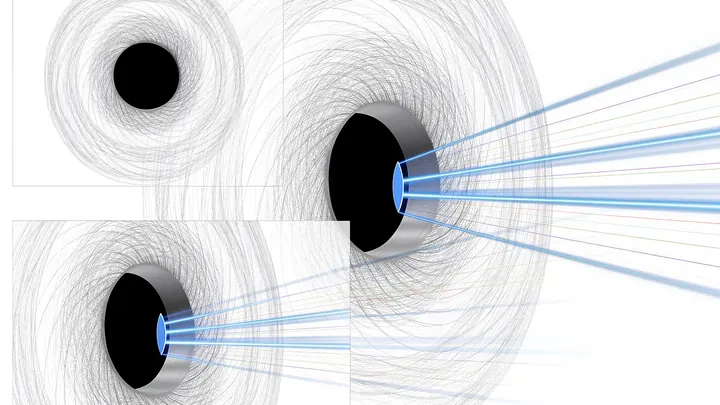
In the center of almost every large galaxy lurks a supermassive black hole, whose gravitational abyss was first mathematically described by Karl Schwarzschild. When it swallows gas, a dazzling active nucleus is born — a quasar.
In quantum mechanics, everything is fuzzy: a particle is not at a single point but smeared across space, and an event does not happen at a single moment. Yet our everyday world is full of definiteness — the coin landed heads, the light bulb turned on, a note appeared in the notebook.
Twins enter a room from different doors. Each gets a box with a button, and each time they press it, either a red or a green light flashes. If the twins are perfectly identical, you'd expect their lights to follow the same internal rules. But what if the rules differ even though the twins are exact copies?
That's precisely the scenario the authors explored.
On one side of the scale lies all the matter in the Universe; on the other, all the antimatter. According to the laws of physics, at the moment of the Universe's birth, the pans should have been balanced. But we see one pan tipping: around us are stars, planets, people, and almost no antimatter. This imbalance is one of the greatest mysteries.
A coffee whirlpool can span two spots in a cup — a blur of swirling liquid. Quantum particles behave similarly: a spacetime whirlpool where they exist in two places at once. But gravity acts as the spoon that stirs the fabric of space and time.
Two particles behave like a pair of unusual dice: thrown at opposite ends of the universe, they always land on the same face. Physicist John Stewart Bell calculated: if the dice had hidden rules, the frequency of matches would have a strict limit.
Sunlight hits a silicon wafer, and a current flows in the circuit. That's the familiar work of a solar cell: light knocks out electrons, and a p–n junction (the boundary between two layers with different conductivities) forces them to move in one direction. But in some crystals, current arises differently — without any junctions, purely from the material's internal structure.
A photographer tries to capture light interference, but has only one lens and the ability to change exposure time. A similar challenge faces cosmologists studying quantum imprints in the cosmic microwave background — the afterglow of the Big Bang.
Three people sit in three corners of a room. Each receives a sealed envelope from an invisible courier, but the couriers do not coordinate and have never met. The people open the envelopes and see a note with one word: "yes" or "no." They choose nothing themselves: they just read.
Two coins are flipped in different cities, but they always land the same way. Physicists call this entanglement: particles behave as if an invisible thread connects them. But what if the thread isn't instantaneous, just very fast — still not faster than light? Then some signal could slip between measurements, and the coincidences would be explained without any magic.
Drop a stone into a pond — the ripples spread evenly and then fade. Gravitational waves born from black hole mergers behave differently: even after the main wave passes, a faint 'tail' remains. It's as if, after the ripples on the water, a tremor persists for a long time, caused not by the stone itself but by how the water 'remembers' the impact.
Galileo, legend has it, dropped balls from the Tower of Pisa to prove that heavy and light objects fall equally. This law formed the foundation of Einstein's theory of gravity. Today, scientists have turned an entire space station into such a tower.
Two accomplices are interrogated separately: betray or stay silent? If neither knows what the other will do, their choice breaks the classical rule of probability. It’s like riding an old bicycle over bumps — the hard seat jolts you off. The textbook rule, the classical model, fails. The authors of a new study found a simple fix: the cyclist needs a soft saddle.
Imagine reality as an undeveloped photograph: until the moment of measurement, it exists only as a cloud of probabilities — a superposition of all possible states. Only the act of observation, like developing film, forces a particle to acquire definite properties.
Comparing two scents is easy even without knowing their ingredients, just tell if they're alike. This everyday principle became the foundation for a new class of Bell inequalities, reimagining tests of the spooky connection between particles. Previously, you had to measure precise properties, like spin direction, but the authors showed that simply comparing outcomes is enough.
At the Large Hadron Collider, by accelerating particles to nearly light speeds, top quarks are created — the heaviest building blocks of the Standard Model. They live for vanishingly small fractions of a second but manage to exhibit complex quantum connections.
On a lab table sits an instrument that looks like a balance, but instead of pans it has two weights made of different metals — beryllium and aluminum. The balance is suspended from a thin fiber that twists if the weights are pulled differently. The whole apparatus turns to follow the Sun, like a sunflower tracking the light, but instead of light it catches the Sun's gravity.
A quantum sensor is like a telegraph line transmitting a hypersensitive message. The slightest disturbance distorts the signal. It used to be thought that accurate measurement required an error-free 'telegraphist' — a perfect error-correction system. But in practice, all elements are noisy. The new approach allows for errors at every step: in sending, verification, and reception.
Two giant black holes spiral together and collide — a ripple of spacetime spreads across the Universe. Detectors of gravitational waves catch this ripple. But the signal may hide more than just mass and distance: if the laws of physics differ ever so slightly in different directions, the wave will be distorted.
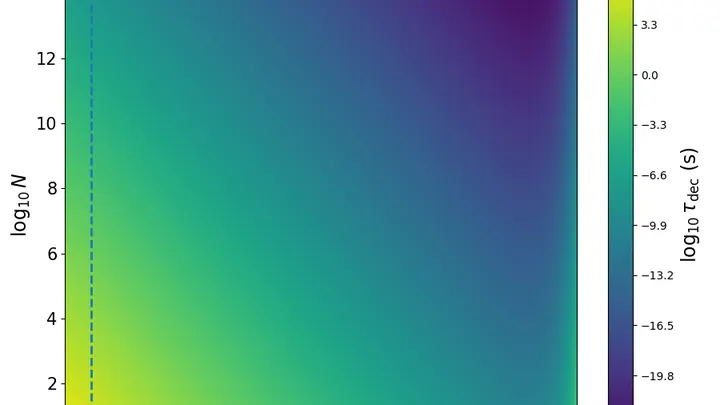
A quantum particle can be in two places at once, but large objects never are. Is it noise that creates chaos and increases entropy? Or does nature itself forbid quantum tricks in the macroworld?
One hypothesis suggests that quantum 'fuzziness' disappears on its own, and the heavier the object, the faster it goes.
We are used to thinking that events have causes, objects exist independently, and signals cannot outpace the speed of light. Quantum mechanics, which describes the Standard Model of particles, challenges all these assumptions at once — as if a recipe couldn't use all seven ingredients.
In the familiar world, we have three spatial dimensions. However, theoretical physics allows for additional, hidden directions — compactified, that is, curled up to microscopic sizes.
Two massive spheres in the cosmic void. Push one, and the second will feel the push only after a moment: gravitational influence travels, like an echo of a shout in the mountains, with inevitable delay. This is how curved space transmits signals locally, step by step — predicted by Einstein long ago.
In an empty concert hall, two musicians play a single part. First the violin, then the cello, or the other way around. It has always been this way: every note has its place in time, its own "earlier" and "later." But what if an orchestra could play both versions at once, in a quantum superposition of two orders?
In the quantum world, particles do not have precise properties until they are measured. The official model refuses to explain what lies behind this uncertainty. But the idea that invisible 'pilots' control particles has been around since the 1920s.
At the hilltop of classical physics, a particle is frozen in unstable equilibrium. The slightest nudge — and it rolls down with increasing speed. In the quantum universe, no nudge is needed: the uncertainty principle itself acts as an all-pervading wind, blowing the particle off the peak.