Proportionality is a fundamental relationship between two quantities where their ratio remains constant. If one quantity doubles, the other doubles as well; if one is halved, the other is halved. This simple idea appears throughout physics, from Hooke's law (force proportional to extension) to Newton's second law (force proportional to acceleration). It provides a way to express how one variable scales with another, often serving as the starting point for more complex models.
History
The concept of proportionality dates back to ancient Greek mathematics, particularly in the work of Euclid, and was formalized in the context of physics by Galileo and Newton in the 17th century.
How it works
When two quantities x and y are proportional, they satisfy y = kx, where k is a constant. This means that plotting y versus x gives a straight line through the origin. In physics formulas, proportionality is often upgraded to an equality by introducing a constant that accounts for units or material properties. For example, in Ohm's law, voltage is proportional to current, with the constant being resistance.
In practice
Proportionality is used everywhere in engineering and science, from scaling laws in fluid dynamics to designing experiments where one variable is varied to see how another responds.
Fun fact
In physics, many 'laws' are just proportionality statements with a constant that hides the underlying complexity—like Einstein's E = mc², where energy is proportional to mass with the speed of light squared as the constant.
A thrown stone arcs through the air, but a planet around the Sun follows a closed curve. Why an ellipse, and not a circle or a spiral? Kepler's first law provides the answer, but its usual proof requires heavy computation. This work offers a shorter path — through a single simple ratio of velocities.
In the quantum world, a fact becomes objective when its value is imprinted on many independent fragments of the environment, like a notice posted on hundreds of bulletin boards across the city. Each copy alone adds no new information, but it changes the rules of the game for anyone trying to erase that information.
Newton gave us a world where bodies move in a void and clocks tick the same for everyone. For three centuries, this picture worked flawlessly. But it relies on many invisible props: absolute position, the 'up-down' direction, and a single rhythm of time for the entire universe. We have never measured these directly — only through the relations between objects.
An old house. The facade is freshly painted, the stairs don't creak. A pretty picture. But try to move in heavy furniture, and the floorboards give way. The beauty of the facade says nothing about the strength of the floors.
It's much the same with black holes without singularities.
The Kerr-NUT black hole is not just a cosmic vacuum cleaner. It's a solution to Einstein's equations where the hole has mass, rotation, and a strange NUT parameter. This parameter behaves like a magnetic charge for gravity: seemingly invisible, yet it alters the properties of surrounding space.
A lead sphere hangs above another lead sphere. According to the usual laws of gravitation, they attract each other exactly along the vertical — along the line connecting their centers.
A billiard ball strikes another, and the sum of their velocities before and after the collision obeys strict rules. The same happens in the microscopic world: energy, momentum, and charge cannot simply vanish.
In the early 20th century, Einstein showed that gravity is the curvature of space and time. A bit earlier, Maxwell had unified electricity and magnetism into a single theory.
In one model, spacetime is a smooth lake, and quantum particles are fish swimming in it. Their motion inevitably creates ripples. The math insists that the water trembles — otherwise the theory collapses. This trembling is strictly ordered and comes in two types.
Toss a dozen coins on a table. The number of heads-and-tails combinations is just over a thousand. For two dozen coins, it's already a million. The number grows as 2 to the power of the number of coins, and that's fast. But quantum systems are far richer.
Each particle here is not a coin with two sides but an arrow that can point in any direction.
If you pour sand into a glass, it settles in a flat layer. But instead of sand, take the tiniest particles of gas: in a gravitational field they don't just fall: each particle races along its own trajectory, collides with neighbors, and all this commotion creates pressure.
To uncover the proton's true size, physicists swapped the electron in a hydrogen atom for its heavy copy — the muon. Acting like a magnifying glass with thousandfold power, the muon gets right up against the nucleus and 'probes' the proton with unprecedented precision.
A typical recipe explains how to cook a dish: step by step, from the initial ingredients to the finished result. The new approach flips the logic: imagine that the future pie itself dictates how much flour to add now. In the quantum world, researchers suggest, a particle receives signals from the future measurement outcome.
Before measurement, a quantum object lives in a world of possibilities, where wave amplitudes add up like sound waves in a studio before pressing the “record” button. Crests amplify each other, troughs cancel out.
Toss a handful of sand on the floor: there are few large grains, many medium ones, and even more tiny ones. This skew, where small events are common and large ones are rare, is described by a power law. It shows up in city sizes, earthquake magnitudes, and citation counts of scientific papers.
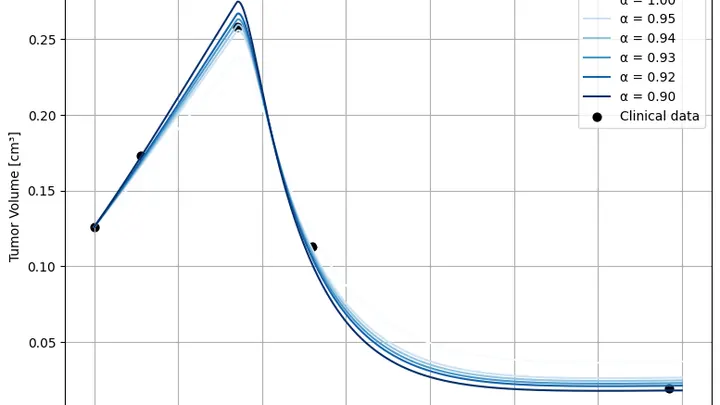
A tumor doesn't grow like a tree; it grows like a city: today's skyline is shaped by yesterday's construction and the fires of the day before. Standard tumor growth equations don't account for this: they only look at the current moment, as if the city were rebuilt from scratch every day. The authors added "memory" to the model: now the equation remembers what came before, and that changes the forecast.
A branching network, like a river delta or a tree crown, is built on the principle of economy. The classic law, derived back in 1926, stated that the cube of the parent vessel's diameter equals the sum of the cubes of the daughter diameters. This rule worked beautifully for ideal tubes, but real arteries stubbornly gave a different exponent — around 2.7 instead of 3.
The authors of the new study found the reason.
On a lab table sits an instrument that looks like a balance, but instead of pans it has two weights made of different metals — beryllium and aluminum. The balance is suspended from a thin fiber that twists if the weights are pulled differently. The whole apparatus turns to follow the Sun, like a sunflower tracking the light, but instead of light it catches the Sun's gravity.
When water churns behind a boat, the energy of motion is converted into heat through a cascade of vortices. Measuring how quickly this happens directly is difficult: you'd need to track all the vortices at once. So scientists use a simplification: they look at only one velocity component at a single point.
A single photon passes through two slits and leaves an interference pattern on a screen. Quantum mechanics describes this process with a wave function, but what happens to the particle itself?
In 1935, Einstein, Podolsky, and Rosen proposed a thought experiment that, in their view, exposed the incompleteness of quantum mechanics. Two particles fly apart after interacting, and measuring the momentum of one instantly gives exact knowledge of the other's momentum.