The equivalence principle is a cornerstone of general relativity, stating that gravitational mass and inertial mass are identical, so all objects fall the same way in a gravitational field regardless of their composition. Testing this principle with high precision is crucial because any violation would signal new physics beyond Einstein's theory, such as a fifth force or quantum gravity effects. Modern tests aim to detect tiny differences in the acceleration of different materials or quantum states.
History
Galileo first articulated the principle in the 16th century, and Newton tested it with pendulums. In the 20th century, Loránd Eötvös performed precise torsion balance experiments. Modern high-precision tests began with the Lunar Laser Ranging experiment in the 1970s and have continued with space missions like MICROSCOPE (2016-2018).
How it works
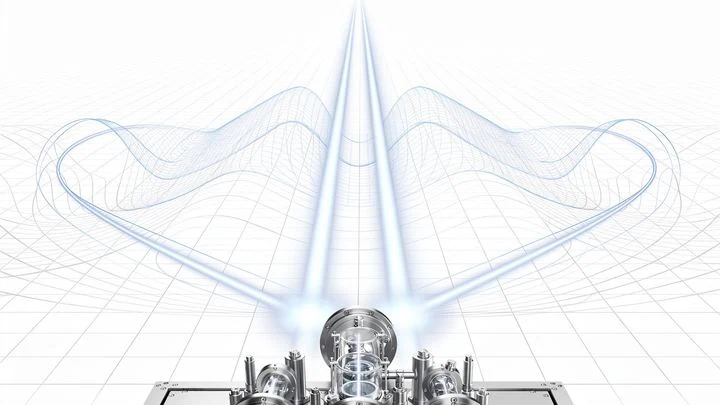
Tests typically compare the free-fall acceleration of two different objects or systems. In classical tests, torsion balances or lunar laser ranging compare the motion of Earth and Moon toward the Sun. Quantum tests use atom interferometry, where atoms in different quantum states are allowed to fall and their interference patterns reveal any differential acceleration. A violation would show up as a phase shift in the interference pattern, indicating that the gravitational interaction depends on internal properties like spin or binding energy.
The MICROSCOPE satellite tested the equivalence principle with an accuracy of 10^-15, meaning that if two masses differed in their gravitational acceleration by more than one part in a quadrillion, it would have detected it — and it found no violation.
At the center of a neutron star, matter is compressed so tightly that a teaspoon weighs a billion tons. You'd think there's no better place to look for signs of quantum gravity. But between the laboratory and the fundamental scale lies a chasm of 10⁸⁰ in density.
Three doors lead into this room.
A thrown stone arcs through the air, but a planet around the Sun follows a closed curve. Why an ellipse, and not a circle or a spiral? Kepler's first law provides the answer, but its usual proof requires heavy computation. This work offers a shorter path — through a single simple ratio of velocities.
An ordinary mirror swaps left and right. Many laws of physics don't notice the swap: they are mirror-symmetric. But some phenomena, like the weak interaction, break this symmetry. Until now, it was thought that gravity and light each break mirror symmetry in their own independent way.
Two tiny diamonds float in a vacuum, separated by a distance that light cannot cross during the experiment. Inside each, like a frozen spark, resides an entangled spin — a quantum state linking them into a single whole. Now the diamonds begin to move, but not just any motion: each one seems to split, existing in two places at once.
Newton gave us a world where bodies move in a void and clocks tick the same for everyone. For three centuries, this picture worked flawlessly. But it relies on many invisible props: absolute position, the 'up-down' direction, and a single rhythm of time for the entire universe. We have never measured these directly — only through the relations between objects.
Quantum mechanics allows a particle to be in two places at once: this is called superposition. But massive objects, like a dust grain or a ball, don't behave that way: their position is always definite. Why? One idea is that it's an illusion: the particle is constantly "jittering" from random environmental kicks, and the blurred picture averages out.
A scale that weighs not a body, but the very space around it. That's how Einstein's equations work in general relativity: they link the curvature of spacetime to what resides within it.
An old house. The facade is freshly painted, the stairs don't creak. A pretty picture. But try to move in heavy furniture, and the floorboards give way. The beauty of the facade says nothing about the strength of the floors.
It's much the same with black holes without singularities.
Light freezes at the edge of the abyss: that's what the event horizon of an ordinary black hole looks like. But at the center of this abyss lurks a singularity, a point where the laws of physics break down. What if, instead of a point, there were a hard shell?
A gravastar is not a black hole.
Two houses with identical facades. Windows, doors, wall color — everything matches. But inside, one is empty, while the other buzzes with life. How can you tell without stepping inside? In space, there's a similar puzzle: a black hole and a gravastar look the same from the outside, but they are built differently.
A pendulum in a noisy room is constantly jostled by people passing by. Its motion is a mix of regular swings and random jerks. Something similar happens with weak gravitational waves against the backdrop of an expanding universe. In Einstein's general relativity, these waves are tiny ripples in spacetime.
The Standard Model of particle physics is a catalog of all known building blocks of the universe: electrons, quarks, and others. But it is silent about dark matter and doesn't get along with gravity.
Gravity in our world is curved spacetime. That's how Einstein's general theory of relativity describes it. But what happens to gravity at the level of atoms and particles, where quantum mechanics rules? This question has remained unanswered for nearly a century.
A huge bowl of water. Drop a stone into it — ripples spread across the surface. The fabric of spacetime works much the same way: when two massive stars merge, they create ripples — gravitational waves. These waves travel to Earth and are picked up by giant detectors like LIGO and Virgo.
The first three minutes after the birth of the world are a cosmic kitchen where nature cooked the lightest atomic nuclei. The recipe is set by gravity: it controls the cooling rate of the hot 'broth' of particles. If gravity worked differently than we are used to, the dish would have turned out different — with different amounts of helium and deuterium.
Gravity isn't just the force that keeps us on the floor. On cosmic scales, it conducts galaxies, bends light rays, and decides the fate of everything. A century ago, Einstein described it as the curvature of space and time.
Two figure skaters on a lake frozen to the horizon. They are so far apart that their silhouettes turn into dots, and their mutual attraction becomes almost an article of faith. By Newton's law, they should circle in an unimaginably slow waltz. But telescopes see otherwise.
A lead sphere hangs above another lead sphere. According to the usual laws of gravitation, they attract each other exactly along the vertical — along the line connecting their centers.
Two light rays meet at a point and then diverge. Their paths form two intersecting surfaces in spacetime — null hypersurfaces (boundaries along which light propagates). It is on such a pair of surfaces that physicists can set initial data for Einstein's equations. This is called the characteristic Cauchy problem.
Building a house on sand is a bad idea. In physics, it was long believed that a quantum theory of gravity could not be built on a fixed "sand"—a pre-existing spacetime.
A ball sits in a pit. It won't roll out on its own: it needs a push. But in the quantum world, a particle can leak through a barrier without extra energy. This trick is called tunneling.
The boundary sets the rules
Quantum gravity is like a theater where spacetime is the stage and fields are the actors. When the stage has an edge, you need to know exactly what happens at the boundary; otherwise, the play falls apart. In 2018, Edward Witten proposed an elegant recipe for such a case.
A builder checks the strength of an arch not by running through all possible shapes in their head, but by mentally nudging it and seeing how much force is expended. That's essentially how the principle of virtual work works in mechanics. The authors of a new study have applied this approach to the very geometry of spacetime.
They constructed a covariant framework of virtual work for the metric.
When a grain of sand falls on a table, its impact is predictable. But if you squeezed it down to the size of an atomic nucleus, the familiar laws of gravity would break down — the force of gravity would grow without bound.
In the early 20th century, Einstein showed that gravity is the curvature of space and time. A bit earlier, Maxwell had unified electricity and magnetism into a single theory.
Gravity is usually explained through the curvature of spacetime. Massive bodies press it down like a bowling ball on a stretched rubber sheet. But this approach has two lesser-known twins. In one, gravity arises from torsion (twisting) of spacetime; in the other, from its non-metricity (when lengths and angles change during transport).
At the very beginning of the universe, when all of space was compressed into a point, the laws of physics break down. This point is called a singularity — an edge where our equations lose meaning. But what if it's not an end, but a special type of boundary?
The authors of this work propose viewing the singularity as a free boundary.
A tightrope walker spirals over an abyss, each loop drawing closer to the center. Their path is not a smooth glide but a series of sharp jerks and pauses. That is roughly how a tiny black hole behaves when it is pulled toward a supermassive neighbor.
A black hole is not just a dark spot in space. It is a region where gravity compresses matter so intensely that even light cannot escape. Among all possible black holes, one stands out — the rotating Kerr black hole. Its description was long thought to be tied to Einstein's equations, like a recipe tied to a specific cookbook.
Gravity seems simple: it keeps us on the ground and makes planets orbit. But if it were classical (described by Einstein's equations as the curvature of spacetime, while all matter follows the quantum laws of the Standard Model) then an ordinary quantum bit (qubit) falling freely…
Gravitational waves are the very trembling of space, born when black holes or other massive bodies collide. Their main oddity isn't that they pass through us, but that they permanently alter the curvature of spacetime and the distances between everything they touch.
An old mechanical alarm clock ticks on the shelf. You hear the steady sound, see the hands moving, and you're certain time is passing. But if you take the clock apart, you won't find a single part labeled "time." Only springs and gears.
Quantum objects live in a world of superpositions — being here and there at the same time, with one spin and another. But as soon as they gain enough mass, this magic fades. Roger Penrose suggested that gravity itself is to blame.
The weak equivalence principle, silently tested since the time of Galileo and laid at the foundation of general relativity, states: all bodies fall equally, regardless of their internal composition.
Two parallel streams of atoms, released from Bose condensates, begin their journey in free fall. In the classical picture, their separation remains unchanged — like two skiers gliding down a perfectly smooth slope. But if spacetime is not frozen snow, but a living, rippling membrane, then every tremble of it is transmitted to matter.
When two dead stars collide in a distant galaxy, two messengers bring us the news: a shiver in space, a gravitational wave, and a flash of light. Both messengers race toward us across the entire Universe, but their paths can differ slightly. Light sometimes gets delayed by cosmic dust, while gravitational waves pass through everything almost without noticing obstacles.
A stone falls into a well, and the splash reaches your ears with a delay. Something similar happens to light as it leaves Earth: its oscillations become less frequent, the beam seems to 'tire.' This is gravitational redshift — a phenomenon Einstein spoke of a century ago.
A mathematical doughnut, a torus, sits on the boundary of a three-dimensional world where gravity acts. You can crumple and stretch it, and physicists decided to see how it behaves. Inside this world, space can be flat like a table, expanding like a soap bubble, or curved like a saddle. The doughnut boundary refused to stay smooth.
Imagine an orchestra tuning up: the violins rise in pitch: that's the familiar 'chirp' of black hole mergers in LIGO detectors. Now picture a funeral march: a sound that descends, like a fading siren. That's exactly the gravitational-wave signature a system with one negative mass should leave.
Holography is the idea that everything happening inside a volume can be encoded on its boundary, like an image on a hologram. In physics, this helps connect gravity to the quantum world. But sometimes, the holographic rules fail to assemble familiar spacetime, and scientists are looking for where exactly the mechanism breaks down.