Light Flows Without Friction: Three Ways to Measure the Limit
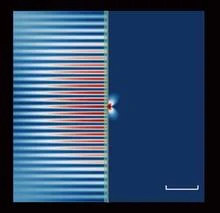
In a Paris laboratory, light was made to flow around an obstacle the way water flows around a rock in a stream. But this water is special: it feels no friction.
Lorentz invariance violation refers to the breakdown of the principle that physical laws are the same for all observers moving at constant velocity, potentially affecting light speed.Lorentz invariance is the pillar of special relativity. It guarantees that the speed of light in a vacuum does not depend on the motion of source or receiver. Lorentz invariance violation (LIV) is a hypothetical deviation from this symmetry, possible at energies close to the Planck scale (10¹⁹ GeV). Such effects are predicted by some approaches to quantum gravity and string theory. LIV would manifest, for example, as a dependence of the speed of light on its frequency: the higher the frequency, the more noticeable the slowdown.
Lorentz invariance is named after Hendrik Lorentz, whose transformations (1904) preserve Maxwell's equations. In Einstein's special relativity (1905), it was elevated to a postulate. The idea of possible violation arose in the 1980s–90s with the development of quantum gravity: V. Kostelecký, R. Mewes, G. Amelino-Camelia proposed models with modified kinematics. Experimental limits were obtained from Fermi telescope observations of gamma-ray bursts, from neutrino data of supernova SN 1987A, and from precision hydrogen spectroscopy. In the 2000s, systematic ground-based searches began using interferometers.
In the Standard-Model Extension (SME), LIV is parameterized by adding terms to the Lagrangian that violate Lorentz symmetry. For photons, this leads to a modified dispersion relation: E² = p²c² + ξ(E³/M)c² (or with a higher power), where ξ is a dimensionless violation parameter, M is the new physics scale. From this, the group velocity v ≈ c [1 + (3/2)ξ(E/M)]. For ξ>0, high-energy photons travel more slowly. Experimentally, one searches for a time delay Δt between the arrival of photons of different energies from a single source: Δt = ξ (ΔE/M) (L/c), where L is the distance. The absence of delay for gamma-ray burst GRB 090510 gave a limit |ξ| < 10⁻³. LIV is also tested in vacuum birefringence and synchrotron radiation. The principle of constant light speed and Lorentz transformations are tested with high precision.
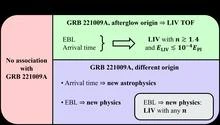
Telescopes capturing gamma-ray bursts look for a delay between photons of different energies. Detecting such a delay would point the way to a theory of quantum gravity.
Gamma-ray bursts — the most powerful explosions in the Universe — serve as natural laboratories: over billions of years of travel, even a tiny speed difference would accumulate into a noticeable delay.