Dark Neutron Decay and Tiny Stars express
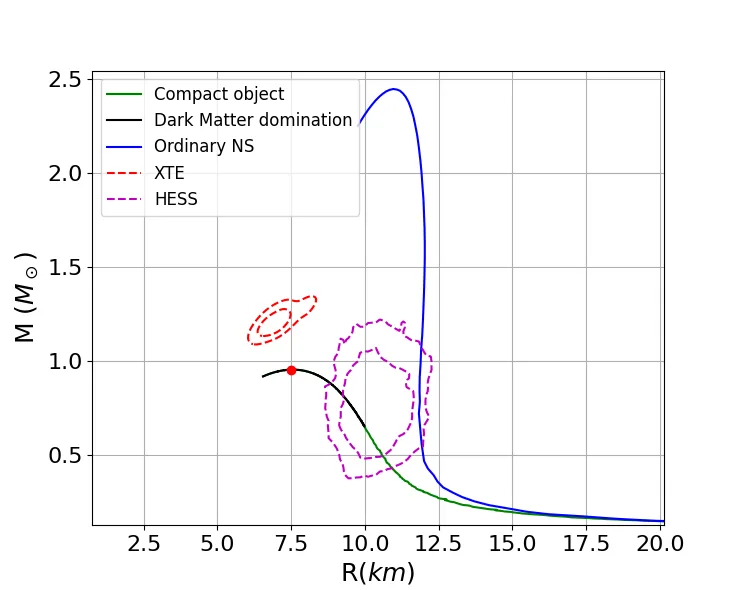
The neutron is the particle that makes up most of a neutron star. On its own, it is unstable: a free neutron lives for about fifteen minutes, then decays into a proton, an electron, and an antineutrino. But in two different types of experiments, the measured lifetimes differ — in a particle beam, neutrons live slightly longer than in a trap. This discrepancy has been bothering physicists for years.
One idea is that sometimes a neutron decays differently — into a proton and invisible "dark" particles that leave no trace in detectors. Then some decays simply go unnoticed, making the lifetime appear longer. A new study examines what would happen if such dark decay occurs inside a neutron star. There, neutrons are packed so tightly that a spoonful of matter would weigh as much as a mountain. If the decay is not suppressed, the star loses neutrons and contracts more than usual.
The authors proposed that in the superdense interior, dark neutron decay is suppressed: at densities several times that of an atomic nucleus, it hardly occurs. Then the star remains stable, but in its outer layers, where density is lower, decay is possible. This creates a mixture of ordinary matter and dark particles inside the star — without any collisions with other objects. Such a mixture explains both the light stars and the existence of ordinary heavy neutron stars with masses up to two Suns.
Dark neutron decay is still a hypothesis, but it neatly ties together two puzzles: why the neutron's lifetime differs across experiments and why some stars are too small. If confirmed, we would learn that invisible matter can be born right inside the densest objects in the Universe.
A neutron star the size of a city can weigh more than the Sun, and a spoonful of its matter weighs about a billion tons, like a small mountain.
In Stanislaw Lem's novel "Solaris," the planet's ocean behaves like intelligent matter — dark particles inside stars could also create unexpected structures.