object

gw190814

A gravitational-wave event detected in 2019 from a black hole merging with a compact object.
159 related articles

Description

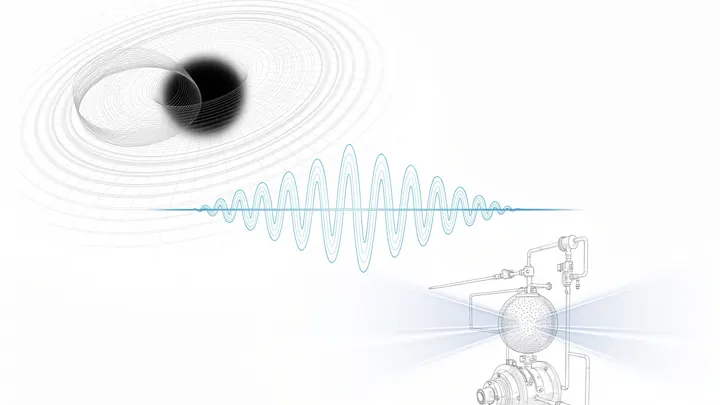
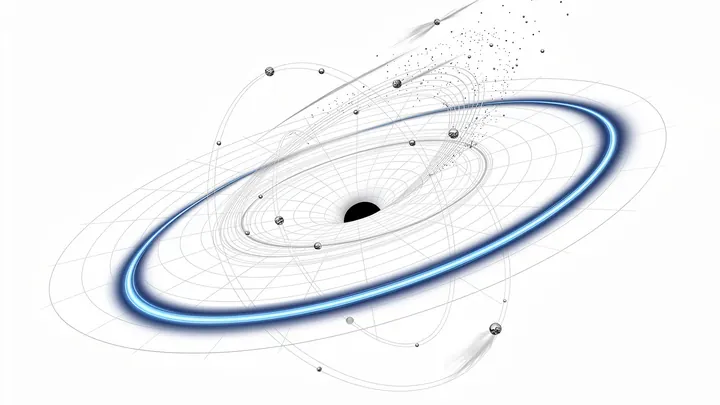
GW190814 is a gravitational-wave event detected on August 14, 2019, by the LIGO and Virgo observatories. It originated from the merger of a black hole with a compact object of about 2.6 solar masses, which lies in the so-called 'mass gap' between the heaviest known neutron stars and the lightest known black holes. This event is significant because it challenges our understanding of compact object formation and the boundary between neutron stars and black holes.

History

The event was announced in 2020 by the LIGO-Virgo collaboration. It is one of the most intriguing detections because of the secondary object's mass, which has no clear precedent in electromagnetic observations.

How it works

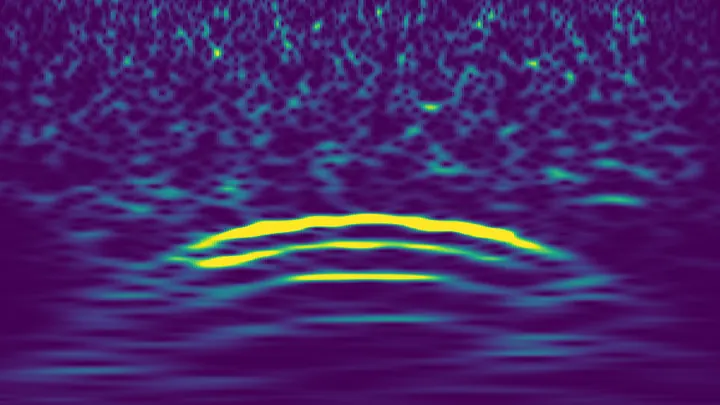
The signal was detected as a chirp-like waveform in the gravitational-wave strain data, lasting about a second. By matching the observed waveform to theoretical templates from general relativity, the masses and spins of the two objects were inferred. The primary black hole had a mass of about 23 solar masses, while the secondary object's mass of 2.6 solar masses is uncertain in nature—it could be a very heavy neutron star or a very light black hole.

In practice

GW190814 provides a unique testbed for nuclear physics and astrophysics, helping to constrain the equation of state of neutron stars and the formation channels of binary systems.

Fun fact

The secondary object in GW190814 is the most massive neutron star ever observed if it is indeed a neutron star, or the lightest black hole ever found if it is a black hole.

Concept graph →

Related articles · 159

Stellar2026-09-013 minarXiv:2609.00630
A Lighthouse Hidden by Its Own Smoke
A lighthouse on a rocky shore shines steadily until the wind carries smoke from the keeper's fire. The light fades before your eyes, even though the flame inside remains intact.
A Lighthouse the Size of a City
Pulsar PSR J0614-3329 spins 318 times per second. A point on its equator moves at about 10% of the speed of light. From a distance, the star looks like a lighthouse spinning so fast that its beam blurs into a continuous ring.
Galaxies2026-08-191 minarXiv:2608.19326express
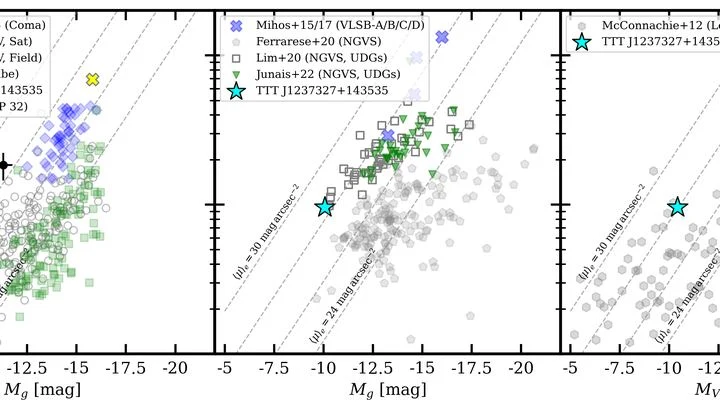
A Faint Ghost Galaxy in the Virgo Cluster
The night sky only looks black: telescopes reveal millions of galaxies, but some are so dim they blend into the background. Astronomers caught just such a "nearly invisible" one by chance while observing the Virgo Cluster with the two-meter telescope at Teide Observatory. The galaxy is named TTT J1237327+143535.
Instrumentation2026-08-122 minarXiv:2608.11673express
Gravitational Hearing: How to Catch the Whisper of Merging Black Holes
Gravitational-wave detectors are like extremely sensitive ears: they pick up the trembling of space when black holes or neutron stars collide somewhere in the universe. But even the most sophisticated "ears" cannot hear everything. The new LIGO A# project is like replacing the eardrum with a thinner, more sensitive membrane.
Cosmology2026-08-122 minarXiv:2608.12042
Radio Echo at the Cluster's Edge: MeerKAT Catches a Ghostly Glow
The galaxy cluster RXC J0528.9−3927 is like a city shrouded in fog: at its center, a radio halo shines brightly, but farther out, beyond the usual boundaries, astronomers have spotted a barely visible glow. It stretches for two million light-years — three times farther than the halo itself.
Galaxies2026-08-111 minarXiv:2608.10719express
A Wanderer That Feeds on the Go
A black hole with a mass of 35,000 Suns drifts through a galaxy's gas like a barge through fog. Its gravity rakes the material ahead of it, leaving a dense trail behind — a wake of gas. Some of that gas gets pulled into the black hole, and it grows.
General Relativity2026-08-102 minarXiv:2608.09811express
How Light Particles Put the Brakes on Black Holes
A black hole is like a spinning top that never stops on its own. But if a cloud of ultra-light particles, bosons, forms around it, the picture changes. This "fog" acts like an invisible brake: the particles drain the hole's spin, slowing it down.
Cosmology2026-08-103 minarXiv:2608.09929
A Lottery with No Winners: Why the Gravitational-Wave Background Map Is Usually Blank
Imagine a lottery where instead of money, you win black holes. Each ticket is a random spot on the sky, and the prize is a gravitational wave from the merger of two giants. The chance of hitting the jackpot is minuscule, but if you do, the wave is heard across the entire universe.
High Energy2026-08-072 minarXiv:2608.06944express
Gravitational Hunt for Whirling Black Holes
Somewhere in the depths of space, two supermassive black holes are circling each other. Their dance is not smooth — the orbit is stretched, like a rubber band that alternately tightens and relaxes. Each revolution sends ripples through the fabric of spacetime — gravitational waves.
General Relativity2026-08-072 minarXiv:2608.07229express
A Black Hole in a Fur Hat
A dance floor where couples whirl. At the center, an invisible master of ceremonies sets the rhythm. This is the supermassive black hole at the heart of the Milky Way, and the couples are stars whose orbits astronomers have tracked for years. But what if the master himself is wrapped in a fluffy fur coat of tenuous matter?
High Energy2026-08-031 minarXiv:2608.02747express
Star Explosions Sing on Two Frequencies
When a star many times heavier than the Sun dies, it collapses and explodes as a supernova. This is not just a flash of light — the entire process, from core collapse to the ejection of the outer layers, makes space itself tremble. These ripples are called gravitational waves.
General Relativity2026-07-312 minarXiv:2608.00281express
Two Signals in the Universe's Noise
A noisy café. You're trying to make out two quiet conversations: one from the table by the window (black hole mergers), the other a barely audible whisper from the far corner (echoes of the universe's birth). But the hiss of the espresso machine and street noise (detector jitter) drown everything out. New work teaches a computer to separate these sounds.
Whisper from the Dawn of Time: Hunting for Subsolar Black Holes
For a whole year, LIGO, Virgo, and KAGRA listened to the trembling of spacetime. Thousands of mergers of black holes and neutron stars left clear signatures. But hidden among them was another signal — a barely audible whisper.
Four Layers of Black Holes: Gravitational Waves Reveal Merger History
Layer by layer, artifact by artifact — an archaeologist reconstructs the history of an ancient settlement. Similarly, astrophysicists sifting through 259 records from LIGO–Virgo–KAGRA saw a clear layered structure among merging black holes.
Cosmology2026-07-233 minarXiv:2607.21834
Cosmic Funhouse Mirror: The Mystery of Signal GW231123
On November 23, 2023, LIGO detectors caught something strange. The gravitational wave signal from a black hole merger, designated GW231123, pointed to record masses—137 and 101 solar masses, and anomalously fast spin. That would be the most massive and fastest-spinning pair ever detected.
General Relativity2026-07-212 minarXiv:2607.18919express
Echo Fades into the Silence of a Black Hole
Space is full of invisible waves — ripples in the fabric of spacetime left behind by cataclysms like black hole mergers. An ordinary black hole swallows everything without a trace. But there are hypothetical exotic objects — ultradense clumps of matter without an event horizon (a surface from which not even light can escape).
General Relativity2026-07-212 minarXiv:2607.19293express
Gravity Passes Another Test: 168 Mergers Confirm Einstein
A huge bowl of water. Drop a stone into it — ripples spread across the surface. The fabric of spacetime works much the same way: when two massive stars merge, they create ripples — gravitational waves. These waves travel to Earth and are picked up by giant detectors like LIGO and Virgo.
Cosmic Graininess: Finsler Gravity Extends the Mass Limit of Neutron Stars
In August 2019, the LIGO and Virgo detectors picked up gravitational waves from the merger of two compact objects in a binary star. One weighed 23 solar masses — a standard black hole. The other came in at 2.5–2.67 M⊙.
General Relativity2026-07-202 minarXiv:2607.18219express
The Cosmic Top That Brakes Too Fast
A spinning top that makes a hundred turns per second suddenly starts losing speed dramatically — much faster than any known top. That's exactly what pulsar J0435+3233 is doing. It's a dead star, crushed to the size of a city, but whirling at a furious rate.
The Universe's Bell with a Crack: How a Quantum Defect Births Gravitational Waves
In the first moments after the Big Bang, the Universe hummed like a bell. Inflation, the epoch of rapid expansion confirmed by measurements of the cosmic microwave background, ended, and the inflaton field began oscillating around the minimum of its potential.
General Relativity2026-07-192 minarXiv:2607.17431express
Gravitational Waves with a Space-Time Correction
When two black holes merge far away, we receive a tremor of space — gravitational waves. Usually, they are described by Einstein's equations, but what if gravity works differently at the tiniest distances? The authors took one such hypothesis — Hořava–Lifshitz gravity.
Eccentricity: a magnifying glass for gravitational waves
In May 2020, the LIGO and Virgo detectors picked up a gravitational-wave burst known as GW200105. Among the many similar gravitational waves recorded, this one stood out for an oddity: the orbit of the colliding neutron star and black hole was not a perfect circle, but a stretched ellipse.
Sapphire Tuning Fork: How to Hear the Echo of the Big Bang
The Universe is humming, but our ears catch only the bass. LIGO hears the rumble of black hole mergers — the infrasound of space. Higher up, in the gigahertz range, the flutes and violins of primordial gravity ring out.
Star Harp: How Orbits Around a Black Hole Weigh the Graviton
At the center of the Milky Way, shrouded in dust and glare, lurks a supermassive black hole — Sagittarius A*. Around it, like moths around a flame, swarm dozens of guide stars. Two of them, S2 and S38, with eccentric orbits and periods of just a few years, have become the protagonists in testing the fundamental laws of the cosmos.
General Relativity2026-07-102 minarXiv:2607.09111express
A Noise Filter for Gravitational Waves
Gravitational-wave detectors are like sensitive microphones, listening for the whispers of distant cataclysms. But every now and then, a sharp crack bursts in — a brief noise spike known as a glitch.
General Relativity2026-07-102 minarXiv:2607.09201express
Tiny Black Holes Build Giants
The James Webb Space Telescope peered into an era when the universe was less than a billion years old and spotted strange objects—'little red dots.' These are black holes with masses of millions of suns, but in very compact, chemically pristine galaxies. Standard scenarios can't grow such heavyweights that early.
High Energy2026-07-081 minarXiv:2607.07120express
A Lens for Ghosts: How Gravity Reveals the Universe's Secrets
Two neutron stars spiral closer and collide. The result: a gravitational wave, a ripple in spacetime, a short gamma-ray burst, and a faint glow astronomers call a kilonova. But sometimes the signal passes by a massive galaxy.
High Energy2026-07-082 minarXiv:2607.07477express
Cosmic Clocks and the Whisper of Gravity
A low rumble coming from underground could be the noise of a distant construction site, or it could be the echo of an ancient earthquake. Astronomers faced a similar puzzle in 2023 when they detected ultra-low-frequency gravitational waves — the trembling of spacetime itself, rippling across the universe.
Cosmic Palimpsest: Gravitational Waves Reveal the Story of Ancestor Black Holes
The universe rewrites its history again and again. Where ordinary astronomy sees only a point, a black hole, gravitational waves peel back thin layers of the past, like an ancient palimpsest. The idea that black holes can grow by devouring each other, and their offspring can enter new unions, has been discussed by astrophysicists for half a century.
Galaxies2026-07-063 minarXiv:2607.05208
The Ocean of Spacetime: The Hum of Black Holes and the Precision of Simulations
In the ocean of space, every storm of birth or merger of supermassive black holes generates ripples — gravitational waves traveling at the speed of light. Over billions of years, these waves superimpose, merging into a low-frequency hum, like a distant surf.
Cosmology2026-07-023 minarXiv:2607.01818
Invisible Planet in Warped Light
The light of a distant star is no perfect beacon. Passing through the gravitational field of another star, it bends, splits, and magnifies, creating a fleeting Einstein ring in the sky. This is how gravitational microlensing manifests, predicted by Fritz Zwicky back in the 1930s.
15 Solar Masses: The Spin Frontier of Black Holes
The mergers of black holes, first predicted by Karl Schwarzschild, are the main source of gravitational waves picked up by LIGO detectors. Over the years, 259 events have accumulated, each one an encrypted birth story of a pair. But is there a hidden system in this data?
High Energy2026-06-292 minarXiv:2606.30144express
Gravitational Lenses Distort Black Hole Portraits
The cosmos sets its own lenses in the path of gravitational waves. When two black holes merge, the resulting ripple travels through the universe. If it encounters a massive galaxy cluster along the way, its gravity bends the path of the waves — much like glass focuses light.
Gravitational Slingshot: How Black Holes Accelerate Dark Matter
In 1933, Fritz Zwicky first spoke of an invisible mass holding galaxy clusters together. Decades later, Vera Rubin mapped galactic rotation, revealing the ghostly presence of dark matter. Today we know it pervades the cosmos, but its particle nature remains elusive.
High Energy2026-06-262 minarXiv:2606.27852express
Cosmic Scales: How Black Holes Swap Roles
Gravitational-wave detectors picked up a strange burst — the signal GW241011. Two black holes merged, but the pair looked unusual: one hole was about three times lighter than the other, and the system as a whole was spinning rapidly. Such a combination is a rare guest in the catalogs.