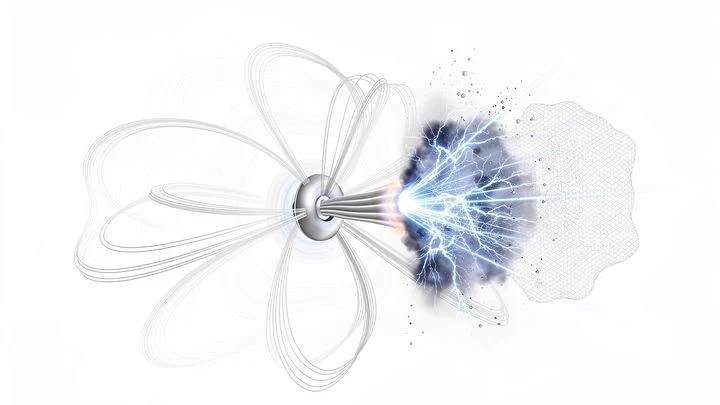
High-energyneutrinos are ghostly subatomic particles that carry enormous kinetic energy, often millions to billions of times more than the neutrinos produced by the Sun. They are produced in the most violent environments in the universe, such as supernova explosions, active galactic nuclei, and gamma-ray bursts, where particles are accelerated to extreme speeds. Because neutrinos interact only via the weak nuclear force, they travel vast distances through matter and radiation without being deflected or absorbed, making them unique messengers from the most energetic processes in the cosmos. Unlike photons, which can be blocked by dust or altered by magnetic fields, neutrinos point straight back to their sources, offering a pristine view of the universe's most extreme accelerators.
History
The first high-energy astrophysical neutrinos were detected by the IceCube Observatory in 2013, after decades of searching. The concept of using neutrinos to study cosmic accelerators was proposed in the 1960s by Kenneth Greisen, Georgy Zatsepin, and Vadim Kuzmin, among others.
How it works
High-energyneutrinos are produced when accelerated protons or nuclei collide with other matter or radiation, creating charged pions that decay into neutrinos and other particles. These collisions occur in environments like the shocks around supernova remnants or the jets of active galactic nuclei. The neutrinos then travel across the universe, passing through planets and stars as if they were transparent. To detect them, scientists build massive detectors, like IceCube at the South Pole, which use cubic kilometers of clear ice to catch the rare interaction of a neutrino with an atomic nucleus. When a neutrino interacts, it produces a charged particle that emits a flash of Cherenkov light, which is then recorded by a grid of sensors.
In practice
High-energyneutrinos are used to identify the sources of cosmic rays and to study the most extreme environments in the universe, complementing observations with photons and gravitational waves.
Fun fact
A single high-energyneutrino can carry as much energy as a fast-moving baseball, but it can pass through a light-year of lead with only a 50% chance of interacting.
In a tank holding three tons of liquid xenon, buried deep underground, something stirred one day. Not the xenon itself, but one of its atomic nuclei: it received a kick with an energy of 248 thousand electronvolts and recoiled like a billiard ball struck by an invisible cue ball.
A particle with an energy of $$10^{18}$$ eV hitting Earth's atmosphere is like a tennis ball traveling at 200 km/h slamming into a wall. Astrophysicists have debated for decades where such projectiles come from. Gamma-ray bursts, brief and powerful explosions of gamma radiation, have long been suspected as accelerators.
Pulsar PSR J1740+1000 is a city-sized star spinning faster than a kitchen blender. After a supernova explosion, it left behind a dense core that accelerates particles to near-light speeds. These particles fly into space, and previously it was thought they scatter in all directions, like splashes from a stone thrown into water.
In the distant Cigar Galaxy, there is an unusual beacon. It doesn't shine in the usual sense: its rays are born in a scorching cloud around a black hole that is devouring matter from a companion star. Such objects are called ultraluminous X-ray sources. Their X-ray brilliance is so intense that it outshines entire galaxies.
This cloud, the corona, is like a boiling cauldron.
Deep beneath the ice of the South Pole, nearly two and a half kilometers down, an unusual telescope is at work. It is not pointed at the sky but through the Earth. Its quarry: neutrinos, nearly elusive particles that pass through planets and stars without interacting with anything.
A billiard ball clicks against another in complete darkness. The sound of the impact and the clatter of balls dropping into pockets: that's all you hear. This is roughly how physicists study the interactions of elementary particles at energies that no terrestrial accelerator can reproduce.
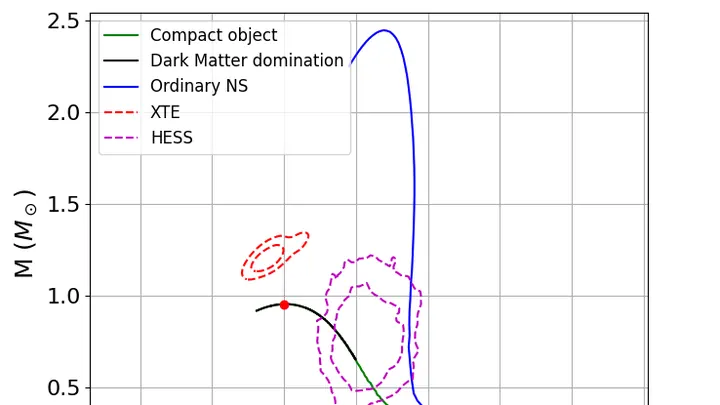
Deep inside a neutron star, matter is squeezed so tightly that familiar protons and neutrons give way to new players. Hyperons are born there — particles that harbor a strange quark.
When two neutron stars, the ultra-dense cores of dead stars, collide, a kilonova is born: an explosion a thousand times brighter than a typical nova. This is the universe's true smelting works. In the scorching cloud racing outward at near-light speeds, a furious flux of neutrons transmutes atomic nuclei into gold, platinum, osmium.
At the heart of the Galaxy, about 7 kiloparsecs away, lies a true natural particle accelerator. This is a rapidly spinning neutron star — the pulsar PSR J1849-0001, left behind by a supernova explosion.
A stone falls into a pond, and ripples spread across the water. Likewise, light from distant galaxies spreads in all directions — calmly and steadily. But at the center of some galaxies, it's not a stone but a veritable cannon: it fires particles with monstrous force. Astronomers call such objects HSP BL Lac.
Two neutron stars (the remnants of dead stars, compressed to the size of a city but weighing as much as the Sun) spiral around each other and eventually collide. At that moment, something between a black hole and a super-powered magnet is born: a field billions of times stronger than that of the most powerful MRI machine.
Deep in the Mediterranean Sea, where water presses down with the force of hundreds of atmospheres, a network of light-sensitive spheres waited for a rare guest. And it came — a neutrino that carried through the bulk of the Earth an energy comparable to the impact of a flying brick.
Neutrinos are almost elusive particles: they zip through planets without noticing atoms. So every catch is a stroke of luck. Recently, the underwater detector KM3NeT snagged a neutrino with energy millions of times greater than Earth's most powerful accelerators can produce.
A powerful searchlight shines through thick fog. The beam itself is invisible, but the fog begins to glow faintly, and gives away the searchlight's presence.
Massive stars end their lives in a colossal explosion, which Fritz Zwicky called a supernova. The core crushes down into a black hole or a neutron star.
A high-speed collision knocked a neutron out of a helium-8 nucleus, and for an instant a helium-7 nucleus appeared, like an overloaded shelf shedding three books at once. This fleeting 'sound' of decay was captured for the first time: three neutrons flew apart, leaving behind an ordinary helium-4 nucleus.
A laser flash strikes a copper oxide crystal, and magnetic excitation waves, magnons, ripple outward like ripples on water. For the first time, scientists traced their path from birth to disappearance with femtosecond precision (millionths of a billionth of a second).
The night sky is full of beacons, but some shine in a way that makes them nearly invisible. Astronomers have discovered a new class of objects: ultrasoft X-ray sources. They are so "cool" by X-ray standards that their emission falls at the boundary between ultraviolet and soft X-rays, where ordinary telescopes are almost blind.
The neutron is the particle that makes up most of a neutron star. On its own, it is unstable: a free neutron lives for about fifteen minutes, then decays into a proton, an electron, and an antineutrino.
At the center of galaxy NGC 4278 sits a black hole that shoots out two plasma jets, like a giant cannon firing particles into space. These jets accelerate particles to energies that no earthly accelerator could ever dream of.
In the binary system Cyg X-2, a neutron star pulls matter from a normal companion star. The infalling gas spirals in, heats up to millions of degrees, and shines brightly in X-rays. Astronomers pointed two space telescopes, IXPE and NuSTAR, at this object and, for the first time, measured in detail how polarized that light is.
Cosmic neutrinos are ghost particles, passing freely through the Earth. The IceCube telescope in the ice of Antarctica once caught such a neutrino, and it matched an infrared flare. That flare turned out to be the moment a black hole tore a star apart in a distant galaxy.
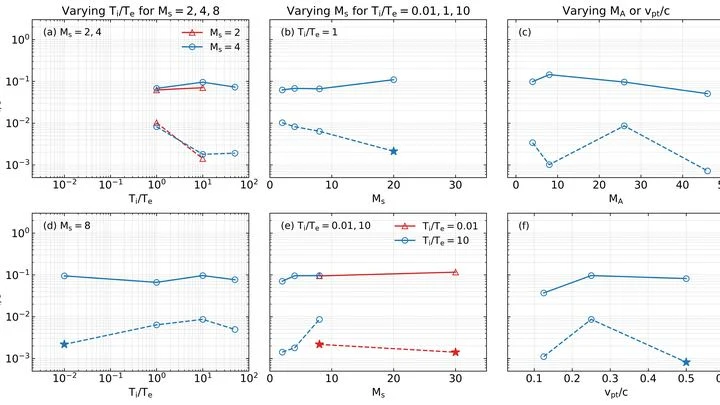
A new study confirms: shock waves in plasma around supermassive black holes at the cores of galaxies act like ocean swells, shoving protons to near-light speeds. Even a weak wave passes on a tenth of its energy, like a gentle surf launching a surfer into space.
Deep inside stars, light nuclei fuse, giving birth to helium and streams of neutrons. On Earth, we recreate this process by combining deuterium and tritium — special isotopes of hydrogen.
When a massive star exhausts its thermonuclear fuel, its core collapses, and the outer layers are ejected into space at speeds of thousands of kilometers per second. This is how a supernova remnant is born — an expanding cloud of shock-compressed gas spanning light-years.
In 1181, Chinese and Japanese astronomers recorded the appearance of a 'guest star', a bright object that shone for six months in the constellation Cassiopeia and then vanished. Today, that spot hosts Pa 30: a nebula with a hot central source ejecting material at 16,000 km/s.