A stellar remnant is the compact object left behind after a star exhausts its nuclear fuel. Depending on the star's initial mass, the remnant can be a white dwarf, neutron star, or black hole. These objects are extreme laboratories: white dwarfs pack a solar mass into an Earth-sized volume, while neutron stars compress a solar mass into a city-sized sphere. Stellar remnants are key to understanding the life cycle of stars, the production of heavy elements, and the evolution of galaxies.
History
The concept of white dwarfs emerged in the early 20th century, with the first identified white dwarf (40 Eridani B) recognized around 1910. The theoretical framework was developed by Subrahmanyan Chandrasekhar in the 1930s.
How it works
When a star runs out of fuel, the outward pressure from nuclear fusion ceases, and gravity compresses the core. For low- and medium-mass stars, electron degeneracy pressure halts the collapse, forming a white dwarf. For more massive stars, the core collapses further, triggering a supernova and leaving behind a neutron star or black hole. The remnant's properties — mass, radius, and composition — are determined by the balance between gravity and quantum mechanical pressure.
In practice
Stellar remnants serve as natural laboratories for testing extreme physics, and their observations help calibrate distance scales in cosmology.
Fun fact
A teaspoon of white dwarf material would weigh about as much as an elephant on Earth.
In the stellar family of the Phoenix galaxy, there are five old globular clusters, and the sixth child was long considered a foundling. The object Fornax 6, located just 270 parsecs from the galaxy's center, looked like a random clump of field stars or a compact group of distant galaxies. Astronomers argued over whether it deserved to be called a cluster.
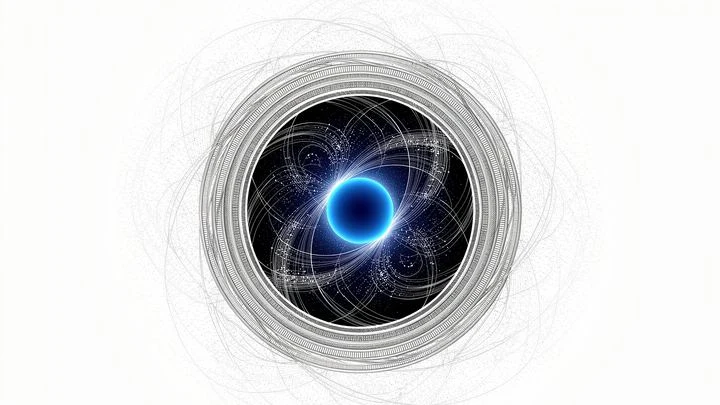
A light ray passing near a massive body bends around it, like a runner rounding the corner of a stadium. For a neutron star, this deflection angle is usually assumed to be the same as for a point mass. But if the star is wrapped in an invisible halo of dark matter, the picture changes: light passing through the halo is deflected less than the total mass would predict.
A white dwarf is the former core of a star like the Sun, squeezed down to the size of Earth. A teaspoon of its material would weigh several tons. A neutron star is an even denser remnant: a city the size of Manhattan, but with more mass than the Sun.
On August 6, 1181, Chinese astronomers spotted a new star in the constellation Cassiopeia. It shone for 185 days, slowly fading, and then vanished, leaving only a record in the chronicles. Today, at its location, there is a hot white dwarf — a compressed stellar core with no nuclear reactions, heated to tens of thousands of degrees.
Three milliseconds before the merger. A gargantuan black hole spinning at breakneck speed drags in a neutron star — a ball the size of a city but with 1.5 times the Sun's mass. Tidal forces stretch the star into a thread as thin as a needle and fling its matter outward.
It takes the stellar pair J05+50 nearly two months to complete one orbit around their common center. From Earth, it appears as a faint point in the constellation Hercules — 4625 parsecs away. Photometry of the binary star only captures a steady flicker of brightness, like the pulse of a giant heart.
Neutron stars — remnants of supernovae — are among the densest objects in the Universe. Their central density exceeds nuclear density many times over, and gravity is surpassed only by black holes.
At the center of the Milky Way, like a matryoshka doll within a matryoshka doll, lies a supermassive black hole, surrounded by a swarm of stars and an invisible shell of dark matter. This shell, or "spike," is expected to be extremely dense right at the horizon.
Civilizations in the Universe are separated not just by distance, but by the vast gulf of time. Hunting for their traces is like archaeology: instead of palace ruins, we find clouds of cosmic dust.
For a long time, a void yawned in the family of ultra-dense remnants of dead stars. Neutron stars, swift city-sized tops, rarely weigh more than two Suns. Black holes start at about five solar masses. Between them lies a 'gap' where for decades no object could be found.
Black holes come in two types: tiny ones — the remnants of supernova explosions, and giants in the cores of galaxies. But where are the intermediate ones, with hundreds and thousands of solar masses? The answer may lie in star swarms, where black holes collide like balls on a billiard table and, merging, bulk up.
A handful of sand weighing as much as a small mountain: that's roughly what strangelets are like: tiny clumps of 'strange' quark matter where particles are squeezed to unimaginable densities. In a new study, astrophysicists tested whether such objects could exist in nature and what they would look like.
In the searing plasma of the newborn Universe, when space itself still rang with the echo of the Big Bang, objects may have emerged that challenge gravity itself. Not ordinary black holes — but electrically charged giants, astrons.
A lighthouse blinks steadily once per second. If it moves in a circle, its flashes arrive sometimes a bit early, sometimes a bit late, and they give away an invisible companion. That's exactly how astronomers exposed the hidden partner of the star IY Lyrae.
IY Lyrae is a pulsating variable star in the thick disk of the Galaxy.
An atomic nucleus is like a droplet with a thin coating — a neutron 'skin.' Inside the droplet, protons and neutrons are mixed evenly, but on the outside, like the froth on milk, a layer forms where neutrons are noticeably more abundant.
Every second, invisible projectiles from the depths of space pierce through us. These are cosmic rays — atomic nuclei accelerated to speeds nearly indistinguishable from the speed of light. Their energy is hundreds of millions of times greater than what our most powerful accelerators can achieve. Where does this monstrous force come from?
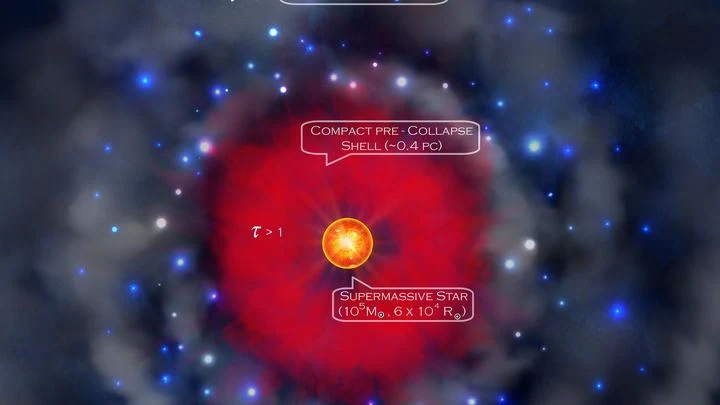
A star weighing a hundred thousand Suns lives bright and brief. Its finale is a rapid collapse into a black hole. But just before the end, it manages to wrap itself in a dense gas cocoon.
When a heavy atomic nucleus splits, it doesn't break into even halves. First, two fragments form that look like pears pressed together at their narrow ends. Then the junction begins to smooth out, like two droplets merging and the surface quickly leveling.
In that brief moment, the surface moves inward, and particles inside the nucleus can bounce off it, like a ball off an oncoming wall.
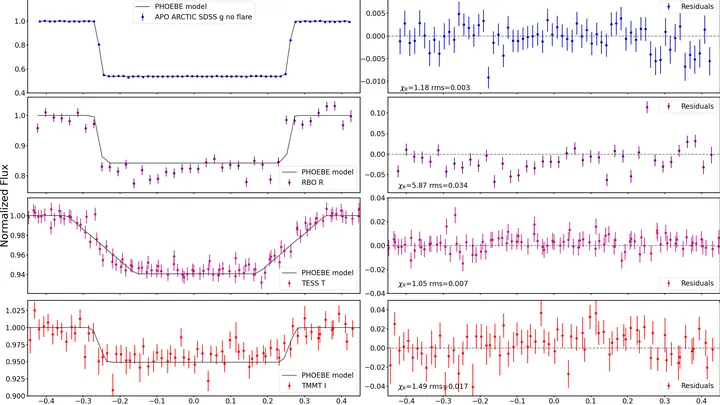
Every 15 hours, in a constellation 57 light-years away, a miniature solar eclipse takes place. A tiny white dwarf — a star the size of Earth but heavier than the Sun — ducks behind the disk of a red dwarf. For astronomers, this is not just a pretty coincidence but a way to peek into the pair's past.
The center of our galaxy is a crowded kitchen where several dishes are simmering at once, and their steam blends into a single cloud. X-rays from the exploded star's remnant, from the stellar wind around the supermassive black hole, and from hot gas between stars all overlap.
When two heavy bodies collide, they don't always stay put. Merging black holes get a powerful kick, like the recoil of a gun, but instead of gunpowder, it's the curvature of spacetime doing the work. This kick can send the new hole flying out of a galaxy's center or even beyond its outskirts.
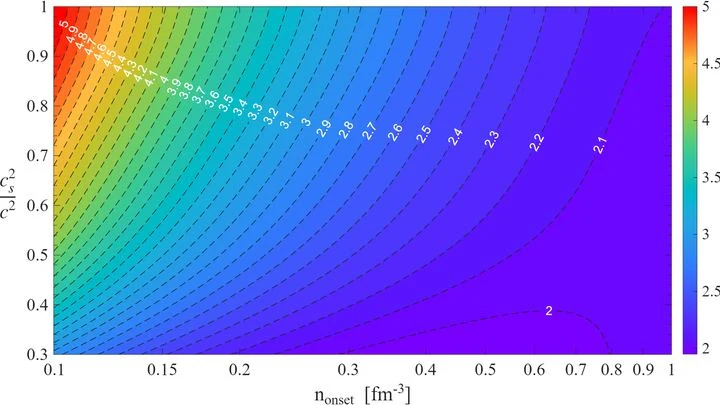
The density at the center of a neutron star is so extreme that a teaspoon of its material would weigh as much as a mountain. Physicists have long tried to figure out how massive such a star can get before it collapses into a black hole.
In a gas cloud left after a star exploded (called a supernova remnant), astronomers noticed a giant glowing letter S. It was drawn by two jets of superheated material ejected during the cataclysm. These jets didn't just shoot straight out — they slowly spun like a top, which bent their path into curves.
A sugar cube sits on a saucer next to a cup of hot tea. Drop it in, and it dissolves within minutes. But if you lower it slowly, the sugar melts gradually, releasing its sweetness into the drink. Something similar is happening in two newly discovered stellar pairs, except the sugar is a brown dwarf and the tea is a star.
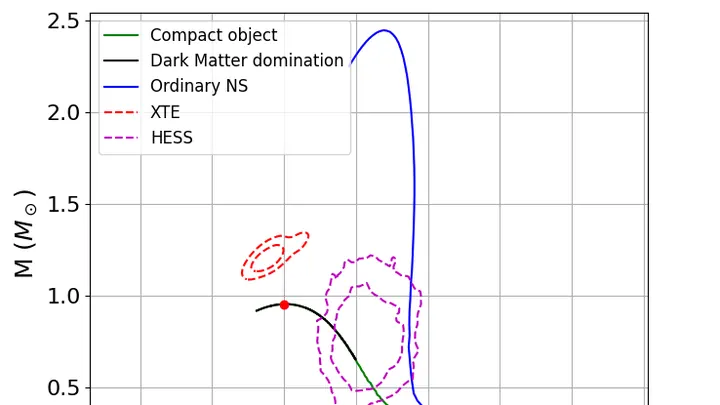
A star made of dark matter is an invisible ocean of ultra-light particles, whose existence was first suspected by Fritz Zwicky back in the 1930s. Into this ocean plunges a neutron star — a tiny, yet unimaginably dense sphere.
The neutron is the particle that makes up most of a neutron star. On its own, it is unstable: a free neutron lives for about fifteen minutes, then decays into a proton, an electron, and an antineutrino.
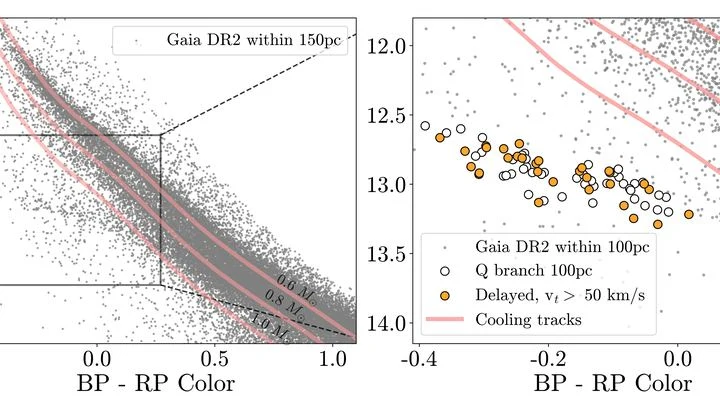
An old star like the Sun, at the end of its life, shrinks into a white dwarf — a dense sphere about the size of Earth. After that, it simply cools down, like embers in a campfire. But some white dwarfs somehow stay hot for billions of years. Astronomers studied such objects within a radius of one hundred parsecs from us and found an unexpected pattern.
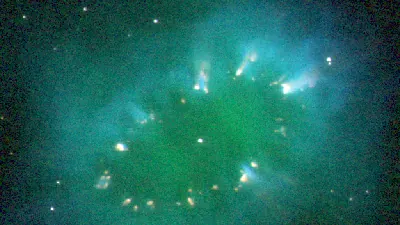
Deep in space, there's a cloud of gas that looks like a necklace with bright beads. This is the Necklace Nebula — the remains of a star that once swelled up and swallowed its neighbor. At the center, a pair remains: a small, hot star and its bloated companion, rich in carbon.
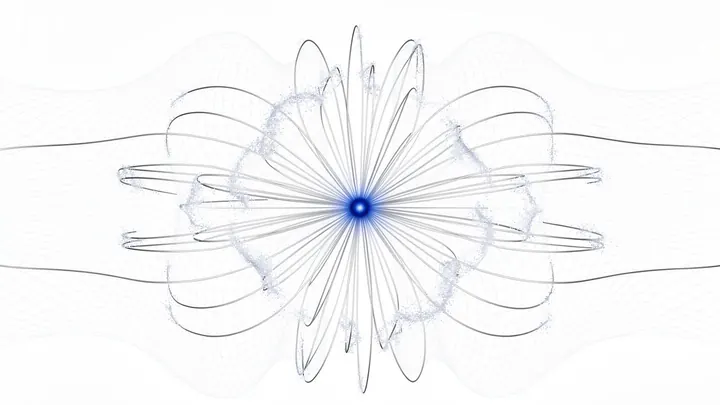
Light from a distant source passing near a neutron star bends like a flashlight beam in a funhouse mirror. Astrophysicists ran a numerical experiment: they traced rays backward from the observer to the star and looked at what picture a telescope would see.
Two stars whirl in a tight dance. One is a neutron star — an ultra-dense sphere the size of a city but with a mass of one and a half Suns. The other is an ordinary star that swells and spills its matter onto its neighbor. Sometimes this transfer happens too fast, and the stars become enveloped in a shared gas shell, like two spoons in one pot of boiling soup.
Short gamma-ray bursts are colossal explosions that release, in a fraction of a second, energy comparable to what our Sun will emit over billions of years.
Neutron stars are the compressed remnants of massive stars: their matter is squeezed so tightly that a thimble-sized amount would weigh a colossal amount. If dark matter, the mysterious invisible substance thought to hold galaxies together with its gravity, accumulates inside such an object, under certain conditions this accumulation becomes fatal.
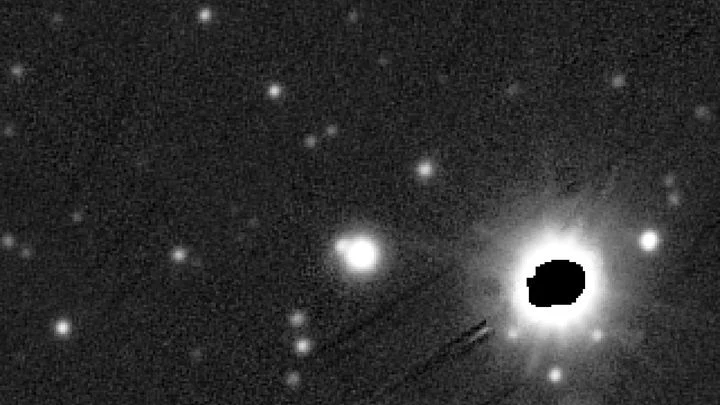
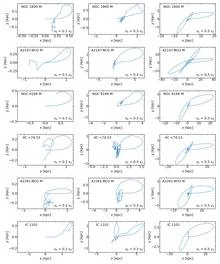
At the center of galaxy NGC 1600, 200 million light-years away, astronomers spotted a dense cluster of stars. It looked like a bright knot against the diffuse glow, and that was unexpected.
The collision of two neutron stars is a strike heard across the universe. Gravitational wave detectors pick up the ripples in spacetime, but the most interesting sound begins after the impact: the merger remnant, a rapidly spinning hypermassive neutron star, continues to vibrate, emitting waves for a few more…
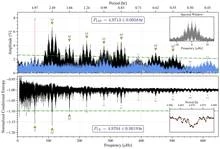
Four hours and fifty-eight minutes. With a rhythm like a metronome, something passes in front of the white dwarf ZTF J1944+4557, dimming its light by a third, sometimes almost by half.