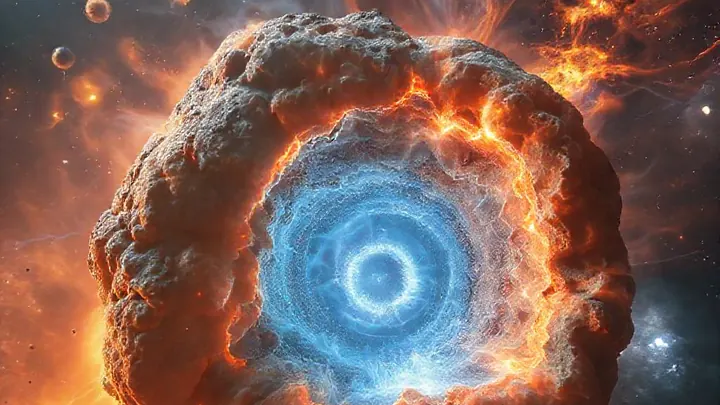
Neutron stars are the collapsed cores of massive stars, packing more mass than the Sun into a sphere the size of a city. Their extreme density and strong gravity make them natural gravitational traps for dark matter particles, which might accumulate in their interiors over cosmic time. This accumulation could subtly alter the star's properties — its temperature, rotation, or structure — and even trigger collapse if enough dark matter gathers in the core. Because neutron stars are so compact, they amplify the effects of even a small amount of captured dark matter, making them sensitive probes of a substance that otherwise passes through ordinary matter almost unnoticed.
History
The idea that compact stars could capture dark matter dates back to the 1980s, with early work by Press and Spergel on capture in the Sun. The specific application to neutron stars as dark-matter detectors gained traction in the 1990s and 2000s, particularly with the realization that gravitational-wave observatories could probe the resulting black-hole formation.
How it works
Dark matter particles passing through a neutron star can lose energy through scattering with nucleons and become gravitationally bound. Over millions of years, repeated interactions cause them to sink toward the center, forming a dense dark-matter core. If the particles are self-annihilating, this core heats the star, potentially observable as an anomalous surface temperature. If they do not annihilate, the core may grow until it exceeds a critical mass and collapses into a small black hole, which would then swallow the neutron star from inside — a process that could be detected through gravitational waves or the sudden disappearance of the star.
In practice
Neutron stars serve as natural dark-matter detectors: by monitoring their temperatures, rotation rates, and gravitational-wave emissions, astronomers can constrain dark-matter properties such as its scattering cross-section and self-annihilation rate.
Fun fact
If dark matter accumulates enough in a neutron star, it can trigger a collapse into a black hole, and the resulting gravitational-wave signal would be a unique fingerprint of dark matter's particle nature.
A neutron star is the ultra-dense remnant of a supernova: the mass of the Sun packed into a sphere the size of a city. For billions of years, it travels through space, gathering around itself invisible matter, dark matter, which emits no light but pulls with gravity.
At the heart of a dying star, as its core collapses into a neutron sphere, an invisible storm is born. Trillions of neutrinos, particles that barely interact with matter, race through the scorching plasma. There are so many of them that they begin to influence each other, changing their 'flavors' (electron, muon, tau) like chameleons.
At the end of a massive star's life, its core collapses in a fraction of a second, giving birth to a supernova flash. This cataclysm shakes spacetime itself, emitting gravitational waves — ripples that race across the Universe.
At the centers of many galaxies, not only supermassive black holes lurk, but also vast clouds of invisible matter. If this matter consists of ultralight particles, it can gather into dense clumps — a kind of 'star' made of dark matter.
A neutron star is a city the size of Manhattan that weighs as much as half a million Earths. A teaspoon of its material would outweigh Mount Everest. Now, into this superdense sphere, something invisible and elusive has been mixed — dark matter particles.
That's exactly what physicists did in a new study.
Neutron stars — remnants of supernovae — are among the densest objects in the Universe. Their central density exceeds nuclear density many times over, and gravity is surpassed only by black holes.
Two million years away, around the young star CI Tau, a gas-dust disk whirls — a protoplanetary cradle. ALMA observations have already shown rings and gaps in it, but the finest details remained invisible: their width is smaller than the instrument's resolution.
A teaspoon of neutron star matter weighs as much as a mountain. But this mountain may have an invisible twin.
Deep inside a neutron star, ordinary matter is compressed to unimaginable densities. There, protons and neutrons can dissolve into a quark soup.
Previously, Uranus and Neptune were considered ice giants because of assumed thick layers of frozen water, methane, and ammonia. New calculations paint a different picture: deep inside them hides an ocean of hot magma, which under immense pressure has absorbed a colossal amount of hydrogen.
The story began with a puzzle: in the 1930s, Fritz Zwicky noticed that clusters of galaxies behave as if an enormous invisible mass is hidden within them. Half a century later, Vera Rubin confirmed that stars on the outskirts of galaxies rotate too fast to be held by visible matter alone.
A neutron star is a super-dense remnant of a supernova explosion, where a teaspoon of matter weighs a billion tons. Many of them, as discovered back in 1967 by Jocelyn Bell Burnell, become pulsars — cosmic lighthouses that regularly flash in the radio band.
Drop a stone into a pond, and ripples spread outward. Something similar happens inside compact clumps of dark matter when they encounter a special medium — a scalar field. This field, which pervades everything around us, can spontaneously intensify in the depths of such objects, much like ripples on water growing ever taller and more pronounced.
In the standard picture, black holes are the undisputed density champions: all their matter is squeezed into a single point. Imagine the entire mass of Mount Everest packed into a grain of salt. But physicists have found a theoretical trick.
Just after the Big Bang, clumps weighing as much as a trillion Suns and with an electric charge of colossal strength, like trillions of electrified balloons, could have drifted through space.
Imagine an interpreter at a crucial negotiation suddenly switching to another language, and the meaning of everything changes. That's roughly what neutrinos do in the depths of a dying star. These invisible particles are born in enormous numbers when a star's core compresses into a city-sized lump. But on their way out, neutrinos can change their type — physicists call this flavor transformation.
A translator halfway across the hall suddenly starts rendering the message backwards. That's roughly how a neutrino, a ghost particle that barely notices matter, might behave if it encounters a cloud of ultralight dark matter.
In the kitchen, there's a bucket of water and an identical bucket of sand. Pour the sand into the water, and you get a mixture where there's exactly five times more sand than water. That's roughly how our universe is arranged: one part ordinary matter — the stuff stars, planets, and we ourselves are made of — and five parts elusive dark matter.
A neutron star is the dead core of a massive star, crushed to the size of a city. A teaspoon of its material weighs as much as a mountain. Dark matter particles fly through such a dense medium almost unimpeded, but occasionally they do hit neutrons and get stuck, like bullets bogging down in deep sand.
The neutron is the particle that makes up most of a neutron star. On its own, it is unstable: a free neutron lives for about fifteen minutes, then decays into a proton, an electron, and an antineutrino.
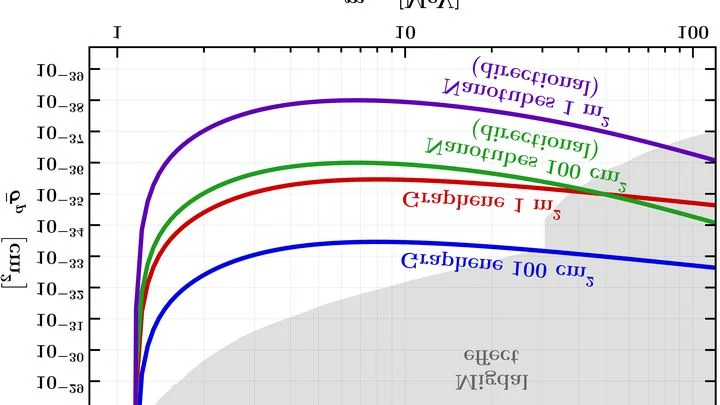
Dark matter is invisible, but you can catch it on the rebound. Hydrogen embedded in a carbon film acts like a billiard ball: when a dark matter particle hits it, the proton flies out. That ejection is the signal you're looking for.
Neutron stars are the compressed remnants of massive stars: their matter is squeezed so tightly that a thimble-sized amount would weigh a colossal amount. If dark matter, the mysterious invisible substance thought to hold galaxies together with its gravity, accumulates inside such an object, under certain conditions this accumulation becomes fatal.
An electron flies out of a tritium nucleus with an energy of 18.57 keV, leaving behind an invisible partner: a neutrino. If that neutrino has access to a fifth dimension, its mass splits into a whole tower of states, and each one takes its own bite out of the spectrum.
Gravitational waves from a neutron star merging with a black hole carry the imprint of the intricate dynamics of spacetime. To decode that imprint, physicists compute scattering amplitudes, the quantum probabilities that two bodies fly apart at a given angle.