A Waterfall of Planets: The Mystery of the Vanishing Water Worlds express
The Kepler telescope William Borucki's caught the faint twinkling of distant stars and discovered thousands of planets around other suns. Among them gapes a gap: almost no worlds sized between rocky balls and puffy water giants. This 'radius valley' was explained by a new model: planets initially divide into rocky and water ones. Water worlds with a steam atmosphere fill the gap, but at three times Earth's size they abruptly cut off — like a stream plunging over a waterfall.
Upon reaching a critical mass, such a planet captures hydrogen and helium and becomes a gas giant. Large water worlds simply don't get a chance to appear — they transform earlier. But inside them lies a surprise: water under immense pressure turns into hot ice — solid but scorching. Light measurements from Kepler show that the oceans there have no bottom. And although such water worlds are common in the galaxy, our Solar System is just one possible recipe.
Original abstract
as written by the authors arXiv:2602.11923
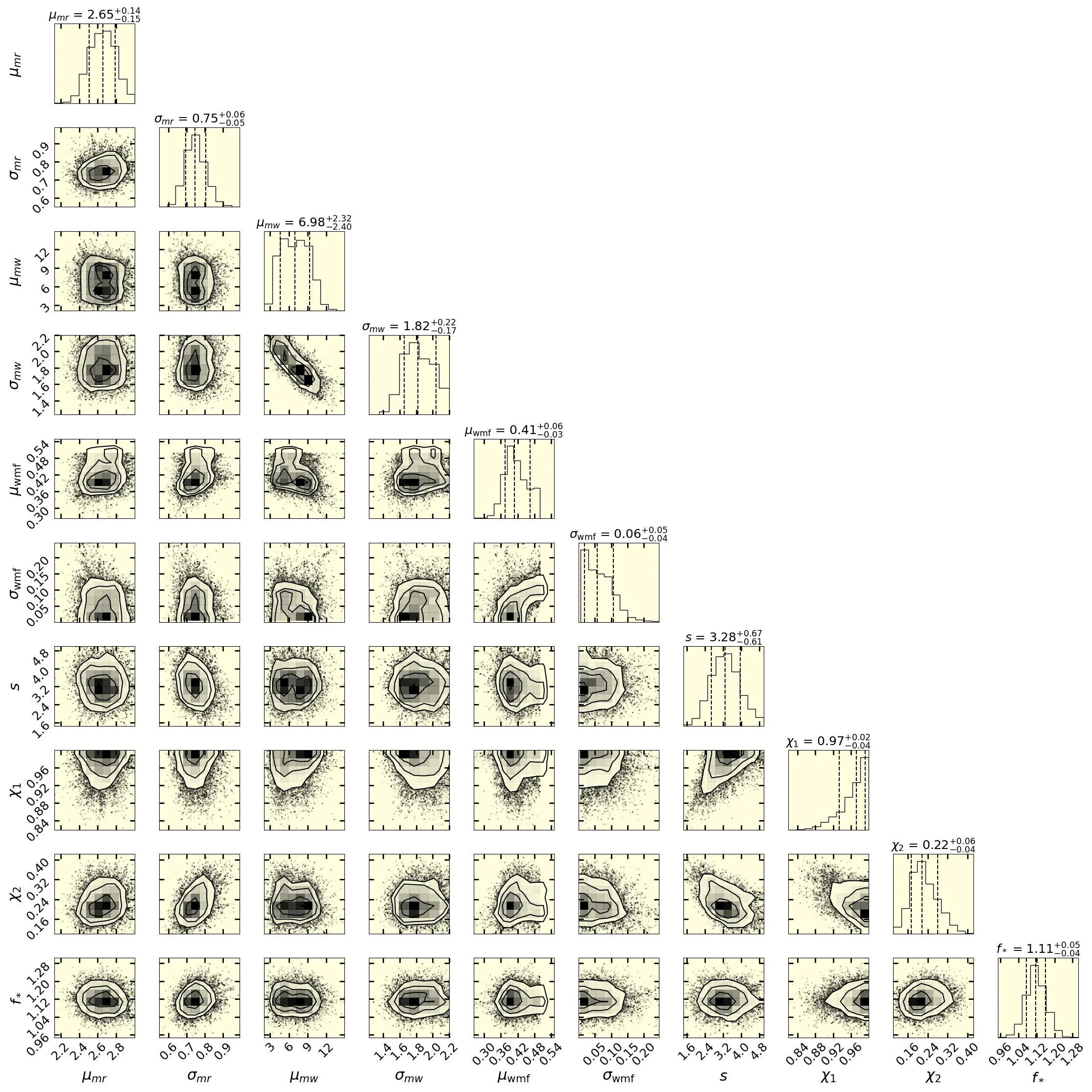
The demographics of Kepler planets provide a key testbed for models of planet formation and evolution, particularly for explaining the radius valley separating super-Earths and sub-Neptunes. A primordial interpretation based on differences in bulk densities -- where rocky and water-rich planets form via migration pathways -- offers an alternative to atmospheric loss scenarios. Updated interior structure models of water worlds with adiabatic steam atmospheres reproduce the observed valley near $$\sim2~R_\oplus$$ more accurately. Furthermore, migration models from our Genesis library suggest that these formation pathways can also account for the distinct period distributions of super-Earths and sub-Neptunes, as well as the emergence of the hot Neptune desert. Motivated by this, we develop a Bayesian hierarchical mixture model for close-in Kepler planets ($$P<100$$ days), combining rocky planets and water worlds without H/He envelopes. The inferred mass distributions of rocky and water-rich planets peak at $$\sim2.6~M_\oplus$$ and $$\sim7~M_\oplus$$, respectively, with the water mass fraction of water worlds peaking at $$\sim41\%$$. Water worlds provide a good representation of the Kepler sub-Neptune population, with the radius cliff emerging as a ``waterfall" -- a sharp decline in their occurrence. However, our mass-radius analysis shows that water worlds alone cannot explain planets with $$R \gtrsim 3~R_\oplus$$, implying that at least $$\sim20\%$$ of sub-Neptunes in the sample are enriched in H/He gas.
On water planets, water turns into hot ice under incredible pressure — a solid substance that remains red-hot. So the oceans there can be liquid on top and icy deep down at the same time.
In 'Interstellar,' the characters visit Miller's planet, covered by a shallow ocean. But real water worlds are more like giant droplets without a solid surface, far deeper than any Earthly seas.