Cryoelectronics: Controlling Qubits at 4 Kelvin express
Quantum computers promise to solve problems beyond the reach of classical machines, but their heart, the qubits, requires ultra-low temperatures near absolute zero. Controlling qubits and reading out their states typically means working from a warm room, running many cables through the refrigerator. It's like conducting an orchestra from a neighboring building through long tubes: the signal gets distorted, and as the number of qubits grows, the system becomes unwieldy.
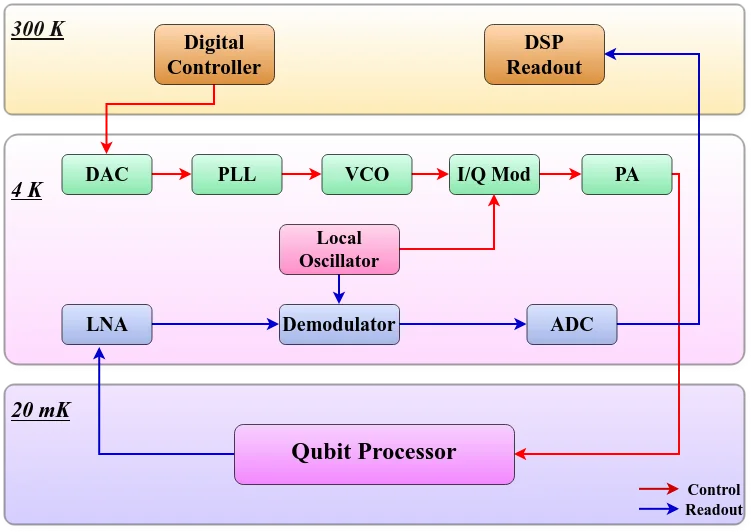
This new work proposes moving part of the electronics right into the cold — onto a stage at 4 Kelvin (that's -269°C, the temperature of liquid helium). There, inside the cryostat, analog circuits generate precise radio signals to control the qubits and amplify the weak signals from them for readout. The entire system was simulated taking into account how transistors behave at low temperatures: charge carriers 'freeze out,' threshold voltage increases, but electron mobility improves.
The simulation results are impressive: the phase error between two signal components is below 2 degrees, rejection of the unwanted image channel is above 35 decibels, and the probability of a symbol error is below one in a million. That means qubits receive clean commands, and their responses are read without confusion.
This architecture, modular and validated by simulations, paves the way for scalable quantum processors where control electronics live alongside the qubits, reducing cables and distortions.
Original abstract
as written by the authors arXiv:2602.14165
This paper presents a comprehensive cryogenic analog signal processing architecture designed for superconducting qubit control and quantum state readout operating at 4 Kelvin. The proposed system implements a complete bidirectional signal path bridging room-temperature digital controllers with quantum processors at millikelvin stages. The control path incorporates a Phase-Locked Loop (PLL) for stable local oscillator generation, In-phase/Quadrature (I/Q) modulation for precise qubit gate operations, and a cryogenic power amplifier for signal conditioning. The readout path features a Low Noise Amplifier (LNA) with 14 dB gain and 8-Phase Shift Keying (8-PSK) demodulation for quantum state discrimination. All circuit blocks are designed and validated through SPICE simulations employing cryogenic MOSFET models at 180nm that account for carrier freeze-out, threshold voltage elevation, and enhanced mobility at 4 K. Simulation results demonstrate successful end-to-end signal integrity with I/Q phase error below 2{\deg}, image rejection ratio exceeding 35~dB, and symbol error rate below $$10^{-6}$$. This work provides a modular, simulation-validated framework for scalable cryogenic quantum control systems.
A temperature of 4 Kelvin is the boiling point of liquid helium, which is used to cool superconducting magnets in MRI machines.