Gate voltage is the electrical potential applied to the gate electrode of a field-effect transistor, the fundamental building block of modern electronics. This voltage creates an electric field that controls the flow of current between the source and drain terminals, effectively turning the transistor on or off. In quantum computing and precision measurement, gate voltage is used to manipulate individual electrons, ions, or quantum dots, making it a critical tool for controlling the behavior of matter at the nanoscale.
History
The concept of using a voltage on a gate electrode to control current dates back to the 1920s, with the first working field-effect transistor demonstrated by John Bardeen, Walter Brattain, and William Shockley in 1947. The idea of using gate voltages to confine and manipulate single quantum particles emerged later, with the development of quantum dots in the 1980s.
How it works
In a typical transistor, the gate is separated from the conducting channel by a thin insulating layer. Applying a voltage to the gate induces charges in the channel, either attracting or repelling charge carriers (electrons or holes). This changes the channel's conductivity, allowing the transistor to act as a switch or amplifier. In quantum devices, gate voltages are used to create electrostatic potentials that trap single particles, such as electrons in quantum dots or ions in traps, and to tune their energy levels for precise manipulation. The voltage must be extremely stable and noise-free, as tiny fluctuations can disturb the fragile quantum states.
In practice
Gate voltages are essential in every computer chip, from microprocessors to memory, and are also used in quantum computers to control qubits, in sensitivedetectors like single-electron transistors, and in tuning the properties of novel materials like graphene.
Fun fact
In a quantum dot, a single electron can be trapped and controlled by a gate voltage, and its spin state can be used to store a bit of quantum information, a concept that underpins many quantum computing designs.
Units by system: SI: volt · CGS: statvolt · Planck: planck voltage · natural: electronvolt per elementary charge
It is easier to turn a jar lid by gripping its edge than its center. Layered crystals such as graphite behave similarly when one layer is twisted relative to another: the resistance arises not from the whole contact area but only from its rim.
Picture a mountain road where cars drive fast and free until they slam into a sharp bend. In a gallium oxide transistor, electrons play the role of cars, and high voltage plays the role of the bend. In typical devices, electrons scatter off road bumps and lose speed, but here the channel is engineered so they fly without hindrance.
A regular battery releases heat smoothly: what you store is what you get. The power is fixed once and for all, like a faucet that pours water in a single stream. But sometimes you don't need a steady flow; you need a short, powerful burst: to instantly heat a part, trigger a reaction, or dump excess heat.
In a narrow corridor, people walk in rows rather than as a crowd. The number of rows depends on the width of the passage. In graphene, this corridor is a quantum point contact — a constriction where electrons move ballistically without scattering.
Inside an MRI magnet, current flows through a closed superconducting loop, like water circling in a bucket after you give it a spin, it just keeps going on its own. To change that current, you heat the loop with a small heater: it stops being superconducting, becomes an ordinary resistor, and then an external source can 'top up' or 'draw off' current.
Electricians working with high voltage are like divers: they need to see what's happening deep underwater without going down themselves. What's needed is a sensor that stays away from the dangerous current and relays information to the surface. Usually, light is used: a beam passes through a transparent crystal, and the electric field slightly rotates it.
Two dancers on stage must move in perfect sync, but if one hesitates, the whole routine is ruined. That's roughly how quantum computers with neutral atoms work: two atoms are entangled by putting them into a Rydberg state (as huge as a balloon compared to an ordinary atom), and then you wait for them to 'dance' their part.
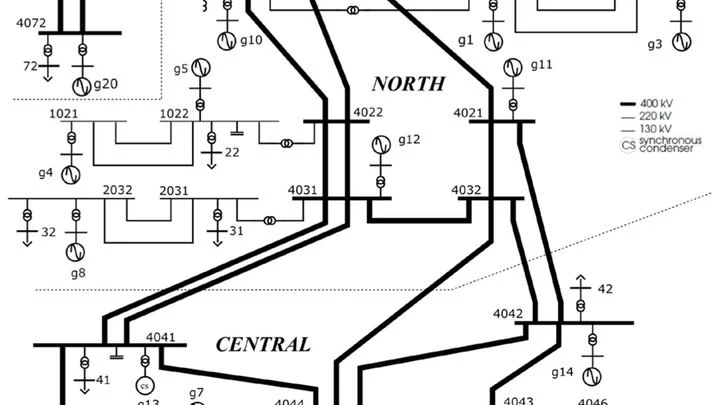
The power grid can be pictured as a water supply system: pipes are the lines, and pumps are the converters. When pressure (voltage) drops in some district, powerful pumps can send extra water (power) there. The trouble is, too strong a flow causes overload, and too weak a flow doesn't help. You need to know exactly how far to open the valve.
Engineers found the answer.
The power grid is a galaxy, where massive generators, like stars, set the rhythm with their synchronous rotation. With the advent of green energy, "planets" appear — power converters. Some obediently circle in their orbits, while others try to become centers of attraction.
In the first moments after the Big Bang, the Universe was like a supercooled bottle of champagne. In addition to ordinary matter, it concealed a dark sector — an invisible sparkling “wine” of fields and particles, candidates for dark matter.
Three guitar strings on the same instrument, but each tuning peg turns with a different resistance: one gives way immediately, another is stiff, and the third is completely stuck.
An ordinary field-effect transistor is like a faucet with a very sensitive handle: turn it slightly, and water flows. In the cold depths of a quantum computer, where everything is chilled to near absolute zero, such a faucet must open strictly on command.
A quantum computer measures a molecule's energy much like an old tape measure that only has markings every meter. If the actual length of a table is 2.37 meters, the tape shows “two and a bit,” and you can't do better. Physicists call this resolution: the step of the grid, finer than which you cannot go.
The authors of the new work turn this flaw into an advantage.
The atom is like a conductor, and the light in the resonator is the orchestra. Their energy exchange, known as the Jaynes–Cummings interaction (part of the Standard Model), lets the atom use “baton” strokes to change the rhythm and timbre of the oscillations.
An ordinary flash drive in your pocket gets warm even when it's just sitting there. Now imagine memory that, in the cold, uses almost nothing, like a thermos that never cools down. A superconductor carries current without loss at liquid-helium temperatures, but it couldn't store data. The new cell changes that.
Physicists are trying to hear a whisper in a noisy room. They build a soundproof booth, but even inside, their own breathing and heartbeat create interference. That's roughly how the search for quantum gravity goes: they want to see gravity bind two particles into a single whole — entangle them.
When you flip a switch, the light doesn't come on immediately — electrons in the wires need time to 'get going' and move together. In ordinary metals and semiconductors, current builds up gradually, like water in a hose when you first open the tap.
A neutral-atom quantum computer is like a library where books not only need to be read but also quickly returned to the shelf. Slow readout of results is like a sluggish librarian holding up the entire queue. Scientists have found a way to speed up this process by adding helpers.
Think of a stack of paper: when the sheets lie perfectly aligned, light passes through them uniformly. But turn one sheet by a few degrees, and the picture changes. Something similar happens with layers in certain materials: rotate them relative to each other, and their properties change — sometimes dramatically.
Spectroscopy isn't the key here, or rather, it's not the method used.
A rug lies flat, but if you push it from the edge, wrinkles run across it. In a thin film of tantalum sulfide (1T-TaS2), wrinkles made of electrons, charge waves, freeze as if the rug were stuck to the floor. To move them, you need to apply force. Scientists have found a way to control this force using an electric field and a magnet.
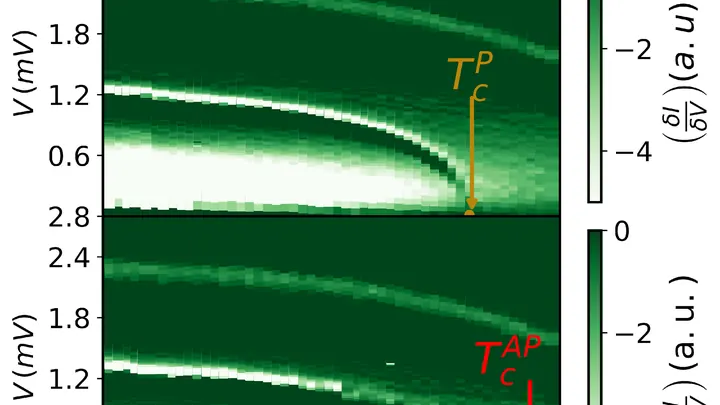
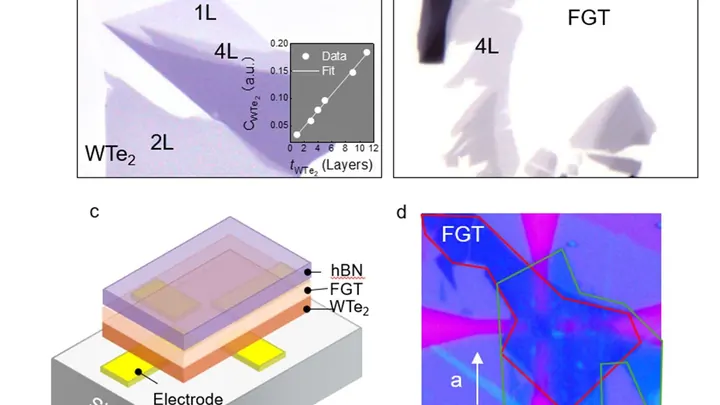
Usually, current in a metal acts like boiling water on ice: it heats the material and destroys magnetic order. But in a layered structure of tungsten ditelluride and the ferromagnet Fe3GeTe2, current behaves differently.
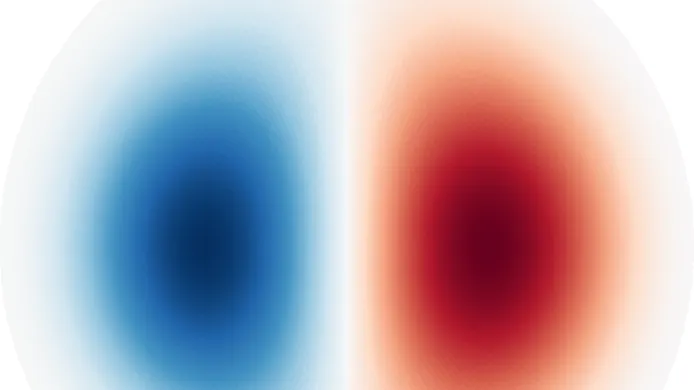
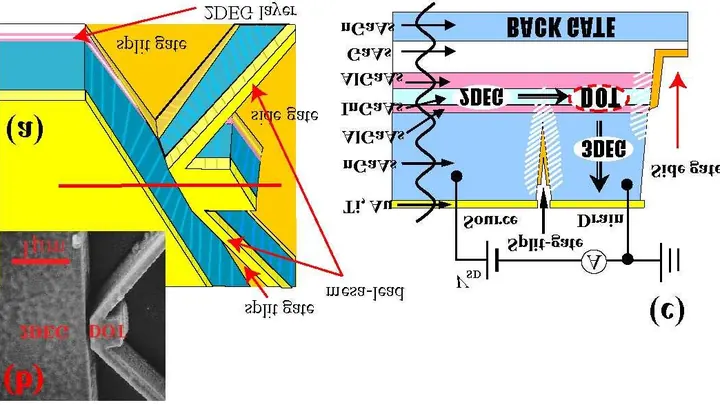
A quantum dot is like a tiny island where one or a few electrons can settle. In this new work, such an island was connected to two 'seas' of electrons: one flat like a pancake, the other bulky like an ocean. Electrons can hop from the island to the seas and back, and this hop depends on the shape of the electron's wave on the island.
An ion quantum computer is like a chandelier with a dozen pendants: pull one, and they all start swinging. Each ion is a qubit, but when there are many, their collective vibrations crowd the stage. Any operation on one pair disturbs the neighbors, and the computation goes awry.
A special material — a topological insulator — conducts current only on its surface, as if its interior is a perfect insulator. It hosts a quantum effect similar to the one discovered by Klaus von Klitzing, but mathematically it is equivalent to a four-dimensional world.
A quantum computer is like an orchestra where every musician must come in exactly on the beat. The faintest rustle in the hall throws off the violinist, and the melody falls apart. In silicon chips, that rustle is electrical noise: random fluctuations of charge inside the material. They make quantum bits err.
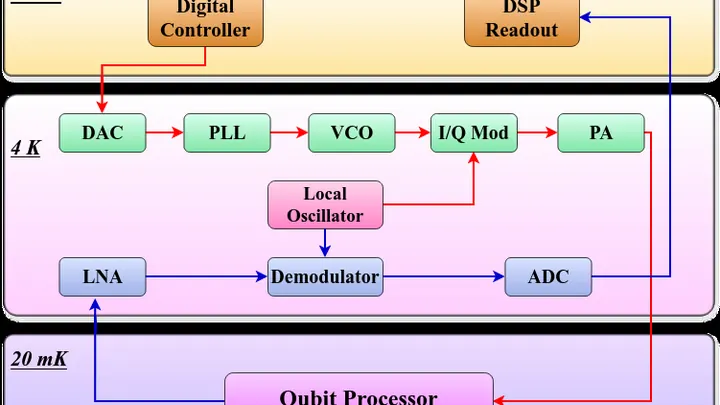
Quantum computers promise to solve problems beyond the reach of classical machines, but their heart, the qubits, requires ultra-low temperatures near absolute zero. Controlling qubits and reading out their states typically means working from a warm room, running many cables through the refrigerator.
A qubit is like a tenant in a tiny apartment: it usually takes the ground floor to avoid distractions from upstairs neighbors. In germanium quantum dots, where spin qubits live, this tenant is a hole: that is, a missing electron. The hole has a spin that acts like a tiny magnetic needle.
A superconductor is a material where electric current flows without loss, like water through a perfectly smooth pipe. But if vortices appear, the current starts to 'stumble' over these tiny whirlpools. In graphene twisted at a special angle, such vortices can be created and studied one by one.
An ordinary sensor is like a scale that always shakes a little on its own. Even in total silence and at zero temperature, every particle jitters — this is quantum jitter, and it limits the precision of any measurement.
Superconductors are materials that conduct electricity without loss, but their properties are usually fixed. In the new work, scientists made a device resembling a crossroads of two superconducting tracks. By applying a weak magnetic field perpendicular to this crossroads, they were able to change the current the device can carry by a factor of four.
Physicists built a chain of Rydberg atoms — atoms with electrons in enormous orbits, comparable to planetary paths. These giant atoms feel their neighbors intensely, turning the chain into a quantum analog of a string.
Imagine a superhighway where cars zoom along with barely a slowdown: that's what a layer of ultraclean semiconductor looks like, where electrons travel vast distances without a single collision. Scientists have built a transistor in which electrons run twice as fast as in any similar device before.
On a table lies a handful of round magnets. As long as no one touches them, they lie in disarray. But send a short current pulse through them, and each disk flips: the north pole swaps with the south. Neighboring disks push each other with their fields, like people in a crowded queue, and the whole handful arranges into a pattern that depends on which way the magnetic wind blew and how warm it is around.
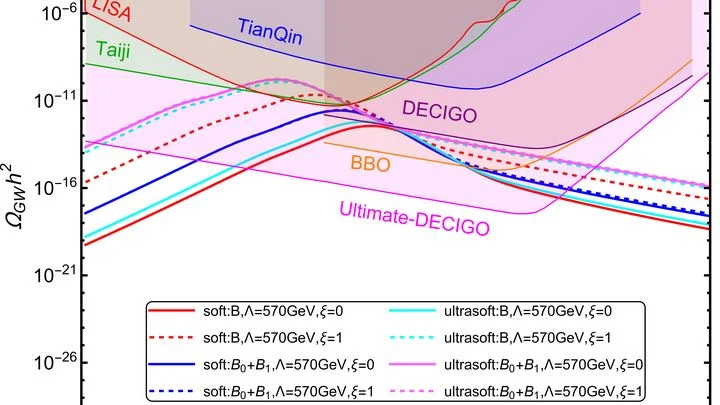
In the infant universe, right after the Big Bang, space was expanding rapidly, and the vacuum resembled a superheated liquid. When 'boiling' began, bubbles of true vacuum emerged. Expanding at the speed of light, they triggered gravitational waves — tremors of space itself that have reached us.
In the quantum world, particles can walk through walls: this is quantum tunneling. If you place a detector right in the path of such a 'ghostly' passage, the moment of detection acts like a starting pistol: the particle gets a sharp kick and flies out of the barrier with excess energy, turning into a tiny engine.
A lone ion in a trap jitters like a swing, and each oscillation introduces an error into quantum calculations. Traditionally, jitter is suppressed by cooling almost to absolute zero: this is bulky and expensive.
Two superconducting qubits on a single chip sound as clean as soloists in an orchestra. Each is a transmon, a qubit with reduced sensitivity to charge noise. They are connected through a tunable coupler, an auxiliary element that adjusts the interaction strength between them.
Two vortex rings launched one after the other pass through each other and swap places. This dance, first seen in the 19th century with smoke rings, has now been reproduced on a quantum processor. Vortices are the actors on a quantum stage where time plays the role of an extra dimension.
A quantum computer is an orchestra where every qubit must come in exactly on cue. But instead of a conductor with a baton, we have an arbitrary waveform generator (AWG) that delivers microwave signals lasting tens of nanoseconds.