Liquid helium is helium in its liquid state, achieved at temperatures below 4.2 K (about -269°C) at standard pressure. It is a critical cryogenic coolant because it is the only substance that remains liquid at absolute zero under normal pressure, and it has extremely high thermal conductivity. In the provided articles, liquid helium is used to cool detectors to ultra-low temperatures, enabling the observation of quantum effects like superconductivity and superfluidity.
History
Liquid helium was first produced by Heike Kamerlingh Onnes in 1908 at the University of Leiden, who later used it to discover superconductivity in 1911.
How it works
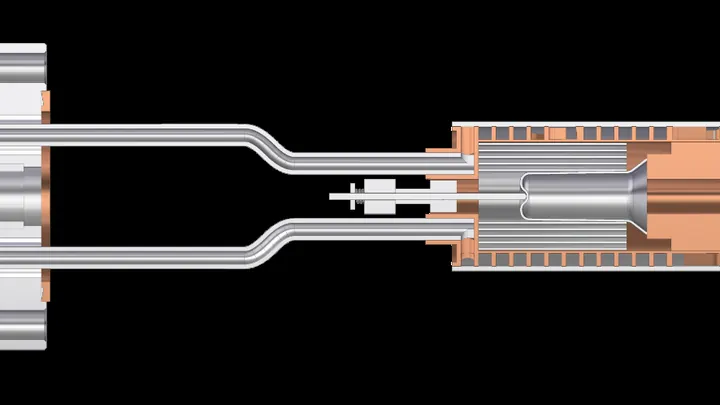
Helium gas is compressed and cooled through a series of heat exchangers and expansion turbines until it liquefies. The resulting liquid helium absorbs heat from the surrounding environment as it evaporates, providing a stable low-temperature bath. In experiments, samples are immersed in liquid helium to reach temperatures where thermal noise is negligible, allowing for precise measurements of quantum phenomena. Specialized cryostats use liquid helium in a closed cycle to maintain temperatures for extended periods.
In practice
Liquid helium is used to cool superconducting magnets in MRI machines, particle accelerators like the LHC, and quantum computers, as well as in infrared detectors and space telescopes.
Fun fact
Liquid helium can flow through microscopic cracks that are completely impermeable to any other liquid, a phenomenon known as superfluidity, which occurs below 2.17 K.
In the dark chamber of the trap, thousands of charged particles dance under electric fields. At first they move freely, like a crowd in a square, but cool the cloud and the dance slows: ions begin to sense each other, their steps become constrained.
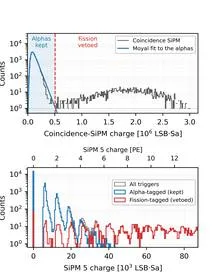
The stage is bathed in icy light, and on it stand silicon spectators. Each is an array of tiny avalanche diodes capable of spotting a single photon, but only if the surrounding temperature drops to 165 K.
Instead of an ice bath, a warm gas blanket. That is how the cryogenic current comparator at Japan's National Metrology Institute is now cooled. Previously, this instrument, which compares electric currents to within billionths of a percent, required immersion in liquid helium.
In the cold cloud TMC-1, where the temperature never rises above ten degrees above absolute zero, molecules rarely encounter one another. But every so often a helium atom whizzes past, and that brief touch is enough to alter the molecule's rotation. Such collisions dictate what radiation we see from Earth.
One universal interpreter for all dialects of sodium. Liquid sodium in a reactor behaves differently: near the pipe wall it is dense and fast, near the boiling surface it is rarefied and slow. Previously, each state required its own set of calculations, as if hiring a new translator for every phrase.
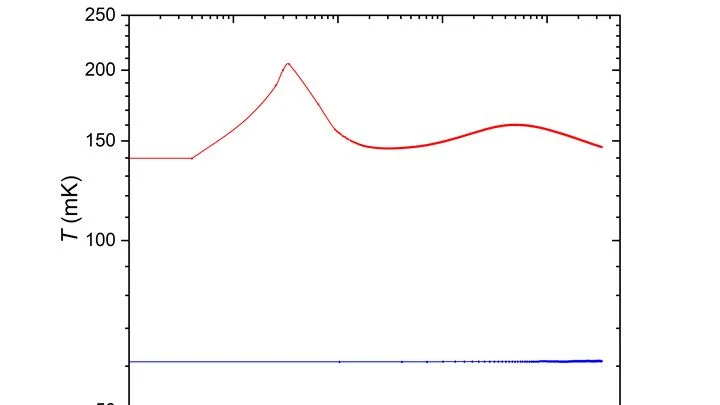
A quantum lab is like a kitchen where the chef waits a day for the stove to cool down. Superconducting qubits only work at temperatures of a few hundredths of a kelvin, and each 'cool, measure, warm up' cycle eats a whole day. A team of engineers built a fridge the size of a melon, weighing 3 kg, that does the job in just two hours.
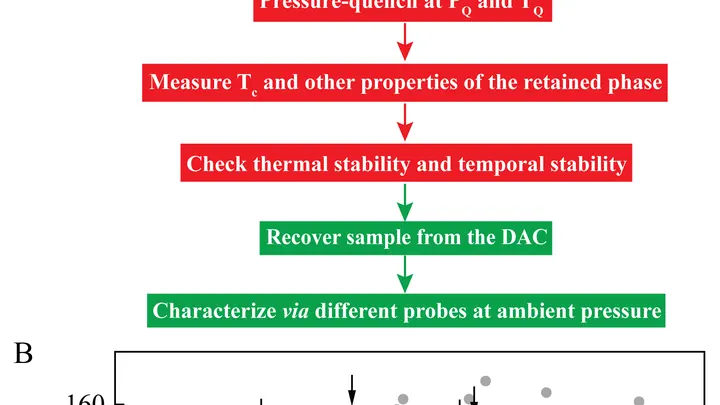
Inside a diamond anvil cell, squeezing a sample with a force millions of times greater than atmospheric pressure, a thin film of lanthanum meets hydrogen. The hydrogen comes from ammonia borane — a powder that, when heated, releases its hydrogen like a sponge releasing water.
A billiard ball hangs in midair. Tiny peas shoot at it from a blowgun. Each hit is barely perceptible, but if the ball is very light and barely trembles from heat, you can make out individual nudges. That's essentially the setup: a glass sphere the size of a bacterium levitates in a vacuum while a narrow beam of xenon atoms flies at it.
An ordinary wire heats up when current flows through it — some energy is wasted. A superconductor lacks this flaw: electricity flows through it without loss, like water through a perfectly smooth pipe. The trouble is that most superconductors require either very low temperatures or colossal pressures, like those found in the depths of planets.
A bridge where pedestrians and cyclists flow together without getting in each other's way. That's roughly how hybrid systems of superconductors and semiconductors work: the former carry current without loss, the latter control that current.
The five-hundred-meter FAST radio telescope picked up a signal at the 21-centimeter wavelength — the telltale glow of cold hydrogen. The signal came from a cloud named Cloud-9. It hangs in space near the galaxy M94, but it contains not a single star.
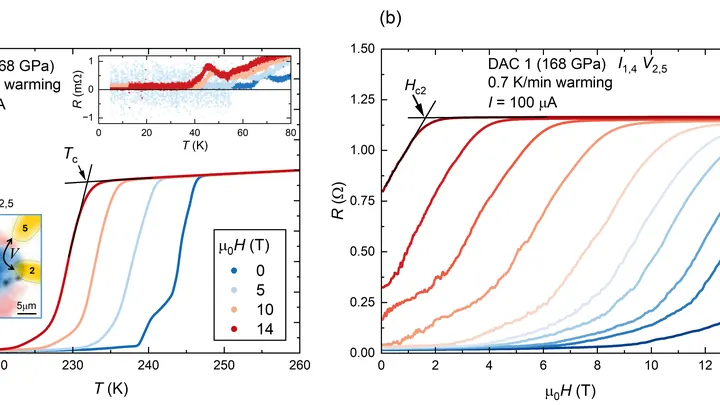
A film sliver thinner than a human hair was placed between diamond anvils and squeezed. The pressure climbed — a hundred thousand atmospheres, half a million, a million… Yet the material kept conducting electricity without resistance.
Many materials behave like finicky ice: at one pressure they melt, at another they turn harder. Superconductors in the cuprate family are no exception. Their ability to carry current without loss depends on how tightly the crystal lattice is squeezed. In a new study, physicists traced this dependence for the compound Bi-2223.
The river splits in two. One branch is wide and fast, with water flowing smoothly, but as temperature rises, the flow slows: eddies and waves appear. The second branch is narrow, with rapids, where water leaps from rock to rock. This flow, on the contrary, becomes more lively with warming.
Empty space is not as empty as it seems. According to quantum theory, the vacuum is filled with particles that constantly pop in and out of existence. In 1976, physicist Bill Unruh showed that if an observer moves with acceleration, this 'quantum soup' turns into a genuinely warm bath for them — the Unruh effect.
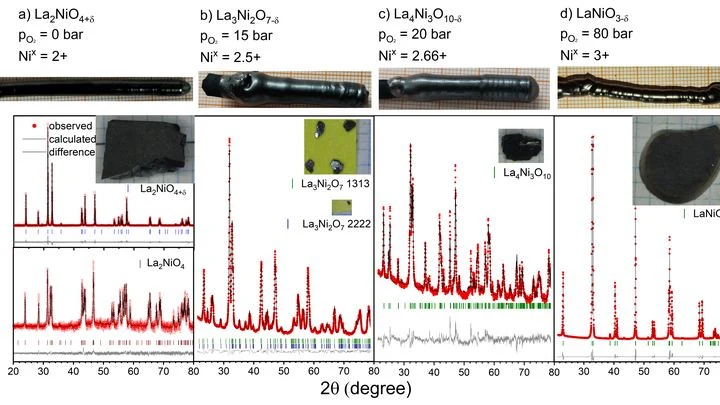
The nickelate family consists of layered crystals, like a stack of pancakes: nickel and oxygen layers alternate with lanthanum spacers. Two years ago, superconductivity was discovered in them — the ability to conduct electricity without resistance when cooled.
The Sun is a giant nuclear reactor that continuously sends us light and heat. But it also has another, almost silent postal service: every second, tens of billions of neutrinos, ghostly particles born in the thermonuclear furnace, fly through a square centimeter of your palm. Most of them leave no trace.
Imagine a sandwich where the bread is made of copper oxide layers and the filling is a thin layer of strontium ions. That's the infinite-layer cuprate, the simplest version of superconducting ceramics, conceived nearly 40 years ago.
A magnet the size of a grain of rice floats in a vacuum without touching the walls. It is held by the magnetic field of a superconducting trap — a ring cooled to a state where current flows without resistance.
A tiny ball weighing a fraction of a milligram, suspended in a magnetic field and cooled to near absolute zero, oscillates for 110 hours without stopping: this is record isolation. The energy loss is so small that the system's entropy barely increases, making any external influence noticeable.
A pot of water on the stove: the hotter the burner, the faster ice turns to water, and water to steam. Heat destroys order. But sometimes nature pulls a trick, and heating makes a liquid freeze, like a puddle turning to ice on a frosty morning.
A giant cauldron of simmering soup stretches across millions of light-years. This is the atmosphere of the Perseus galaxy cluster — a cloud of scorching gas held together by gravity. Until recently, astronomers thought that in the center of this cauldron, the gas was calmly cooling, ready to condense into new stars.
A crystal that promised to conduct electricity without loss at room temperature turned out to be like a house of cards: touch it and it falls apart. Two compounds (one with silver, one with gold) were considered superconductor candidates, but tests showed that neither can withstand even ordinary conditions.
In the silver variant, the lattice simply collapses.
A red-hot piece of metal in a furnace is like a frying pan on the stove: the hotter it gets, the faster heat travels to your hand if you touch it. But at temperatures where the metal is close to melting, measuring that speed is very tricky: sensors don't make good contact, heat escapes into the air, and the glowing sample confuses the instruments.
This new method sidesteps those obstacles.
An ordinary transistor in a phone is made in a vacuum chamber, where atoms are deposited layer by layer. Expensive and slow. But indium oxide can be printed like ink — from a drop of liquid metal that, in air, coats itself with a thin oxide film.
The authors took indium, melted it, and rolled it over a substrate at 250 degrees.
An ordinary aluminum pot on a stove doesn't emit molecules you can catch with light. But if you take aluminum and an aluminum salt, heat them together in a small oven, you get a stream of aluminum fluoride molecules, like steam from a kettle's spout, except instead of water droplets, tiny particles fly out.
Niobium is a metal that, when cooled to a few degrees above absolute zero, conducts electricity without resistance. In labs, it is deposited as thin strips onto a substrate, like frosting on a cake. But during deposition, oxygen from the special mask seeps into the metal, and it spoils the superconducting properties.
A film as thin as a spider's web, made of five metals, took the hit from a laser. Inside, the pressure soared to 55 gigapascals — imagine a hundred elephants balanced on your thumbnail. The alloy withstood it, compressing for a fraction of a nanosecond without breaking.
One gigapascal is a thousand megapascals.
A thin semiconductor layer at low temperatures behaves like a pot of honey: electrons flow not as individual particles but as a thick liquid. If you run an alternating current through such a layer, the resistance responds with a smooth curve.
Hydrogen is a champion in energy per kilogram, but storing it is a hassle. As a gas, it takes up a huge volume, and if you compress it or cool it to a liquid, you need heavy tanks and lots of energy. There's a third way: some solid materials absorb hydrogen like a sponge soaks up water and hold it within. Heat it up, hydrogen comes out; cool it down, it gets absorbed back.
Superconductivity is the ability of a material to conduct electricity without losses. Ordinary wires heat up, and some energy is lost as heat, but a superconductor carries current with zero resistance.
Quantum materials are like finicky flowers: they only bloom in the cold. At room temperature, they hide their unusual properties, but when deeply cooled, they become superconductors or change their magnetic behavior. To understand how they work, you need to examine their atoms in the very cold where these properties reside.
Ordinary soldering doesn't work for quantum circuits: when cooled to liquid helium temperatures, metal cracks, and the contacts themselves introduce noise. Engineers from the research group tried something different — a drop of gallium alloy that stays liquid at room temperature, like mercury in an old thermometer.
At 0.1 K, just three-tenths of a degree above absolute zero, matter stops following the usual rules. Helium becomes superfluid: it flows without friction, seeps through cracks, and behaves like one giant quantum liquid. Seeing what happens inside such cold is a challenge at the edge of possibility.
A tiny cloud of 300,000 ytterbium atoms, cooled to near absolute zero, was shuttled along a light track 34 centimeters long, like transporting a fragile cargo over a bumpy road without shaking it apart.
An ordinary wire heats up when current flows through it. A superconductor doesn't. But almost all known superconductors require either very low temperatures or enormous pressures, like those deep inside planets. Scientists have long searched for a material that avoids these extremes.
An X-ray beam strikes a piece of superconductor, and the material warms up ever so slightly. That heating, by billionths of a degree, is the only trace the light leaves behind. The new detector catches exactly that, like a sensitive thermometer pressed against cold metal.
A cage of sixty carbon atoms, shaped like a soccer ball, lets small molecules slip inside. Carbon buckyballs, fullerenes, pack into a crystal like oranges in a crate, leaving gaps between them. At 570 degrees Celsius and 30 atmospheres of pressure, hydrogen seeped into those gaps.
A thin film of silicon nitride is stretched over a frame like the skin of a drum. The slightest nudge from gas molecules makes it tremble. A laser beam delivered through a glass fiber picks up that trembling and turns it into a pressure reading. The whole setup fits in a pocket, not on an optical table.
A quantum computer is a machine where qubits replace ordinary bits. A qubit can be not just a 0 or a 1, but both at the same time. One way to make a qubit is to take an electron and make it hover above the surface of liquid helium. The helium is cooled to below two degrees above absolute zero.