A Shadow Instead of a Full Portrait express
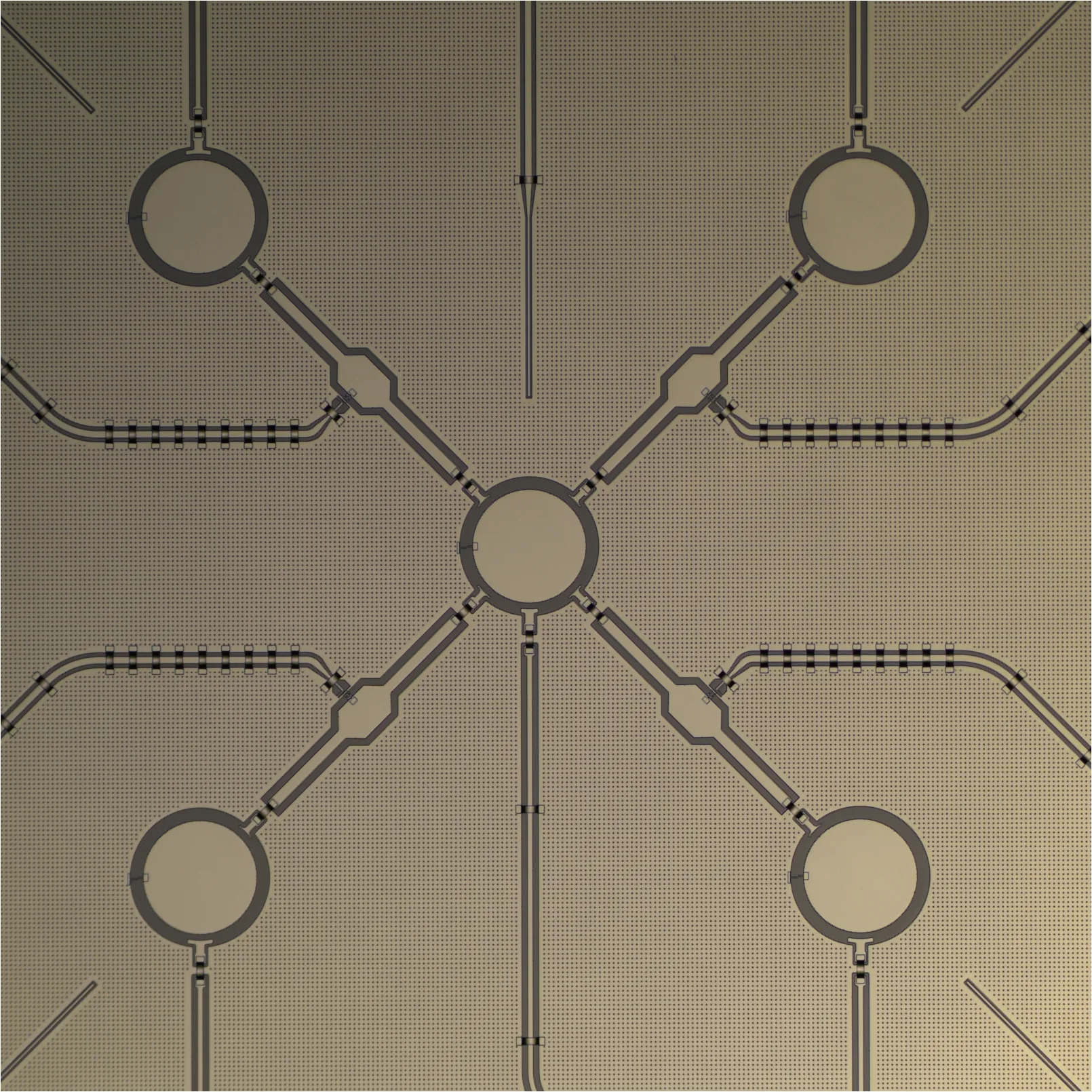
A quantum processor is like an orchestra where each musician (qubit) must play their part precisely in time. But in reality, the instruments go out of tune: qubits lose energy, and their interactions get distorted. To tune this orchestra, you first need to record how it sounds right now: that is, measure the noise parameters and couplings. The usual way is to do full 'tomography': enumerate all possible states and record the results. But with each new qubit, the number of such states doubles, and for five qubits that already means 58 hours of continuous measurements.
The authors used shadow tomography. Instead of a full enumeration, they make random measurements, as if the conductor listened not to each musician individually, but to random snippets of the whole score, and then reconstructed the overall picture from those fragments. It turned out that for a processor made of superconducting qubits, such random 'shadows' give the same information about noise and couplings as a full enumeration, but require far fewer measurements. In the experiment on five qubits, the time dropped from 58 hours to 9.
The practical benefit is obvious: the faster we learn how a quantum computer is 'out of tune,' the faster we can calibrate it and make it compute without errors. For growing processors with dozens or hundreds of qubits, this is not just convenience but a necessity. The shadow method no longer looks exotic: it works on real hardware and gives precise numbers.
Original abstract
as written by the authors arXiv:2602.14694
Spurious couplings and decoherence degrade the performance of solid-state quantum processors, demanding careful design, calibration, and mitigation protocols. These strategies often rely on characterization of the idling processor, but tomographic recovery of (time-independent) Lindblad dynamics scales exponentially with qubit count. Here, we experimentally benchmark and demonstrate that randomized ("shadow") measurements accelerate Lindblad tomography on a superconducting transmon processor. We first implement extensible Lindblad tomography, which estimates Lindblad parameters using a complete tomographic dataset, and use it as a baseline to benchmark a shadow tomography approach, shadow Lindblad tomography. The shadow approach recycles randomized configurations to estimate the same Lindblad parameters using far fewer resources under physically motivated locality assumptions. We experimentally verify these assumptions in our processor by implementing the protocols on one- and three-qubit subsystems; here, shadow Lindblad tomography reproduces extensible Lindblad tomography within uncertainties while using exponentially fewer configurations. Leveraging this efficiency, we apply shadow Lindblad tomography to the full five-qubit processor and recover all single qubit dissipation and two-qubit coupling parameters in 9 hours of acquisition time compared to an estimated 58 hours for extensible Lindblad tomography. Additionally, our shadow implementation is compatible with conventional Gaussian error propagation, avoiding the use of median-of-means estimators. Together, these results demonstrate how randomized shadow tomography protocols can be practically implemented to learn quantum processor dynamics at an increasing qubit count.
Random measurements in quantum mechanics resemble public opinion polling: instead of asking every citizen, you survey a random sample and infer about the whole population.