Quantum computing robustness refers to the set of techniques that protect quantum information from errors caused by decoherence, noise, and imperfect operations. Unlike classical bits, quantum bits (qubits) are extremely fragile — any interaction with the environment can destroy their superposition state. Robustness is the field's central challenge, as without it, quantum computers cannot perform calculations longer than a few microseconds. The goal is to make quantum computations reliable enough to outperform classical computers on real problems.
History
The theoretical foundations were laid by Peter Shor and Andrew Steane in 1995, who independently discovered quantum error correction codes. The first experimental demonstrations came in the early 2000s, but practical fault-tolerant quantum computing remains an active research frontier.
How it works
The primary approach is quantum error correction, which encodes a single logical qubit into many physical qubits so that errors can be detected and corrected without measuring the quantum state directly. Other techniques include error mitigation, where noisy results are post-processed to extract accurate answers, and dynamical decoupling, which uses carefully timed pulses to cancel out environmental noise. Recent advances also include 'quantum refrigeration' — actively cooling qubits during operation — and the use of topological qubits that are inherently protected from certain types of errors.
In practice
Robust quantum computing is essential for running Shor's algorithm for factoring large numbers (breaking RSA encryption), simulating quantum materials for drug discovery, and optimizing complex logistics problems.
Fun fact
A single qubit in a superposition state can be disturbed by a single stray photon, but quantum error correction can protect it using as few as 5 physical qubits — though practical systems use hundreds.
Wireless communication for robots is like a conversation in a noisy workshop, where every word can get lost in the din or arrive too late. In this mess, entropy of the channel, robots fail to yield in time, and coordination breaks down.
You're standing in the shower: you turn the tap, and the water is either freezing or scalding. The pipes have a mind of their own — the pressure jumps unpredictably. The new controller learns on the go: it doesn't know the plumbing layout, but within minutes it adapts and gently guides the temperature to comfort, without breaching safety limits.
Qubits in a superconducting quantum computer are like tightly stretched strings. When a particle from space or from a radioactive decay flies by, it strikes these strings and they start to vibrate. This vibration disrupts the fragile quantum states, and computations go awry.
A quantum computer is a finicky instrument. Each measurement of its state is like photographing a fast-moving object: the shorter the exposure, the higher the chance of getting a blurry shot. But if you skillfully process a series of such snapshots, you can reconstruct a clear picture.
That's exactly what the researchers did.
A quantum processor is like an orchestra where each musician (qubit) must play their part precisely in time. But in reality, the instruments go out of tune: qubits lose energy, and their interactions get distorted. To tune this orchestra, you first need to record how it sounds right now: that is, measure the noise parameters and couplings.
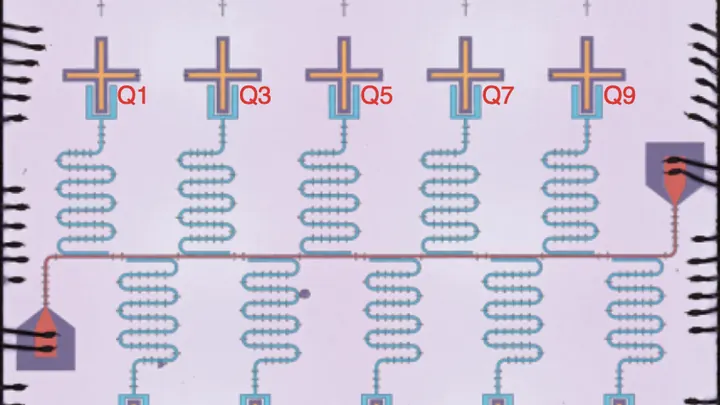
A quantum computer is like an orchestra where every musician must play with precision down to a billionth of a second. If one instrument goes out of tune, the whole symphony collapses. So scientists spent a year watching 27 qubits — the simplest cells of quantum memory.
A quantum computer is like a pot of boiling water: particles are jostling around chaotically, and you need to calm them down to get a useful answer. In a new study, physicists have devised a way to cool a chain of 19 quantum spins (tiny magnets) right on a real device.
Quantum computers require magical states — special helper particles for error-free operation. Previously, they were obtained through repeated purification, akin to endless distillation of alcohol: each step added энтропию (disorder), like weeds in a garden, and consumed resources.
Tuning a string: higher harmonics help hold the pitch without drowning out the fundamental note. In an optical microcavity, a tiny resonator made of two mirrors, light bounces between the reflective surfaces, and any jitter in the spacing knocks it off resonance.