Fluorine ions in gas: measuring the invisible express
In a dark matter detector, the gas acts like photographic film: a passing particle leaves a track of free electrons and ions. But how bright that track is depends on exactly how the particle loses energy in the gas. For light ions like fluorine, the data have been imprecise.
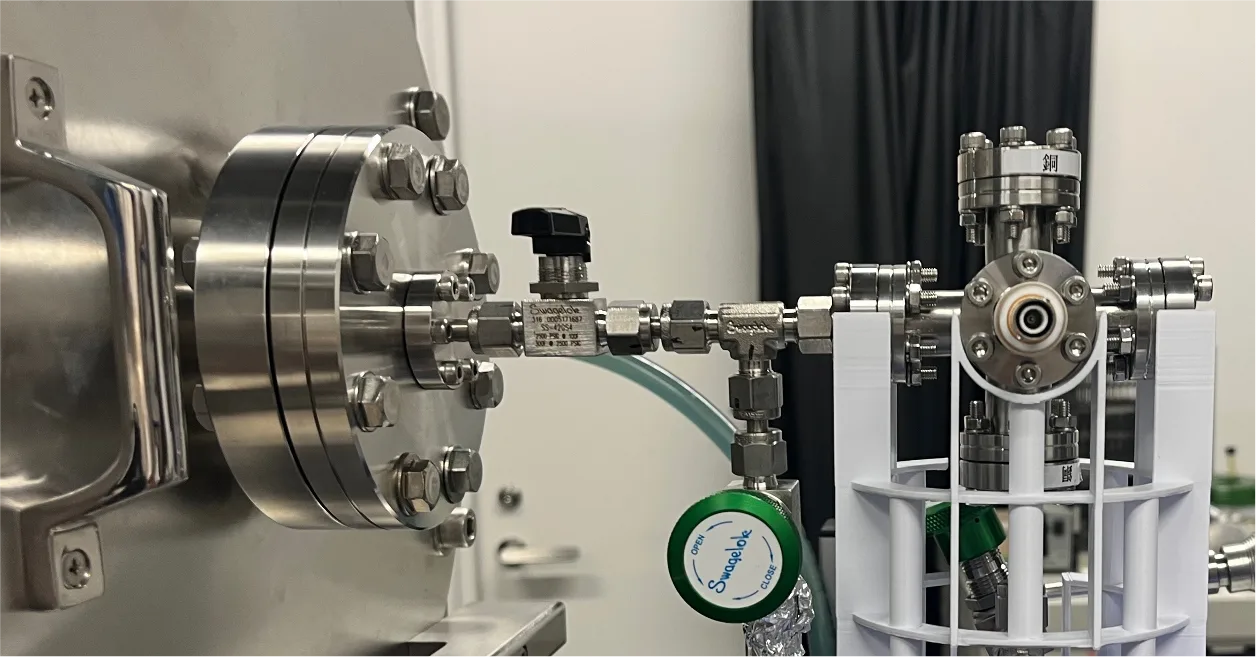
The Kanagawa group built a special chamber with wires, filled with CF4 gas at just 0.06 atmospheres. They sent a beam of fluorine ions with energies from 5 to 50 kiloelectronvolts into it. Each ion knocked out electrons as it traveled through the gas, and the chamber counted how much charge collected on the wires.
They found that at 30 keV, a single fluorine ion creates on average 0.45 ion-electron pairs per kiloelectronvolt of energy deposited. This number barely changes with energy, but drops at the lowest values — the ions start colliding more often with gas nuclei, wasting energy without ionizing.
Now detector developers have a reliable reference point: knowing the ionization yield, they can convert a signal into the particle's energy. It's like calibrating a scale before weighing — without calibration, any reading would be guesswork.
Original abstract
as written by the authors arXiv:2602.17126
Direction-sensitive direct dark matter search experiments have been conducted using gaseous detectors. In spite of the long history of the study on the energy deposition of charged particles in materials, a full agreement between the measured results and theoretical predictions, especially in a low energy scale, are yet to be achieved. It is thus important to measure the ionization yields of recoil nuclei for the experiments with gaseous detectors using an ionization charge readout scheme. This study measured the ionization yield using a low-energy ion beam facility at Kanagawa University. The ionization yields for fluorine ions with an energy range of 5 $$\sim$$ 50 keV were measured using a dedicated proportional wire chamber filled with $$\mathrm{CF}_{4}$$ gas at 0.06 atm. The low-energy ion injection scheme into a gaseous detector was established and the ionization yield for fluorine ions was obtained to be 0.45 at 30 keV with a moderate dependence on the ion energy.
CF4 gas (tetrafluoromethane) is used in detectors because fluorine is one of the best 'mirrors' for collisions with hypothetical dark matter particles.