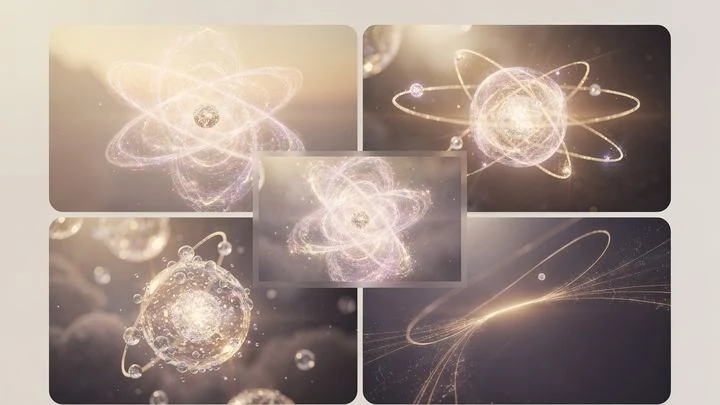
A nuclear collision occurs when a particle — such as a proton, neutron, or electron — strikes an atomic nucleus. In many contexts, especially in particle physics and astrophysics, these collisions can cause energy loss without ionization, meaning the projectile loses energy through interactions with the nucleus as a whole, rather than by knocking out electrons. This process is fundamental to understanding how particles behave in matter, from cosmic rays hitting the atmosphere to particle beams in accelerators.
History
The study of nuclear collisions dates back to Ernest Rutherford's experiments in 1911, which revealed the existence of the nucleus. Later, the development of particle accelerators in the mid-20th century allowed for controlled studies of these interactions, leading to the discovery of many nuclear properties.
How it works
When a particle approaches a nucleus, it can interact via the strong nuclear force (if it's a hadron) or the electromagnetic force (if it's charged). In non-ionizing collisions, the particle may excite the nucleus, causing it to emit gamma rays or other particles, or it may simply scatter elastically, transferring momentum but not breaking the nucleus apart. The energy loss depends on the particle's energy, the nuclear size, and the impact parameter.
In practice
Nuclear collision physics is used in medical radiation therapy, where protons or heavy ions are directed at tumors, and in the design of radiation shielding for spacecraft and nuclear reactors.
Fun fact
In high-energy nuclear collisions, such as those at the Large Hadron Collider, the energy density can be so high that protons and neutrons melt into a quark-gluon plasma, the state of matter that existed just after the Big Bang.
After a nuclear explosion, soot rises into the sky. It settles high above the clouds, in the stratosphere, and stays there for years. This soot acts like a thick curtain: it blocks some sunlight and alters the chemistry of the sky.
Two nuclei with the same number of particles but different neutron skin shapes collide at speeds close to the speed of light. Ruthenium-96 and zirconium-96 are like twins, one with a slightly thicker coat. This difference changes how particles carry charge in the fireball of the collision.
When a heavy atomic nucleus splits into two fragments, an invisible quantum thread remains between them. This thread is entanglement: the state of one fragment is instantly linked to the state of the other, as if they were still a single whole. For the first time, physicists have precisely calculated how long and strong such a thread can be, tracing the fission process step by step.
In the distant Cigar Galaxy, there is an unusual beacon. It doesn't shine in the usual sense: its rays are born in a scorching cloud around a black hole that is devouring matter from a companion star. Such objects are called ultraluminous X-ray sources. Their X-ray brilliance is so intense that it outshines entire galaxies.
This cloud, the corona, is like a boiling cauldron.
A billiard ball clicks against another in complete darkness. The sound of the impact and the clatter of balls dropping into pockets: that's all you hear. This is roughly how physicists study the interactions of elementary particles at energies that no terrestrial accelerator can reproduce.
Two pendulums on a shared string trade motion: push one, and the second starts swinging, and a moment later the first gets a push back. In a thorium-229 atom, energy flows nearly loss-free between the electron shell and the nucleus.
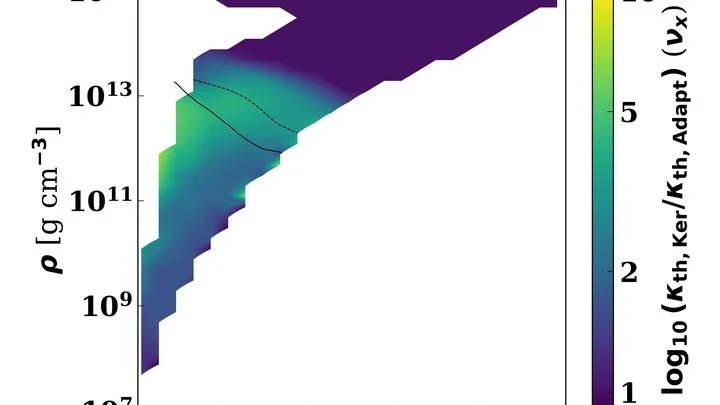
The collision of two neutron stars is a cosmic laboratory where matter is compressed to unimaginable densities. In the first moments after the merger, a hot cloud forms and cools by emitting neutrinos. These ghostly particles carry away energy and dictate how much matter is ejected into space and which heavy elements are synthesized.
An electron flying through a heavy nucleus behaves like a tennis ball sent through a picket fence. If the pickets are unevenly spaced (denser here, sparser there) the ball will deflect differently.
Two guitar strings are stretched on the same neck. They are almost identical, but one is slightly shorter — and they sound different. That's roughly how the two isomers of ethanimine work: molecules with the same set of atoms but rotated differently in space. Astronomers spotted this molecule in the dense clouds near the center of our Galaxy.
In April 2021, in a galaxy 35 megaparsecs away, supernova SN 2021foa erupted. It immediately puzzled astronomers: its spectrum feverishly switched between hydrogen and helium lines — as if the star, in agony, was frantically shedding its outer layers.
Atomic nuclei are not always like billiard balls. Some are elongated, like cigars, others are flattened. But xenon-129 resembles a potato — a bumpy triaxial ellipsoid.
Inside a neutron star, matter is compressed so intensely that atomic nuclei fuse into long strands and flat sheets. Astrophysicists call these structures nuclear pasta. At their surface, the density of matter plummets to nearly zero, like diving out of thick jelly into thin air.
It's this sharp transition that creates the unusual effect.
If you stick two identical thermometers into a pot of hot water, they'll both read the same, and we relax, thinking the temperature is measured correctly. But in a rarefied gas heated to millions of degrees, this trick stops working.
A stone falls into a pond — ripples spread across the water. If the stone doesn't fall but whizzes over the surface at tremendous speed, a straight wave runs along the water. When it hits a floating log, ripples spread out from the point of impact. That's roughly how gravity works in the new study.
A pot of boiling soup bubbles away, and you'd love to know how hot individual droplets are inside. But you can only dip your thermometer at the edge, where things are calmer. Laser fusion is a bit like that: a powerful laser pulse hits a target, creating a cloud of fast protons.
Fusion, the merging of a proton with a boron-11 nucleus, promises a near-perfect energy source: no dangerous neutron flux, just a stream of charged particles that can be directly converted into electric current. But there's a fundamental problem: the Coulomb barrier.
Neutrinos are almost elusive particles: they zip through planets without noticing atoms. So every catch is a stroke of luck. Recently, the underwater detector KM3NeT snagged a neutrino with energy millions of times greater than Earth's most powerful accelerators can produce.
A neural network trained on collisions of protons and electrons transferred its skills to a completely different experiment — catching neutrinos. Like a chef who learned French cuisine and then, without preparation, baked an excellent Uzbek plov.
When particles collide at enormous speeds, they produce a shower of new particles. Among them are antiprotons — twins of ordinary protons but with the opposite charge. Each of these particles has its own spin, like a tennis ball sent with a twist. But whether antiprotons are actually spun up at birth has never been checked.
Near black holes and neutron stars, plasma churns like water in a boiling kettle. But this 'kettle' has no walls — only magnetic fields that twist and tear. At the tears, thin sheets form where magnetic field lines reconnect, giving particles a kick like a surfer catching a wave.
Light reflecting off the scorching disk around a black hole can reveal more about it than we ever thought. When the disk emits heat, some of that light bounces back onto the disk and scatters, acquiring an unusual energy distribution, as if a new component, resembling a power law, is added to the ordinary glow.
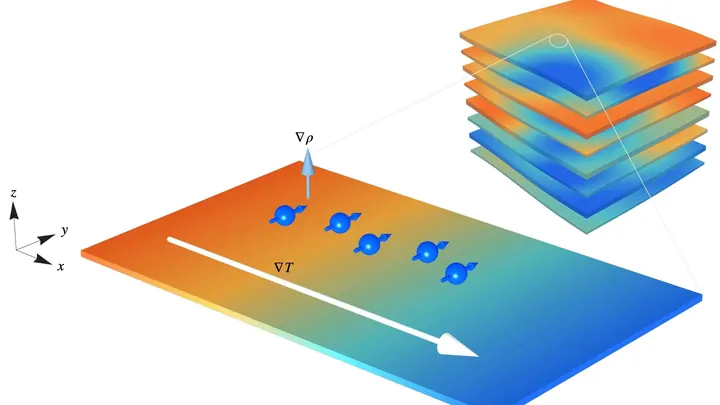
When heavy nuclei collide in accelerators, a multitude of particles is produced, and physicists want to understand how electric charge moves through this chaos. Two trains crash into each other: the passengers (quarks) scatter, but their luggage (charge) may end up far from the crash site.
A dark matter detector is like a super-sensitive microphone listening for silence. It picks up tiny heat jolts, phonons, that occur when a particle grazes a crystal. But instead of silence, the instruments have been hearing noise for years: a slew of weak signals below a few hundred electronvolts.
In quantum communication, a secret key is transmitted using single photons. Eavesdropping on such a channel is supposedly impossible: any interception attempt disturbs the particle and leaves a trace. But the idea has a weak spot — the real hardware, which sometimes behaves differently than theory dictates.
The Large Hadron Collider doesn't just smash protons: it also collides entire atomic nuclei. When two nuclei smash together at tremendous speed, they create a tiny blob of matter so hot that protons and neutrons melt into a 'soup' of quarks and gluons.
Igniting a miniature sun is a long-held dream of humanity. Typically, scientists try to confine scorching plasma (a gas of charged particles) at temperatures of hundreds of millions of degrees. But plasma tends to escape magnetic traps, and confinement comes at enormous cost.
The universe exists in a state of false vacuum, like water behind a dam. Behind it lies the true vacuum — an abyss with different laws. Normally, water can only seep through the pores in a thin trickle (a quantum effect), barely changing the level.
Cosmic rays are elementary particles carrying colossal energy that pierce the intergalactic void. When two such particles smash head-on, the energy density at the point of impact could be enough to collapse into a black hole the size of an atomic nucleus.
A cloud of 41K87Rb molecules held in an optical trap expands like fog at dawn. Each molecule is a weakly bound pair of potassium and rubidium atoms, teetering on the brink of dissociation. Cooling such a cloud to near absolute zero without shattering the molecules has long been a challenge.