A radiation detector is a device that identifies and measures ionizing radiation — particles or photons carrying enough energy to knock electrons out of atoms. This includes alpha and beta particles, gamma rays, X-rays, and neutrons. The core challenge is that ionizing radiation is invisible and often carries tiny amounts of energy, so detectors must be exquisitely sensitive to single events while distinguishing between different types and energies of radiation.
History
Early detectors included Geiger counters (developed in 1908 by Hans Geiger and later improved with Walther Müller) and cloud chambers. Semiconductor detectors emerged in the 1960s with the advent of high-purity silicon and germanium crystals.
How it works
Most modern detectors rely on a semiconducting material, such as silicon or germanium. When ionizing radiation strikes the semiconductor, it liberates electron-hole pairs — the number of pairs is proportional to the energy deposited. An applied electric field sweeps these charges to electrodes, producing a tiny current pulse that electronics amplify and count. Scintillator-based detectors instead convert radiation into visible light, which a photodetector then captures. Timing electronics can also record when each particle arrives, enabling measurements of arrival times with picosecond precision.
In practice
Radiation detectors are used in medical imaging (PET scanners, X-ray detectors), nuclear power plant monitoring, particle physics experiments, environmental radiation surveys, and security screening at borders.
Fun fact
Some dark matter detectors are essentially ultra-pure semiconductor crystals cooled to near absolute zero, waiting for a rare collision with a weakly interacting massive particle.
When an alpha particle tears through a gas, it leaves behind not a continuous track but a chain of individual ionizations: tiny flashes where electrons are knocked off atoms. In a living cell, such flashes damage DNA, and the denser they are packed into a clump, the more severe the damage.
In the layered crystal CrSBr, the magnetic moments of atoms are arranged like notes in a score: within each layer they point in the same direction, but between layers they point in opposite directions. This antiferromagnetic melody plays up to 132 kelvin, beyond which thermal motion destroys the order.
At the end of a massive star's life, its core collapses in a fraction of a second, giving birth to a supernova flash. This cataclysm shakes spacetime itself, emitting gravitational waves — ripples that race across the Universe.
At nine in the morning, the DarkSide-50 detector, 1400 meters beneath Gran Sasso, records a weak ionization pulse. By eleven at night, the frequency of such events drops noticeably. This is not an electronics glitch or a seasonal background variation.
Two sensitive microphones are listening to the Universe. One hears a low hum, the other hears almost nothing. It's not a malfunction: it's about how they are oriented.
Gravitational-wave observatories like LIGO don't just catch loud bursts from black hole mergers.
Dark matter detectors are essentially incredibly sensitive microphones, capable of hearing a whisper amid the roar of a rock concert. Their job is to catch the rare nudges from hypothetical dark matter particles, which are thought to occasionally collide with atomic nuclei of ordinary matter.
The ionosphere at an altitude of 70 kilometers acts like a giant mirror for radio waves. Ground antennas constantly beam signals into it and listen for the reflection. When a solar flare occurs on the Sun, a stream of X-rays reaches Earth in 8 minutes and compresses the lower layer of the ionosphere.
In 1987, astronomers saw a supernova flare up in a neighboring galaxy — the Large Magellanic Cloud. It was a rare gift: the explosion was close enough to catch not just light but also neutrinos, those nearly undetectable particles that pass straight through Earth.
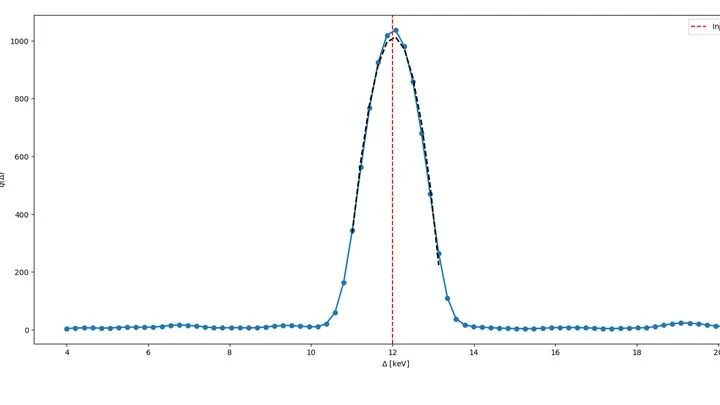
An alpha particle is a helium nucleus that flies out when heavy atoms decay. When it hits a gallium nitride crystal, it deposits its energy and creates an electrical pulse. The pulse height tells you how much energy the particle had.
Conventional dark matter detectors are like a soccer goalkeeper waiting for a powerful shot while the ball barely rolls. The invisible particles filling our galaxy often move too slowly to be noticed by sensitive sensors.
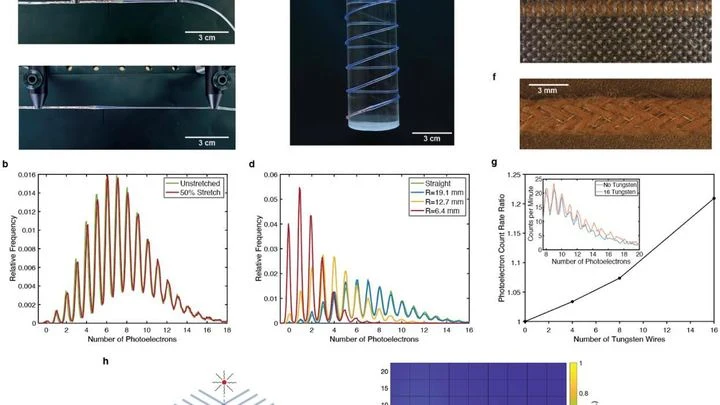
Inside an ultra-thin polymer thread are microscopic crystals — scintillators. When an invisible radioactive particle hits, they flash for a moment, like fireflies. A sensitive sensor catches each flash, turning the thread into a flexible detector.
An ordinary antenna picks up radio waves, but there are fields it barely feels. We're talking about slow electric fields: those that change once a second or less. For them, physicists built a sensor from a beam of rubidium atoms.
Plain water in a glass is clear and calm. But if you add tiny carbon dots made from sugar and citric acid in an ordinary microwave, the water starts to glow when a charged particle flies through it.
A gamma-ray spectrum looks like a picket fence: each line is the precise energy a nucleus released as a photon. But sometimes ghosts appear in that fence — faint lines shifted by the same amount from the main ones. Such a shift could mean that part of the energy went into creating a light particle we cannot yet see directly.
A tiny glass sphere floats in a laser beam like a speck of dust in sunlight. Inside it is radioactive lead, which decays from time to time. Each decay ejects charged particles, and the sphere loses or gains a tiny electric charge.
A quantum computer is like an orchestra, where each qubit is a musician playing their part. But every now and then, a cosmic ray bursts into the hall, and the violinist flinches, losing the rhythm. These particles from deep space pierce the chip, knock out extra electrons, and spoil the delicate quantum music.
A radiation sensor in the city is like a street musician: it has to hit the right notes even when fingers go numb from cold or the instrument is baked by the sun. Usually, such devices are kept in greenhouse conditions, with heating or cooling, otherwise the energy scale (which distinguishes harmless potassium in concrete from dangerous cesium) starts to lie.
When treating epilepsy, doctors adjust the drug dose almost blindly. Too little, and seizures continue; too much, and side effects appear. Usually, a patient's blood is sent to a lab, and the result comes back a day or two later. Now, the same test can be done on a tiny silicon chip.
The sensor works like a highly sensitive nose.
In underground laboratories where dark matter or neutrinoless double beta decay is sought, detectors are surrounded by silence. But even in this silence, radioactive dust quietly settles on their walls. One source is radon, an invisible gas that seeps from rocks. Its short-lived progeny stick to surfaces and spoil measurements.
A dark matter detector is like a room where you're trying to hear a whisper while static electricity crackles nearby. This crackle is produced by radon atoms — a radioactive gas that seeps out from materials and air.
In a dark matter detector, the gas acts like photographic film: a passing particle leaves a track of free electrons and ions. But how bright that track is depends on exactly how the particle loses energy in the gas. For light ions like fluorine, the data have been imprecise.
Cosmic particles with energies millions of times greater than anything our accelerators can produce slam into the atmosphere and create a shower of secondary particles. This shower emits radio waves that antennas on the ground pick up. But the signal is weak: it's swamped by the radio noise of our galaxy and the receivers' own noise.
Terahertz radiation sits between microwaves and infrared light. It passes through clothing, paper, and plastic, but not through metal or water. That's why it's used in security scanners and medical imaging. To see the polarization of such radiation, you need a detector.
A firefighter with a thermal imager can see the source of a fire through smoke. But how do you see a radiation source that has no smell, no glow, and no heat? Gamma cameras solve this problem: they capture gamma rays emitted by radioactive materials and overlay their 'trace' onto a regular photograph. The result is an image showing that the source is, say, behind the far door.
A conventional thermal camera is like a thermometer that slowly heats up and cools down. It shows where heat is well, but it can't keep up with fast motion. The new sensor works differently: it counts individual quanta of heat, like a droplet counter during rain.
In a tank of pure water, particles traveling faster than light in that medium leave bluish flashes, like a plane breaking the sound barrier creates a sonic boom. From these flashes, you can tell what kind of visitor passed through: a gamma quantum or a neutron. This is no idle task: at borders and warehouses, you need to quickly distinguish a harmless radioactive cargo from weapon-usable material.
Treating cancer with a proton beam is a bit like archery: you need to hit the bull's-eye without hitting anything else. Protons release their energy at the end of their path, so healthy tissues are largely spared. But to make the shot safe, every treatment plan is checked in advance — measuring the dose the tumor will get and what the surrounding organs will receive.
Light, regardless of its source, consists of photons — elementary particles, quanta of the electromagnetic field. The simplest light detector, such as a photometric illuminance meter, operates in a binary mode: it merely registers whether photons hit it or not, giving a 'yes/no' answer.
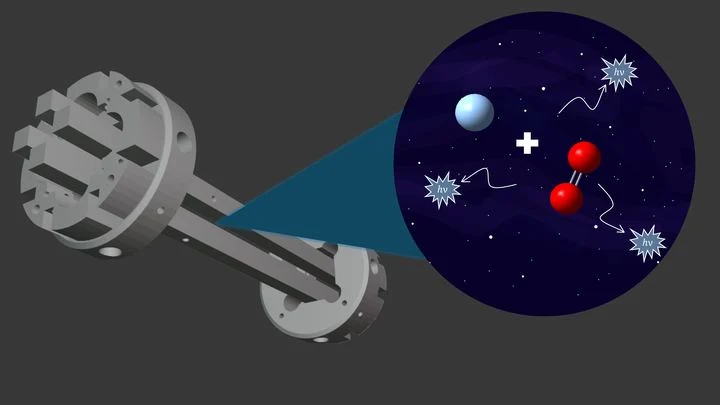
In the cold, sparse clouds of space, particles rarely meet, but sometimes an ion and a neutral molecule pass close enough to stick together. As they do, they emit light, like a muted flash carrying away excess energy. This process is called radiative association, and it is responsible for the formation of many molecules in interstellar space.
Neutrinos are ghost particles: predicted by the Standard Model, they barely interact with matter. Catching them is like trying to hear a whisper in the roar of a waterfall.
In a dark room, you might notice a faint blue glow around some radiation sources. This is Cherenkov light: it appears when a charged particle travels through a medium faster than light can propagate in it. The result is a light shock wave, similar to the sonic boom from a supersonic jet, but made of photons.
Heavy water (the kind where ordinary hydrogen is replaced by its beefier cousin, deuterium) was subjected to an electric current. Palladium settled on the cathode, and in this modest electrochemical bath, detectors repeatedly caught something unexpected: traces of slow neutrons.
Detecting a single quantum emitter is like tuning a piano on a factory floor full of screaming machines: the pure tone drowns in noise. But the tuner doesn’t try to outshout the racket — he picks up a tuning fork and listens for beatings. That’s how even a barely audible echo becomes clear.
Every second, dozens of particles from space fly through each of us. Most are light protons, but there are also heavier atomic nuclei: carbon, oxygen, iron. They are born in stellar explosions and travel to Earth for millions of years. Their energy can be staggering: a single particle can carry as much as a tennis ball on a serve.