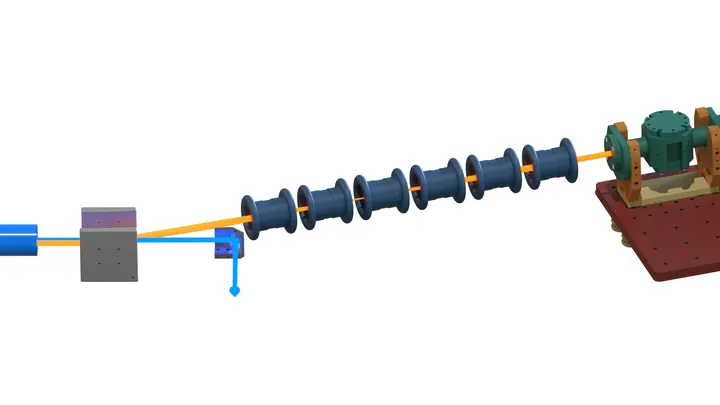
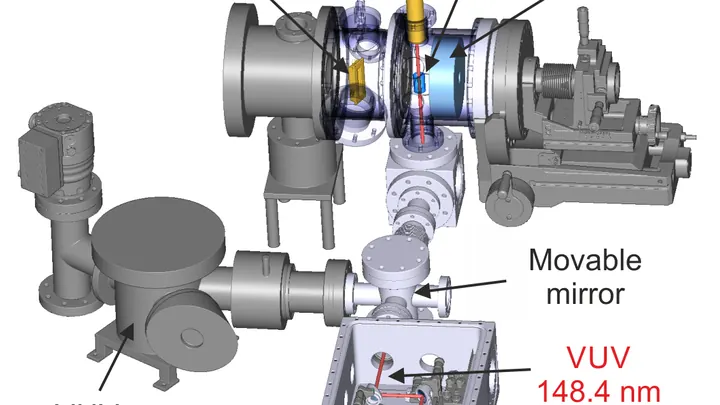
Thorium-229 is a radioactive isotope with a unique nuclear isomer — a metastable excited state lying only about 8.4 electronvolts above the ground state, the lowest known nuclear excitation. This energy gap is in the ultraviolet range, accessible by lasers, unlike typical nuclear transitions that require gamma rays. This makes thorium-229 the prime candidate for building a nuclear clock, a timekeeping device that ticks at the frequency of a nuclear transition, which is far more stable against environmental perturbations than atomic transitions. Such a clock could probe variations in fundamental constants, detect dark matter, and test relativity with unprecedented precision.
History
The low-energy isomer was predicted in 1976 by V.I. Zhudov and colleagues, and first observed in 1994 by a group at the University of Texas. The first direct laser excitation of the isomer was achieved in 2023 by a team at CERN, marking a milestone in nuclear clock development.
How it works
The nucleus of thorium-229 has two energy levels very close together. By exciting the nucleus with a precisely tuned ultraviolet laser, it jumps to the isomer state and then decays, emitting a photon. The frequency of this transition is extremely sharp and insensitive to magnetic fields, electric fields, and temperature, because the nucleus is well shielded by electrons. To build a clock, one traps thorium ions or embeds them in a crystal, then locks a laser to the nuclear transition frequency, counting its oscillations as 'ticks'.
In practice
Thorium-229 nuclear clocks could outperform atomic clocks in precision, enabling tests of fundamental physics, geodesy (measuring Earth's gravitational field), and potentially navigation. They are also used in research on nuclear structure and as a platform for quantum optics with nuclei.
Fun fact
The energy difference in thorium-229 is so small that it can be bridged by a single ultraviolet photon, which is why it is the only nucleus that can be manipulated with tabletop lasers rather than particle accelerators.
The helium atom is like a tightly stretched string: every note it plays is strictly predicted by theory. But in recent years, precise measurements of one such "note"—the energy needed to strip an electron from an excited helium atom — have started to sound slightly higher than they should.
The atomic nucleus is not a bag of marbles but an ordered structure where protons and neutrons fill shells, much like electrons in an atom. When a shell is filled, the nucleus becomes especially stable, and the number of particles is called magic. For calcium with 20 protons, the classic magic neutron numbers are 20 and 28.
The pendulum in these clocks doesn't swing from a spring or a weight, but from a tiny kick inside the atomic nucleus. Ordinary atomic clocks keep time by the oscillations of electrons, but here the pendulum is the nucleus itself — a dense ball of protons and neutrons.
Two pendulums on a shared string trade motion: push one, and the second starts swinging, and a moment later the first gets a push back. In a thorium-229 atom, energy flows nearly loss-free between the electron shell and the nucleus.
Some 158 light-years away, around the dim star TOI-6894, a red dwarf, a planet moves leisurely. Its year lasts less than two Earth days, yet it is a cool world with an equilibrium temperature around 420 K, just a bit warmer than a sauna.
The world's most accurate pendulum isn't a steel rod: it's a tiny atomic nucleus. The isotope thorium-229 has a special excited state: to nudge the nucleus into it, you need surprisingly little energy — about what an ultraviolet laser delivers.
A pendulum that almost nothing can knock off balance (not shaking, not heat, not magnetic fields) because it is hidden in the very heart of the atom. That is the kind of pendulum physicists used when they first switched on a nuclear clock. Previously, the best clocks, optical ones, relied on electron transitions.
The most precise modern clocks count time by the oscillations of electrons in atoms. But their rhythm can be thrown off, like a mechanical watch's spring gets jolted by shaking. Physicists found a more reliable pendulum: the atomic nucleus.
Deep inside the atomic nucleus of thorium-229, there's a stiff lever. To flip it from one position to another, you need to apply force, and that usually takes time. This isotope has two very close energy levels, and the transition between them can be triggered by a laser pulse.
A pendulum swings with such precision that, had it been counting seconds since the Big Bang, it would have drifted by only half a second by today. That is the stability of the new portable ultraviolet laser — the heart of aluminum atomic clocks.
Light from a distant star seeps through a planet's gaseous envelope, and astronomers try to guess what that envelope is made of. That's how we study the atmospheres of worlds we can never touch. When a planet passes in front of its sun's disk, its gaseous veil briefly intercepts some of the rays.
The nucleus of a thorium-229 atom is like a taut guitar string: it vibrates at a strictly defined frequency. To 'pluck the string', a precise strike is needed — a laser beam of a very specific color.
A laser beam as faint as a whisper of light has stirred a thorium-229 nucleus into a higher energy state. Most nuclei demand a blast of energy, but thorium-229 has such a tiny energy gap that even this gentle nudge works.
Neutrinos are tiny particles that pass through the planet's bulk like light through a windowpane. Every second, billions of them fly through your pinky fingernail, but catching even one is no easy feat. To do it, scientists dug a two-kilometer-deep mine in Canada and installed the SNO+ detector.
A customs officer can't take a suitcase apart to see what's inside. They shine X-rays through it and, from the shadows on the screen, tell: here's metal, here's organic matter. In much the same way, an inspector for future nuclear disarmament treaties should be able to check a warhead — without opening it or seeing its secret internals.
Neutrons are better suited for this than X-rays.
In a dark chamber where the temperature sits just four degrees above absolute zero, a sapphire crystal the size of a grain of rice lies waiting. When a neutrino, a ghostly particle that barely notices matter, flies through it, the crystal shudders and warms by a tiny fraction of a degree.
An atomic nucleus usually follows its own rules: its decay doesn't care about temperature, pressure, or molecular neighbors. But the uranium-235m isotope is a striking exception. This nucleus sits in an excited state, like a tightly coiled spring, and sooner or later it releases the extra energy.
A particle zips through silicon in billionths of a second, and the sensor manages to click, recording the exact time. This isn't science fiction; it's the result of testing the MiniCACTUS-v2 prototype at CERN in July 2025. The best result: 48.88 picoseconds — in that time, light travels just 1.5 centimeters.
In a dark matter detector, the gas acts like photographic film: a passing particle leaves a track of free electrons and ions. But how bright that track is depends on exactly how the particle loses energy in the gas. For light ions like fluorine, the data have been imprecise.
Hidden in the nucleus of a gold atom lies a potential future cancer treatment. When a gold target is struck by a gamma ray with an energy of about 30 megaelectronvolts, one of the nuclei loses a proton and a neutron, transforming into a rare platinum isotope — platinum-195m.
An atomic nucleus usually lives in a single energy state, like a ball resting on the floor. But thorium-229 has a rare exception: the nucleus can get stuck on a tiny step above the floor — the so-called isomeric state. This step is so low that it can be nudged by ordinary light, not just hard radiation.
Every year, in the United States alone, doctors perform more than 16 million scans using the radioactive isotope technetium-99m. It lights up the heart, bones, and lungs in images, helping to find tumors or check blood flow. But the isotope itself has a half-life of only six hours, so you can't stockpile it: you need a steady supply.
The helium atom is like a tiny solar system: electrons orbit the nucleus, but their orbits are governed by strict rules. Scientists have learned to observe these motions with incredible precision.
Treating cancer with a proton beam is a bit like archery: you need to hit the bull's-eye without hitting anything else. Protons release their energy at the end of their path, so healthy tissues are largely spared. But to make the shot safe, every treatment plan is checked in advance — measuring the dose the tumor will get and what the surrounding organs will receive.
In a dark corner of the Milky Way, a natural metronome is at work. Every 8196 seconds, about 2 hours and 16 minutes, X-ray light flares on the surface of a neutron star. The star EP J171159.4-333253 pulls gas from a neighboring star, and this gas, falling inward, accumulates on its surface.
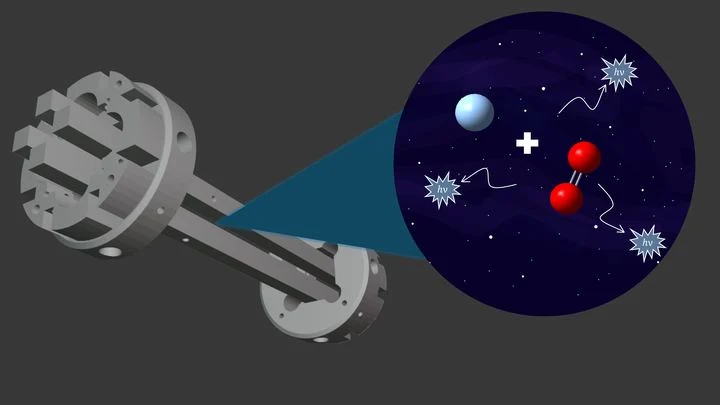
In the cold, sparse clouds of space, particles rarely meet, but sometimes an ion and a neutral molecule pass close enough to stick together. As they do, they emit light, like a muted flash carrying away excess energy. This process is called radiative association, and it is responsible for the formation of many molecules in interstellar space.
Every atom has its own 'voice'—the frequency of light it emits. For isotopes, atoms with different numbers of neutrons, the voices differ slightly. It's like a choir: if you know the score precisely, the slightest false note reveals external interference. The King plot is a way to compare how harmoniously two notes from different isotopes sing together.
A magnetic compass in a test tube sounds like a magic trick, but it's pure physics. In a solution of fumarate (a salt of malic acid), carbon-13 nuclei behave like tiny spinning tops.
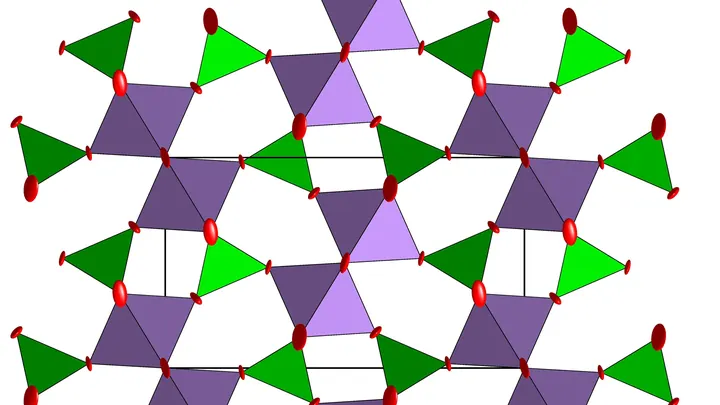
In the tungsten bronze family, one material was considered the quiet one. When cooled, its siblings rearrange their electrons into wave-like patterns, but it did not, or so it was thought until recently.
Now it turns out that this material also undergoes rearrangement.
Conventional atomic clocks are essentially optical counters: they rely on spectroscopy — a method for measuring the frequency of radiation with high precision as electrons jump between energy levels.
Deep inside stars, light nuclei fuse, giving birth to helium and streams of neutrons. On Earth, we recreate this process by combining deuterium and tritium — special isotopes of hydrogen.
A tuning fork cut from a perfect metal rings at a single frequency. Its sound is as pure as a mathematical formula. But clamp it in a vise or dip it in a viscous liquid, and the tone smears, picks up noise, and loses its sharpness. The nucleus of scandium-45 behaves much the same way when placed in a crystal lattice.
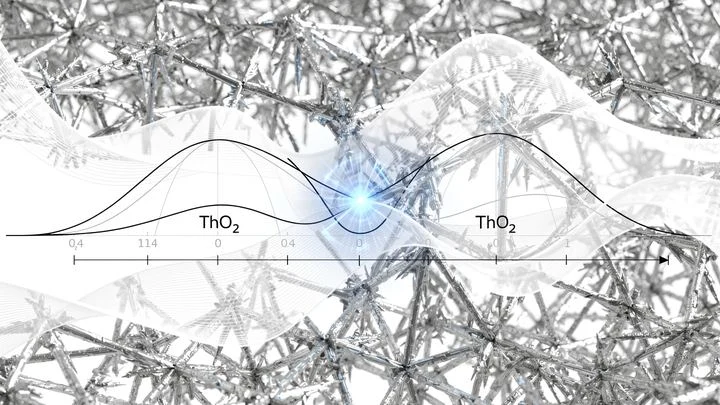
A thin film of thorium dioxide, just 10 nanometers thick, is deposited on a steel disk. A laser pulse strikes it, but instead of the expected glow, the detector catches a stream of electrons.