A Chemical Map of a Starry Swarm express
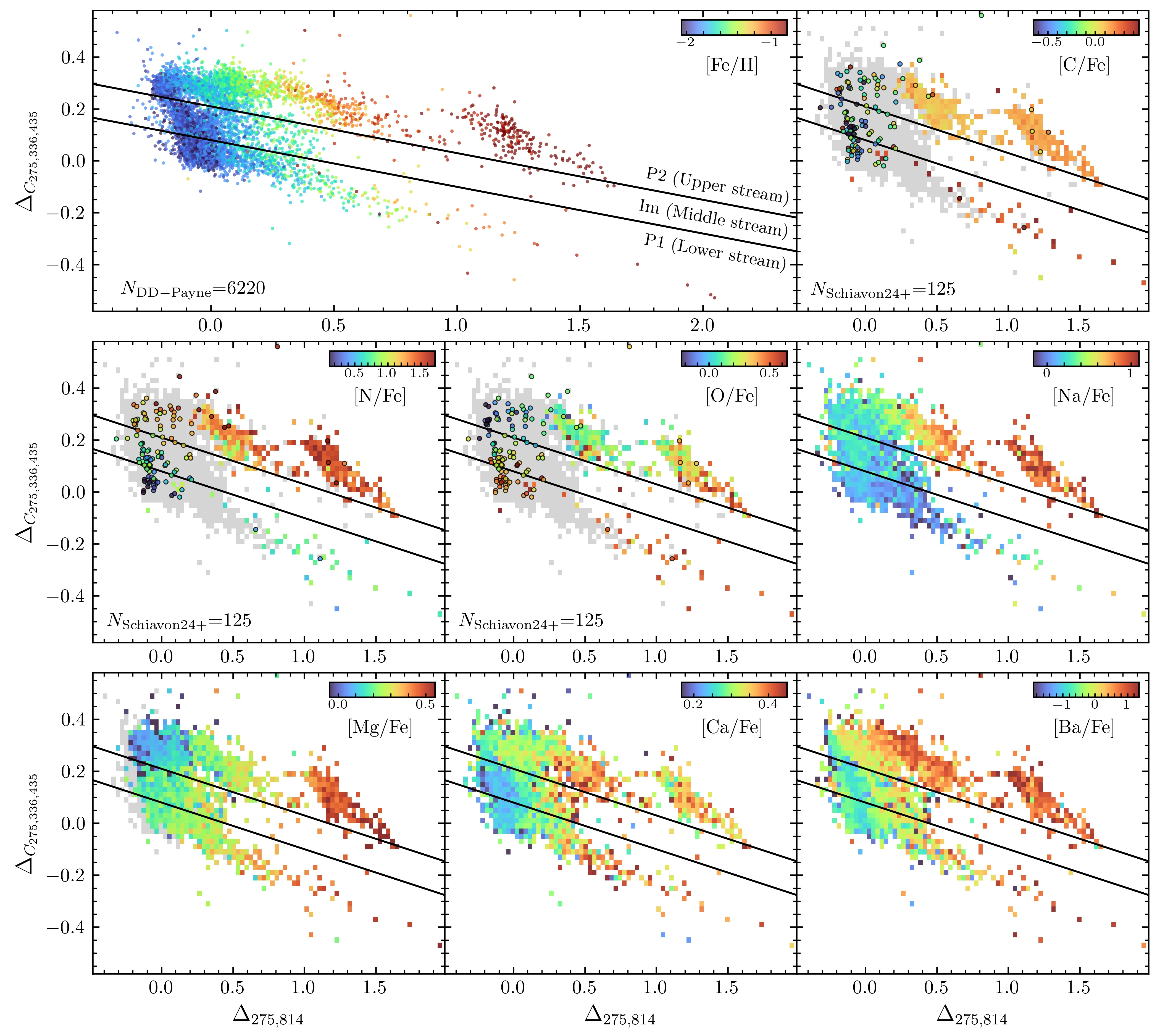
At the heart of Omega Centauri, the most massive globular cluster in our Galaxy, thousands of stars are packed so tightly that their light merges into a single glowing blob when seen from Earth. Separating this swarm into individual stars and determining the composition of each is a task akin to sorting through an overfilled anthill. Astronomers armed themselves with the MUSE spectrograph, which captures thousands of spectra at once, and the neural network DD-Payne, trained to recognize the lines of different elements in them.
In the end, they measured the abundances of carbon, nitrogen, oxygen, magnesium, sodium, calcium, and barium in 7302 red giants within half a light radius of the cluster's center. That's like a chemist taking samples from every resident of a large city and sorting the results by the age of the neighborhoods. It turned out that the stars in Omega Centauri are not all the same: some were born earlier and are poorer in heavy elements, while others formed later and are richer. The difference is especially striking for nitrogen: younger stars have more of it, while for calcium and barium the link with age is weaker.
Such a detailed chemical map allows us to test scenarios for the cluster's birth. For example, if Omega Centauri really was the core of a dwarf galaxy, then stars of different generations should have formed from gas that was gradually enriched in heavy elements by supernova explosions. The observed composition–age trends are consistent with this picture: the younger the stars, the more barium and calcium they contain — elements that are forged in the interiors of old stars and ejected into space when they die.
The work shows that even in the crowded stellar core, the history of each generation can be discerned. The swarm ceases to be a featureless blob and becomes a chronicle, where each star is a line about the gas from which it was born.
Original abstract
as written by the authors arXiv:2603.01041
We present chemical abundance measurements for 7,302 red giant branch stars within the half-light radius (~5') of $$\omega$$ Centauri ($$\omega$$ Cen), derived from MUSE spectra using the neural network model DD-Payne. DD-Payne effectively identifies spectral features of C, N, and O for [Fe/H]>-1.0 dex; Mg for [Fe/H]>-1.5 dex; and Na, Ca, and Ba for all metallicities. By combining these measurements with previous high-resolution studies, we create the most comprehensive picture of $$\omega$$ Cen's rich chemical evolutionary history. For the first time, we map elemental variations across the entire chromosome diagram, which is widely used to identify multiple populations. We analyze the median chemical abundance trends as functions of age and metallicity for different subpopulations. The DD-Payne measurements of [C/Fe], [N/Fe], and [O/Fe] extend literature trends to higher metallicities and show continuous abundance-metallicity relations, with [(C+N+O)/Fe] increasing steadily with [Fe/H]. [Ca/Fe] and the s-process element [Ba/Fe] also increase with metallicity across all populations. For [Ba/Fe], the chemically enhanced (P2) populations are more enriched than primordial (P1) and the intermediate (Im) populations. Furthermore, [N/Fe] correlates strongly with stellar age while [Ca/Fe] and [Ba/Fe] exhibits a weaker age dependence. Using these abundance-metallicity-age relations, we evaluate different formation scenarios of $$\omega$$ Cen proposed in the literature. Our study demonstrates that combining MUSE with machine learning enables large-sample stellar abundance measurements in crowded cluster cores, overcoming the limitations of fiber-fed spectroscopy for studying multiple stellar populations and their evolutionary histories.
In Omega Centauri, stars are packed tens of thousands of times more densely than in the solar neighborhood: if a planet existed there, the night sky would glow like twilight from thousands of nearby suns.
In Isaac Asimov's novel 'The Gods Themselves', a civilization is described that lives in a dense star cluster where the sky is filled with stars — much like the view from a planet inside Omega Centauri.