Chemical enrichment is the cosmic recycling process that turns the pristine hydrogen and helium left over from the Big Bang into the diverse periodic table we know today. Every element heavier than helium — the carbon in our cells, the oxygen we breathe, the iron in our blood — was forged in the interiors of stars and then returned to space, where it mixed with gas clouds and became part of new generations of stars and planets. This process is the reason the Universe is not a boring soup of hydrogen: it is the chemical engine that made rocky planets, complex molecules, and ultimately life possible.
History
The concept emerged in the mid-20th century, notably through the work of Fred Hoyle and collaborators in the 1950s, who showed how heavy elements could be built up by nucleosynthesis in stars. The term 'metallicity' and the idea of galactic chemical evolution were formalized in the following decades.
How it works
Stars are nuclear furnaces that fuse light elements into heavier ones. When massive stars explode as supernovae, or when smaller stars shed their outer layers as planetary nebulae, they eject these newly synthesized elements into the interstellar medium. This enriched gas then gets incorporated into the next generation of stars, which start their lives with a higher 'metallicity' (astronomers call everything heavier than helium a metal). Over billions of years, successive generations of stars gradually increase the metal content of their host galaxy, a process that can be traced by observing stellar spectra and mapping chemical abundances across galactic populations.
In practice
Chemical enrichment is used to date stellar populations, reconstruct the assembly history of galaxies (galactic archaeology), and identify which star-forming regions might host planetary systems with the right ingredients for life.
Fun fact
The iron in your blood was most likely forged in a supernova explosion that occurred billions of years before the Sun was born, and then incorporated into the solar nebula from which our planet formed.
In the first moments, the Universe expanded at an enormous rate. This process is called inflation, and its driving force is the inflaton field. Its energy pushed space apart, like yeast raising dough. But physicists suspect that the dough might have left 'bubbles'—superheavy particles born from the expansion itself.
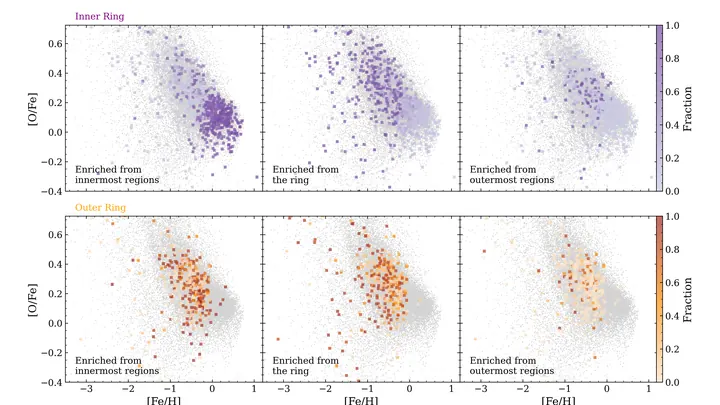
Imagine a forest planted in a single day. At first glance, all trees look alike, but their cross sections tell different stories: some grew on clean soil, others on the ashes of ancient fires.
Two guitar strings are stretched on the same neck. They are almost identical, but one is slightly shorter — and they sound different. That's roughly how the two isomers of ethanimine work: molecules with the same set of atoms but rotated differently in space. Astronomers spotted this molecule in the dense clouds near the center of our Galaxy.
There is something wildly generous about a garden where the first flowers don't just bloom but immediately scatter their seeds far beyond the fence. Something similar was happening in the young universe.
A star inherits the chemical makeup of its parent gas cloud, just like a child inherits genes from its parents. Astronomers turned this into a method: by measuring the fraction of carbon and other elements with spectroscopy (splitting light into colors), they construct family trees for the stars in a galaxy.
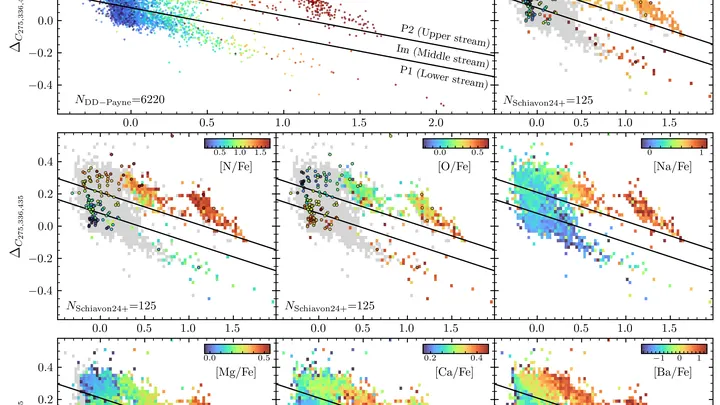
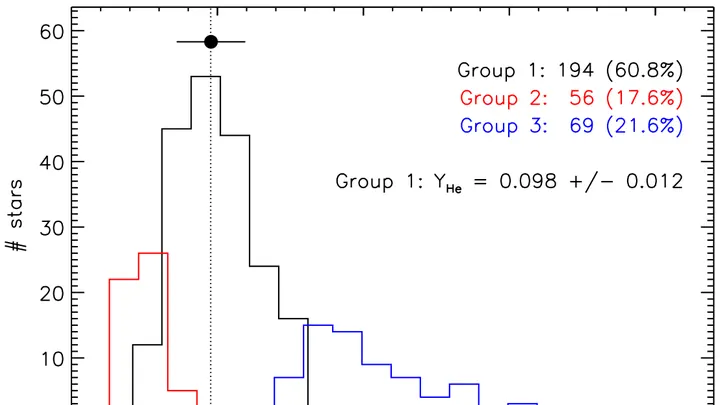
At the heart of Omega Centauri, the most massive globular cluster in our Galaxy, thousands of stars are packed so tightly that their light merges into a single glowing blob when seen from Earth. Separating this swarm into individual stars and determining the composition of each is a task akin to sorting through an overfilled anthill.
In stellar nurseries, massive stars are not born alone but in pairs. Two stars orbit a common center, and the more massive one expands first and begins to shed its outer layers. Some of this material doesn't escape into space but flows onto the companion, like water from an overflowing cup into a cup held beneath.
A piece of chromium exposed to air gets covered in invisible armor, an oxide film, within a minute. That film protects the metal from rust, but for a battery it's a disaster: the film blocks chromium ions, so no current flows.
Scientists mixed five metals — chromium, bismuth, copper, tin, and nickel.