The abundance ratio is a measure used in astrophysics and geochemistry to compare the relative amounts of two chemical elements in a given sample, such as a star, nebula, or planetary atmosphere. Common examples include nitrogen-to-oxygen (N/O) or sulfur-to-oxygen (S/O) ratios. These ratios are more robust than absolute abundances because they cancel out many systematic uncertainties in measurement, such as distance or instrument calibration.
History
The concept of abundance ratios has been used since the early 20th century, particularly in stellar spectroscopy, but it became a standard tool in the 1970s with the advent of quantitative nebular analysis.
How it works
To determine an abundance ratio, scientists measure the intensity of spectral lines emitted or absorbed by each element in the sample. These intensities are converted to column densities or number densities using atomic physics models. The ratio is then simply the quotient of the two densities. Because both elements are observed through the same path and instrument, many errors cancel, making the ratio a reliable diagnostic of the chemical evolution of the sample.
In practice
Abundance ratios are used to trace the chemical enrichment history of galaxies, to classify stars, and to study the formation of planetary systems.
Fun fact
The nitrogen-to-oxygen ratio in the Sun is about 0.14, but in some old stars it can be ten times lower, reflecting the slow buildup of nitrogen over cosmic time.
Forty light-years away lives a star that went unnoticed for a long time: TRAPPIST-1 emits two thousand times less light than the Sun. But it turned out to have seven Earth-sized planets, three of which orbit in the zone where water could remain liquid. Yet little was known about the star itself, about its chemical kitchen.
Two stars, AF Lep A and ε Indi A, have become the focus of close attention. Using the GHOST spectrograph on the Gemini telescope, astronomers split their light into colors and, from absorption lines, determined how much carbon, oxygen, sulfur, and thirteen other elements are in the stars' atmospheres.
High in the mountains, where the air is clear and still, physicists are preparing to catch elusive visitors from space — neutrinos. These particles, like ghosts, pass straight through the Earth, leaving almost no trace. But occasionally a neutrino does slam into an atom, producing a shower of particles that can be seen.
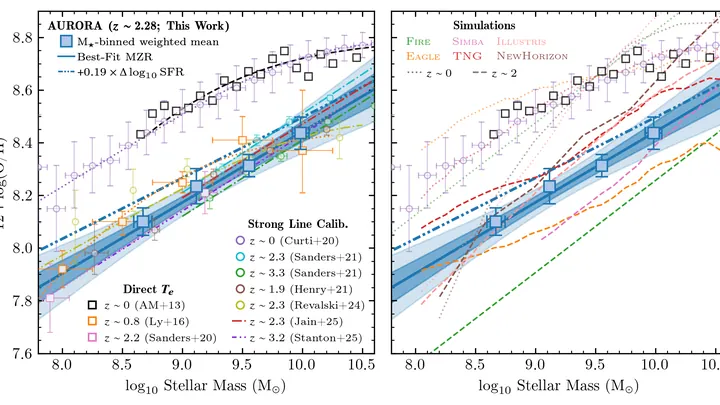
For thirteen billion years, light battled through cosmic emptiness. It bent around massive galaxy clusters that, as Einstein predicted, acted as giant lenses — amplifying and distorting the distant glow. In 2023, the NIRSpec instrument on the James Webb Space Telescope captured this light and spread it into spectra.
In a giant cosmic cradle, the Tarantula Nebula, astronomers took a close look at 122 massive stars, each at least 30 times heavier than the Sun. They measured the nitrogen abundance in their atmospheres, and the picture turned out to be unexpected.
Every star is a living archive, and its spectrum a multilayered manuscript. Over billions of years, the history of the galaxy is written into it: the galactic chemical evolution of the Milky Way leaves a smooth trace in elemental abundances.
When you're planning a renovation, you don't buy paint by eye: you measure the wall area. In science, deciding how many samples to collect is a similar guess, but the stakes are higher. Skimp on samples, and your study becomes a lottery: you might miss a real effect, or you might mistake noise for a discovery. Overshoot, and you're wasting tubes, months, and, in animal experiments, lives.
In astrophysics, some numbers seem random yet recur with the persistence of a spell. One such number is the ratio of X-ray brightness to H-alpha hydrogen emission in turbulent gas tails. From galactic winds to ‘jellyfish’ slicing through clusters, this ratio steadily holds at around three.
A baker adds more sugar to the dough, and the pie turns out different. So it is with a star: the composition of its "dough"—the cloud of gas and dust from which planets are born — determines what worlds will form around it.
Two very small, cool stars, similar to the famous TRAPPIST-1, reside in the young Upper Scorpius star cluster. They are only 5–10 million years old — by cosmic standards, mere infants. Each is surrounded by a disk of gas and dust from which planets may eventually assemble.
Hot massive stars are the kitchens of the Universe, where heavy elements are cooked up. They end their lives in supernova explosions. To understand their recipe, astronomers use spectroscopy — the analysis of the rainbow band of light passed through a prism. Previously, deciphering such a 'menu' took hours.
Ancient stars, nearly devoid of heavy elements, are like fossilized remnants of the first cosmic flashes. For a long time, the odd ratio of carbon, hydrogen, and helium in three such stars was thought to require a hypernova — an ultra-bright supernova with hundreds of times more energy than a regular one.
Deep inside a dying star, just before it goes supernova, nuclear reactions determine which chemical elements will be scattered across the cosmos. One such reaction is the collision of an oxygen nucleus with a proton, producing a nitrogen nucleus and an alpha particle (a helium nucleus).
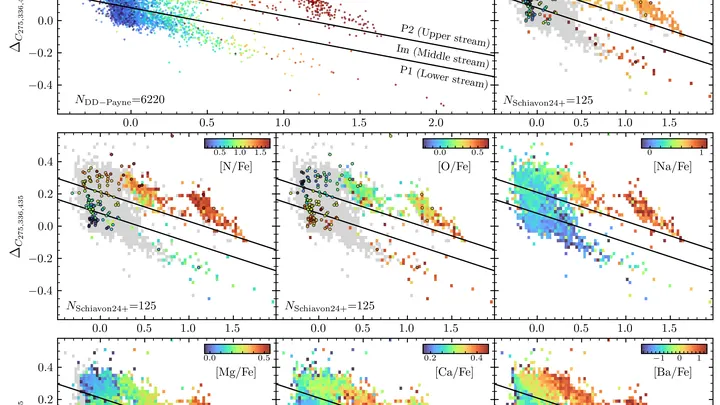
At the heart of Omega Centauri, the most massive globular cluster in our Galaxy, thousands of stars are packed so tightly that their light merges into a single glowing blob when seen from Earth. Separating this swarm into individual stars and determining the composition of each is a task akin to sorting through an overfilled anthill.
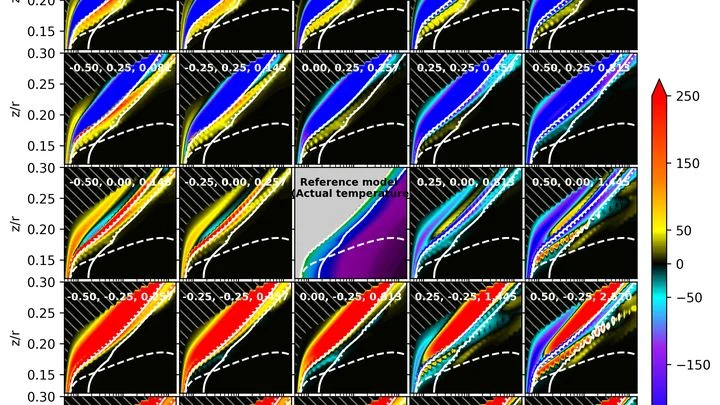
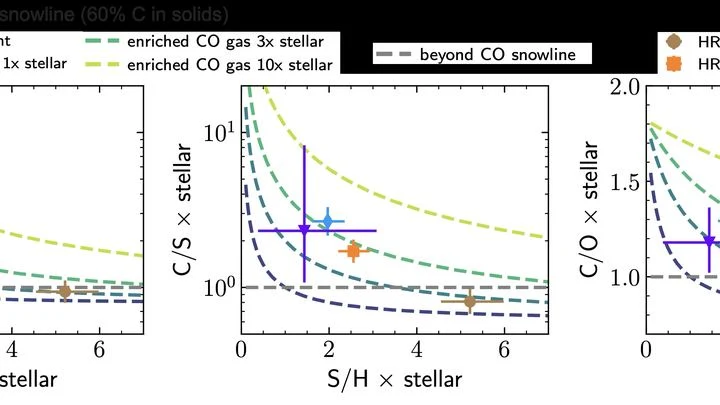
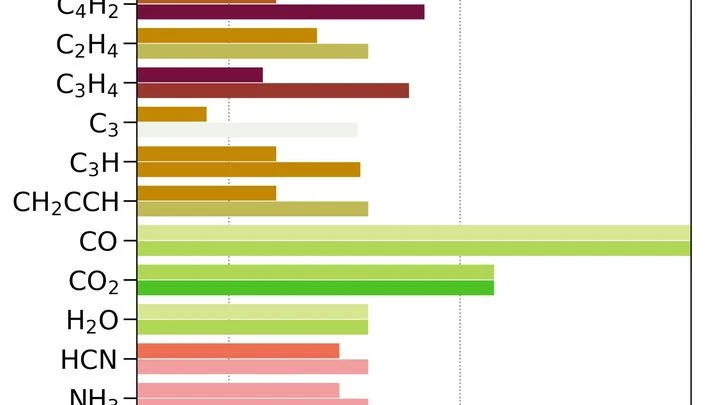
When a chef prepares a dish, not only the proportions of ingredients matter but also their total amount. Two pies with the same sugar-to-flour ratio but made from different batch sizes will turn out differently. So it is with disks around young stars: carbon and oxygen are the key 'spices,' and their absolute amounts change the look of the cosmic 'kitchen' no less than their ratio.
130 light-years away, four giant planets orbit the young star HR 8799—each 5 to 10 times more massive than Jupiter. They lie far from the star, at distances from 15 to 70 astronomical units (one astronomical unit is the distance from Earth to the Sun).
Young stars are surrounded by disks of gas and dust, like construction sites for future planets. From this material, rocky worlds and gas giants will eventually assemble. So the chemical composition of the disk directly determines what the planets will be like.
Galaxies are like giant kitchens where, in stellar cores, light atoms are fused into heavy ones — much like flour and water becoming bread. When a star dies, it spills its accumulated riches into the interstellar gas, seasoning it with 'spices': oxygen, carbon, iron.
In the stream of charged particles flying toward us from the depths of the Galaxy, iron turned out to be the odd one out. The ATIC-2 instrument, lifted on a balloon over Antarctica, compared how the fraction of nuclei from sulfur to chromium relative to iron changes with energy.