concept

metals

In astronomy, all elements heavier than hydrogen and helium.
44 related articles

Description

In astronomy, 'metals' refers to all chemical elements heavier than hydrogen and helium. This terminology reflects the fact that hydrogen and helium were created in the Big Bang, while heavier elements are forged in the interiors of stars and dispersed through supernova explosions and stellar winds. The 'metallicity' of a star or galaxy—its abundance of these heavier elements—is a key indicator of its age and the history of star formation in its environment.

History

The term 'metals' in this astronomical sense was popularized in the mid-20th century, notably by Walter Baade, who used it to distinguish between Population I stars (metal-rich) and Population II stars (metal-poor).

How it works

Metals are produced through nucleosynthesis in stars: elements up to iron are created by fusion in stellar cores, while elements heavier than iron are produced mainly through neutron capture processes (the s-process and r-process) during supernovae or neutron star mergers. These metals are then ejected into the interstellar medium, enriching the gas from which new stars form. Thus, each generation of stars has a higher metallicity than the previous one, making metallicity a cosmic clock.

In practice

Metallicity measurements are used to date stellar populations, trace galactic chemical evolution, identify the most ancient stars in the universe, and even to infer the presence of planets, since planet formation is more likely around metal-rich stars.

Fun fact

The most metal-poor star ever found, SMSS J031300.36-670839.3, has an iron abundance about 10 million times lower than the Sun's, indicating it formed from gas enriched by a single early supernova.


Concept graph →

Related articles · 44

Galaxies2026-08-202 minarXiv:2608.20339
Galaxies2026-08-182 minarXiv:2608.17375express
Faint Galaxies Reveal Their Stellar Secrets
Faint galaxies scattered across the Perseus cluster are like ghosts among their bright neighbors. They are so diffuse that distant objects shine through them, and they contain hundreds of times fewer stars than our Milky Way.
Stellar2026-08-062 minarXiv:2608.05596express
The Sun's Magnetic Loops: Chaos You Can Measure
A sunspot, a dark island on the fiery surface, lives its own turbulent life. Beneath it, in invisible depths, giant magnetic loops drift like twisted cables. When such a loop emerges, it can discharge as a flare, and hurl clouds of charged particles into space. Scientists have long tried to understand what determines the strength and suddenness of these events.
Galaxies2026-07-272 minarXiv:2607.24929
Cosmic Cross-Pollination: How Galaxies Enrich Their Neighbors with Metals
In 1,433 pairs of galaxies scattered across the sky, astronomers noticed an unusual pattern. Neighbors located 'above' or 'below' a massive stellar system contain up to a quarter more oxygen than those lying in the plane of its disk.
Galaxies2026-07-173 minarXiv:2607.15515
Star Chefs of the Early Universe: Nitrogen Excess
For thirteen billion years, light battled through cosmic emptiness. It bent around massive galaxy clusters that, as Einstein predicted, acted as giant lenses — amplifying and distorting the distant glow. In 2023, the NIRSpec instrument on the James Webb Space Telescope captured this light and spread it into spectra.
Stellar2026-07-163 minarXiv:2607.15017
The Milky Way Symphony: Why Star Clocks Tick at Different Speeds
A star's age is the key to the galaxy's history. But prying that key from nature is no simple task: unlike a tree, a star doesn't grow annual rings. Yet, its atmosphere holds a chemical code — the ratio of elements that slowly shifted as generations of stars died and new ones were born.
Galaxies2026-07-083 minarXiv:2607.07973
Stellar2026-07-072 minarXiv:2607.06828express
Stellar Giants Hide a Secret of Rapid Mixing
In a giant cosmic cradle, the Tarantula Nebula, astronomers took a close look at 122 massive stars, each at least 30 times heavier than the Sun. They measured the nitrogen abundance in their atmospheres, and the picture turned out to be unexpected.
Dark Core or Pearlescent Layer: Metamorphoses of Neutron Stars
Neutron stars — remnants of supernovae — are among the densest objects in the Universe. Their central density exceeds nuclear density many times over, and gravity is surpassed only by black holes.
Stellar2026-07-023 minarXiv:2607.02191
Sulfur Anomaly: B[e] Supergiant as a Photochemical Reactor
Massive stars are cosmic titans, living under the sign of indomitable energy. When such a star enters the B[e] supergiant phase, its radiation is so powerful that it would seemingly pulverize any molecule into atoms. The spectral lines, once systematized by Johann Balmer, blaze here with particular fury.
Galaxies2026-06-282 minarXiv:2606.29149express
Dark Matter and the Dance of Stellar Swarms
At the center of attention are tiny stellar cities: ultra-faint dwarf galaxies. They resemble sparse swarms of fireflies circling within a vast invisible cloud. This cloud is a halo of ultralight dark matter. Its particles are so light that they behave not like billiard balls but like waves.
Stellar2026-06-283 minarXiv:2606.29435
Cosmic Rings: How M92 Preserved the Memory of Supernovae
Imagine a forest planted in a single day. At first glance, all trees look alike, but their cross sections tell different stories: some grew on clean soil, others on the ashes of ancient fires.
Galaxies2026-06-152 minarXiv:2606.17153express
Silicone Imprint of Ancient Stars
The galaxy NGC 1277 is like an old book that no one has opened for billions of years. It formed quickly at the dawn of the Universe and has barely changed since — no collisions with neighbors, no new layers added.
Exoplanets2026-06-121 minarXiv:2606.14646express
A Volcanic Planet Breathes Hydrogen
A planet the size of Neptune, but glowing white-hot. Beneath the clouds lies an ocean of magma capable of absorbing an entire hydrogen atmosphere. The new SEAMIST model is the first to trace how such dissolution changes a planet's fate from birth to old age. The big surprise is the mechanism of catastrophic boiling.
Lead Archives: Ancient Minerals vs. Higgsino
The story began almost a century ago, when Edwin Hubble showed that galaxies are receding, and Fritz Zwicky and Vera Rubin later realized: to explain their motions, invisible mass is needed — dark matter.
Galaxies2026-04-232 minarXiv:2604.21218express
Galaxies2026-04-212 minarXiv:2604.19075express
Celestial Newborn: Stars of Pure Hydrogen
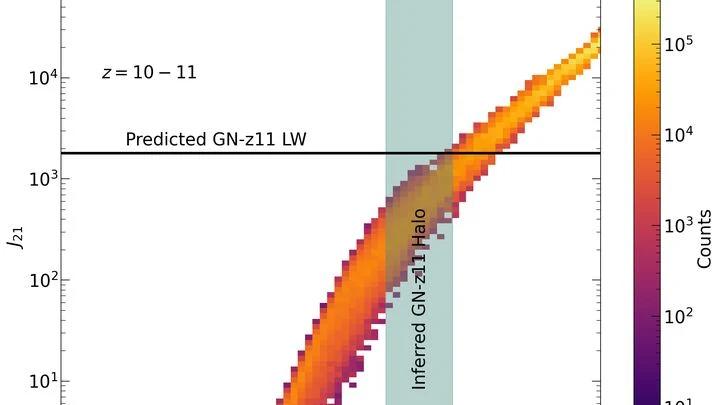
A bonfire built of pure alcohol burns hot and gives off almost no smoke. That's roughly how the first stars shone: they contained no heavy elements, only hydrogen and helium left over from the Big Bang. The James Webb Space Telescope may have caught one such "bonfire" in the galaxy GN-z11.
Instrumentation2026-04-201 minarXiv:2604.18664express
Asteroids Instead of Trucks: Metal for Mars
The Red Planet is surrounded by the rubble of failed worlds — rocky boulders stuffed with metal. Shipping a kilogram of steel from Earth to Mars costs as much as several cars. It's far cheaper to pick up space junk right in orbit.
Exoplanets2026-04-081 minarXiv:2604.06809express
Carbon-Rich Stars Give Birth to Giant Planets Farther Out
A baker adds more sugar to the dough, and the pie turns out different. So it is with a star: the composition of its "dough"—the cloud of gas and dust from which planets are born — determines what worlds will form around it.
Stellar2026-04-062 minarXiv:2604.05221express
Stars and Their Disks: The Carbon Puzzle
Two very small, cool stars, similar to the famous TRAPPIST-1, reside in the young Upper Scorpius star cluster. They are only 5–10 million years old — by cosmic standards, mere infants. Each is surrounded by a disk of gas and dust from which planets may eventually assemble.
Galaxies2026-03-271 minarXiv:2603.26873express
Patchy Blast: How a Regular Supernova Created Anomalous Stars
Ancient stars, nearly devoid of heavy elements, are like fossilized remnants of the first cosmic flashes. For a long time, the odd ratio of carbon, hydrogen, and helium in three such stars was thought to require a hypernova — an ultra-bright supernova with hundreds of times more energy than a regular one.
Materials2026-03-181 minarXiv:2603.17479express
Aluminum vs. Hydrogen: Who Wins in the Alloy?
Hydrogen is the lightest gas, but it has a knack for sneaking into metals. If you pump hydrogen into a steel cylinder at high pressure, some atoms will squeeze between the metal atoms. The metal can become as brittle as a stale cracker. But you can also turn this property on its head — store hydrogen inside a metal sponge.
Exoplanets2026-03-182 minarXiv:2603.17961express
Why Earth Didn't Absorb the Gifts from Space
In its youth, Earth resembled a beehive: it grew by sticking together from countless rocky chunks. When the main construction was over, a late swarm of meteorites rained down on the young planet — the so-called late veneer. These impacts, scientists thought, brought platinum, gold, and other rare metals to Earth's upper layers.
Galaxies2026-03-051 minarXiv:2603.05434express
The Galaxy Thermometer Is on the Fritz
The gas in a galaxy glows like a neon sign, and by the color of that glow, astronomers can tell how hot it is. The logic is simple: the more heavy elements (which astronomers call metals) in the gas, the better it cools. So galaxies rich in metals should have cooler gas. But new observations show the opposite.
Galaxies2026-03-012 minarXiv:2603.01041express
A Chemical Map of a Starry Swarm
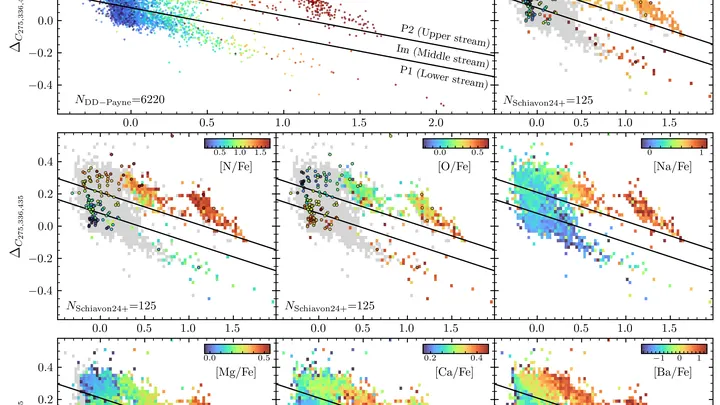
At the heart of Omega Centauri, the most massive globular cluster in our Galaxy, thousands of stars are packed so tightly that their light merges into a single glowing blob when seen from Earth. Separating this swarm into individual stars and determining the composition of each is a task akin to sorting through an overfilled anthill.
Galaxies2026-02-251 minarXiv:2602.21500express
Stars Are Born Where There Is Gas
The kitchen where stars are baked works on a simple recipe: as much flour as you have, that's how many pies you get. For a long time, astronomers saw a strict relation between a galaxy's mass and how fast it forms stars, and they considered it a standalone rule. But a new study of 24,954 nearby galaxies shows that this relation is just a shadow of two more fundamental laws.
Galaxies2026-02-231 minarXiv:2602.20241express
Chemistry Around Galaxies: What Their Outskirts Breathe
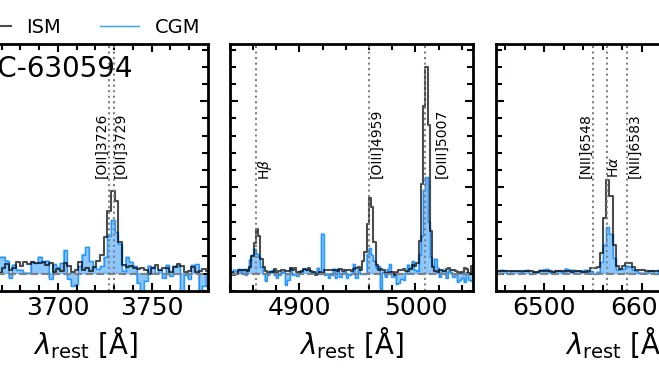
The kitchen of a distant galaxy isn't limited to its bright disk. Around every star system, there's an invisible cloud of gas, like steam above a pot of soup. Astronomers peeked into this steam around galaxies that appear as they were just one and a half billion years after the Big Bang.
Stellar2026-02-171 minarXiv:2602.16082express
The First Stars Could Have Survived to This Day
The first stars ignited from clouds that contained nothing but hydrogen and helium. Heavy elements (carbon, oxygen, iron) came later, forged inside stars. But among those pioneers, there could have been lightweight stars, with masses just below that of the Sun.
Exoplanets2026-02-091 minarXiv:2602.09281express
Saturn's Rings: Trace of a Cosmic Collision
Saturn's system 300 million years ago resembled a crowded dance floor. The most massive moon, Titan, began to migrate, and this movement threw its neighbors off balance. One moon crashed into Titan; the debris swirled into a vortex, gathering into Hyperion.
Stellar2026-02-051 minarXiv:2602.06196express
Heavyweight Stars Take Millions of Years to Grow
Gas clouds in the Milky Way give birth to stars, and the heaviest among them are true giants. Previously, it was thought that such a star ignites almost instantly, like a light bulb. But new research shows that a star grows gradually, like a snowball rolling down a mountain: the longer it rolls, the bigger it gets. The authors compared two catalogs: bright gas clouds around young stars and the stars themselves.
Galaxies2026-02-031 minarXiv:2602.02949express
Turbulence in Space: How Clouds Change the Chemistry of Stars
A boiling cauldron: steam rises, water churns, and the temperature varies from point to point. So it is in space: the gas clouds around young stars are not smooth spheres but a seething mixture with vortices and density fluctuations. Astronomers long treated such clouds as homogeneous, but this simplification can skew conclusions.
Exoplanets2026-01-302 minarXiv:2601.23069express
The Carbon Diet of Young Stars
Young stars are surrounded by disks of gas and dust, like construction sites for future planets. From this material, rocky worlds and gas giants will eventually assemble. So the chemical composition of the disk directly determines what the planets will be like.
Cosmology2026-01-291 minarXiv:2601.22232express
Cosmic Recipe: How Much Helium Was There at the Beginning?
The helium in a party balloon is the very gas that makes it float. But long before balloons, helium appeared in the first minutes after the Big Bang. Its exact abundance in the universe is like a fingerprint: it tells you how many kinds of neutrinos (ghostly particles that pass through walls) exist.
Galaxies2026-01-281 minarXiv:2601.20278express
A Map of Metals Without Distances
Imagine a city map where streets are replaced by car speeds and buildings by the metal content of stars. Such a map can tell you where the center is and where the outskirts are, even without knowing exact distances. This is precisely the approach astronomers took with our Galaxy, using longitude–velocity (ℓ–v) diagrams.
Stellar2026-01-281 minarXiv:2601.20652express
Two Stars, Different Fates
Two stars circle each other like a pair of figure skaters on ice. Both resemble the Sun, but one shines brighter and has puffed up, while the other remains compact. Astronomers peered into their light using spectrographs, instruments that split light into colors, and found something odd: one star is clearly poorer in heavy elements than the other.
Galaxies2026-01-272 minarXiv:2601.19522express
Dwarf Stars Vanish in Metal-Poor Clouds
The galaxy's kitchen has a recipe for stellar soup. The main ingredient is hydrogen, but the flavor depends on a pinch of metals. Astronomers have now peered into the pots where that pinch is almost absent, and found that the smallest stars are missing.
Galaxies2026-01-241 minarXiv:2601.17498express
A Baby Galaxy from the Cosmic Noon
In the deep cosmos, more than 12 billion light-years away, the James Webb Space Telescope has spotted a galaxy that looks like a visitor from the dawn of creation. Its light has been traveling to us since the universe was only about two billion years old — a time when galaxies were growing especially vigorously, a period astronomers call the cosmic noon.
Superconductivity2026-01-202 minarXiv:2601.14500express
Why Some Metals Become Superconductors and Others Don't
The classic BCS theory of superconductivity, developed by John Bardeen, Leon Cooper, and Robert Schrieffer, describes the mechanism by which electrons pair up into Cooper pairs and move without resistance.
Galaxies2026-01-152 minarXiv:2601.10514express
Fossil Stars Found in Dwarf Galaxy
In the Large Magellanic Cloud, a galaxy that orbits our Milky Way, astronomers have caught five stars that look like fossils from the very distant past. They contain almost no metals, only one-hundredth to one-thousandth of what the Sun has, but they have tens of times more carbon.
Stellar2026-01-151 minarXiv:2601.10800express
Weighing a Red Giant's Mass Loss
A red giant is like a balloon slowly letting out gas. The star swells, its outer layers weaken, and stellar wind carries mass into space. But exactly how much does a star lose? This is a crucial question: the answer determines what kind of remnant it will leave behind — a white dwarf, a neutron star, or a black hole.