Aging as a Control Problem: Two Classes of Damage and the Boundary of Control
Context
Aging research has accumulated a vast catalog of molecular and cellular mechanisms (senescence, genomic instability, loss of proteostasis, and others), along with a host of interventions that improve function and healthspan. Yet it remains unclear what minimal conditions of control are needed to guarantee that the organism's breakdown stays bounded over time. Existing approaches often improve function without halting long-term decline, which points to a gap in formalizing the conditions for control. This work sits apart from neighboring studies, which mostly deal with evolution, horizontal gene transfer, and phylogenetic networks; here a control-theoretic perspective is introduced that derives necessary and sufficient conditions for bounded accumulation of damage.
Methods
The author builds a coarse phenomenological model in which the total damage burden D(t) is represented as a scalar and split into two components: A(t), regulatable damage, whose accumulation and clearance are governed by endogenous systemic repair, and B(t), information-limited damage, for which the physiological system lacks sufficient information to detect or correct. The dynamics are set by simple differential equations with constant production rates and multiplicative removal rates. To test the boundedness conditions, the study uses deterministic phase diagrams obtained by integrating the model over a parameter grid, plus a global sensitivity analysis via Latin hypercube sampling with partial rank correlation coefficients (PRCC) on 3000 samples. Stochastic extensions are also considered to account for rare events such as clonal fixation.
Results
A sufficiency theorem is proved: with constant production rates α and β and multiplicative removal rates $R_A$(S) and $R_B$, if there exist stable controls S* and $R_B$* such that $R_A$(S*) ≥ α and $R_B$* ≥ β for all t, then A(t) and B(t) remain uniformly bounded, and therefore the total burden D(t) is bounded as well. Conversely, if $R_B$ ≡ 0 while β > 0, then B(t) grows without bound, which proves that control of information-limited damage is necessary. The phase diagram reveals a sharp boundary between bounded, drifting, and diverging regimes: for any fixed β there is a critical $μ_c$(β) below which damage grows without bound. The global sensitivity analysis shows that the production rate of information-limited damage β is the dominant predictor of the asymptotic slope of aging, with PRCC ≈ +0.480, whereas the physiological repair ceiling $R_{max}^A$ has a weak correlation (PRCC ≈ +0.079) and engineered removal $R_B$ is nearly zero (PRCC ≈ -0.011) because of threshold behavior. The stochastic analysis demonstrates that a moderate reduction in β or an increase in $R_B$ exponentially suppresses the probability of catastrophic events, while boosting endogenous repair $R_A$ has no effect on the fixation of information-limited damage.
Implications
The work differs from neighboring studies in that, instead of an empirical description or a predictive architecture, it derives formal necessary and sufficient conditions for boundedness from control theory. This helps explain why many interventions improve function but do not stop aging: they act on regulatable damage without touching information-limited damage. The practical consequence is the need for two parallel tracks: keeping endogenous repair above the production of regulatable damage, and actively removing or constraining information-limited damage. The model also offers operational guidance on a safe order of interventions: first observation and reduction of clonal risks, then restoration of immunity, then pulsed activation of systemic repair, and after that continuous engineered support.
Future development
The topic could move toward experimental identification of observable quantities that correspond to the model's variables. Longitudinal multi-omic data would allow estimation of the mutual information between latent damage and systemic signals, while perturbation interventions would reveal how sensitive the rate of damage change is to control. This would make the split into A and B classes operationally testable. In addition, the model can be extended to account for spatial heterogeneity, tissue-specific turnover, and ecological interactions between cell populations, which would shift the quantitative thresholds but preserve the structural conclusions.
Impact
The proposed approach could influence the design of clinical trials for anti-aging interventions, the choice of biomarkers, and safety-monitoring strategies. It also provides a common language for integrating heterogeneous aging data into a single control framework.
Next steps
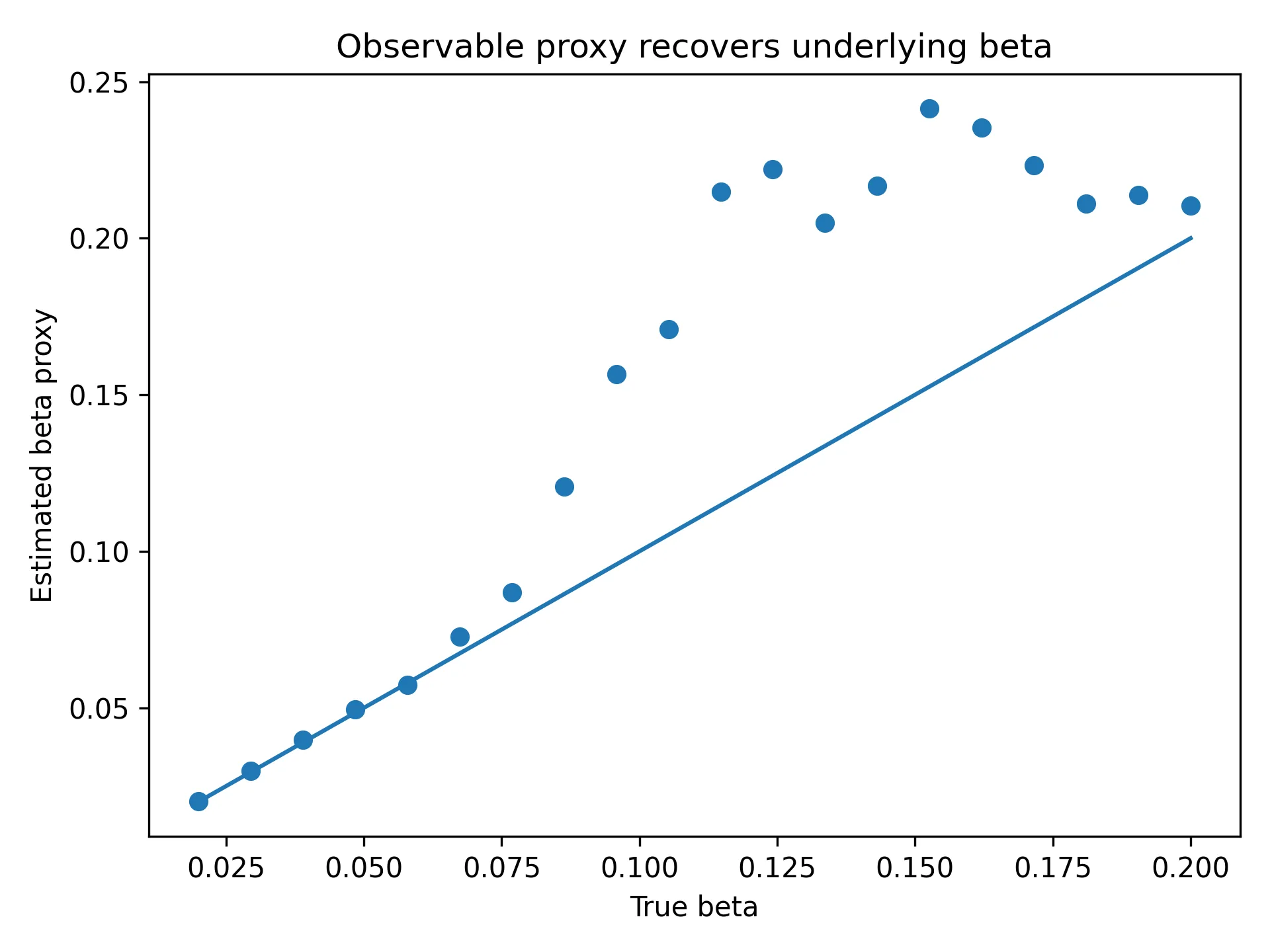
The immediate steps include calibrating the model on real longitudinal data (epigenetic clocks, clonal heteroplasmy, functional trajectories) and testing the predictions about threshold effects in animal-model experiments. There is also a need to develop methods for estimating mutual information and sensitivity to control from limited clinical data.
Key open problems
The work speaks directly to an unsolved problem in aging biology: why interventions that improve health do not stop the fundamental process of breakdown. Formalizing the two classes of damage and proving that control of information-limited damage is necessary offers a new frame for understanding the limits of endogenous regulation and the role of accumulating mutations, mitochondrial defects, and irreversible cell loss.
In the model, the threshold nature of controlling information-limited damage means that small changes in their production rate can exponentially shift the probability of catastrophic events such as clonal expansion. This resembles the behavior of phase transitions in physics: below the critical point the system barely responds, and past it, it changes abruptly.
The idea of managing aging through control over two classes of damage echoes Greg Egan's novel Permutation City, where digital copies of consciousness run up against computational resource limits analogous to information-limited damage that demands outside intervention.
Key numbers
- PRCC for β: 0.480
- PRCC for R_max^A: 0.079
- PRCC for R_B: -0.011
- Number of LHS samples: 3000
- Integration horizon T_final: 200 time units