Teenage Galaxies in a Crowd Grow Differently express
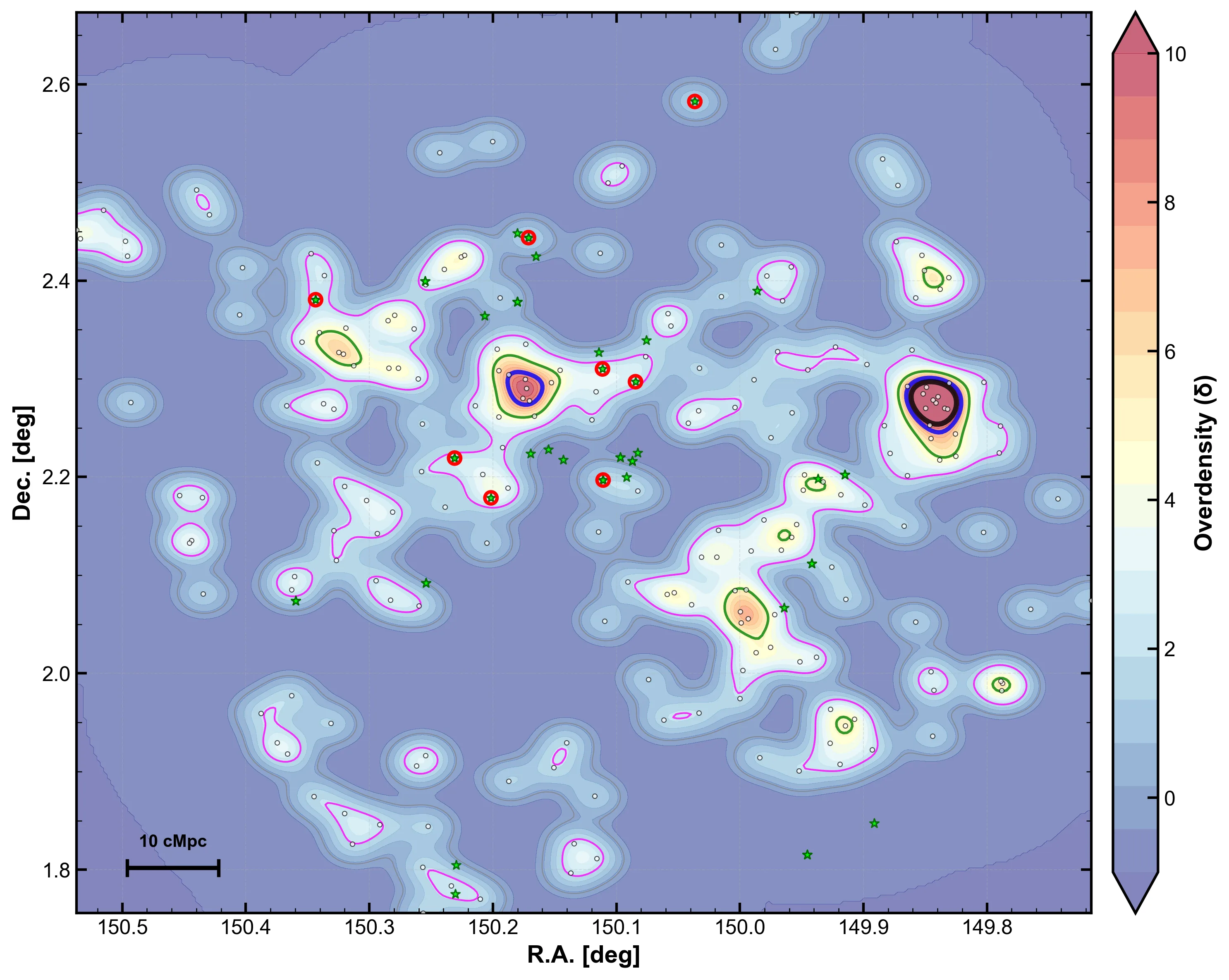
In the vast COSMOS field, where telescopes scrutinize thousands of distant galaxies, a special group stands out: four clumps of young galaxies spread over a patch of sky the size of several full moons. The main clump is so dense that it contains four times as many galaxies as the average across the sky. This is not a fully formed cluster but its embryo — a protocluster where galaxies are just beginning to gather.
Astronomers used data from the SILVERRUSH narrowband survey and images from the James Webb Space Telescope to systematically compare, for the first time, the shapes and sizes of galaxies in the protocluster and in the field. They selected 16 galaxies from the protocluster and 23 from empty regions, all at the same distance: their light has been traveling for nearly 12.5 billion years. For each galaxy, they measured how brightness fades from the center to the edge and fitted a standard profile.
The result was surprising: in the optical range (which traces older, redder stars), galaxies in the protocluster turned out to be on average 40% larger than their isolated counterparts. In the ultraviolet, where young, hot stars shine, there is no difference. This selective effect suggests that the close proximity of other galaxies gently stretches the outer, older stellar outskirts but leaves the bright inner regions untouched.
This is the first observational hint that the environment influences galaxy structure already when the universe was just over a billion years old. It seems that tidal interactions between neighbors, where one galaxy's gravity pulls stars from another, start working very early. Thus, the embryos of future giant clusters already reshape their members in infancy.
The size difference shows up only in the optical, not in the ultraviolet: old stars on the outskirts feel the neighbors, while young ones in the center do not.
In Isaac Asimov's novel The Gods Themselves, a parallel universe influences ours through matter exchange — here, neighboring galaxies subtly reshape each other long before merging.