The Lyman-alpha forest is a dense thicket of absorption lines that appears in the spectra of distant quasars. When light from a quasar passes throughclouds of neutral hydrogen gas scattered across the universe, each cloud absorbs a specific wavelength of light — the Lyman-alpha transition of hydrogen. Because the universe is expanding, each cloud's absorption is redshifted by a different amount depending on its distance, creating a 'forest' of lines rather than a single one. This pattern is a powerful probe of the large-scale structure of the cosmos, revealing where gas is distributed along the line of sight.
History
The Lyman-alpha forest was first identified in quasar spectra in the early 1970s, with the term coined by astronomer Roger Lynds in 1971. It was soon recognized as a powerful cosmological tool, and its interpretation as a tracer of intergalactic gas was solidified through observations and simulations in the 1990s.
How it works
Neutral hydrogen absorbs light at a rest wavelength of 121.6 nanometers (the Lyman-alpha line). As the quasar's light travels toward us, it encounters clouds of this gas at various distances. The expansion of the universe stretches the light, so the absorption from a closer cloud appears at a shorter wavelength than that from a more distant one. The result is a series of absorption dips at different wavelengths, each marking a distinct cloud. By analyzing the density and distribution of these lines, astronomers can map the distribution of neutral hydrogen and infer the underlying dark matter structure, since gas follows the gravitational pull of dark matter.
In practice
The Lyman-alpha forest is used to constrain cosmological parameters, such as the matter density and the amplitude of density fluctuations, and to study the epoch of reionization and the distribution of dark matter.
Fun fact
The Lyman-alpha forest is so sensitive to the presence of neutral hydrogen that it can detect gas clouds with densities as low as a few atoms per cubic meter — far more rarefied than the best vacuum ever created on Earth.
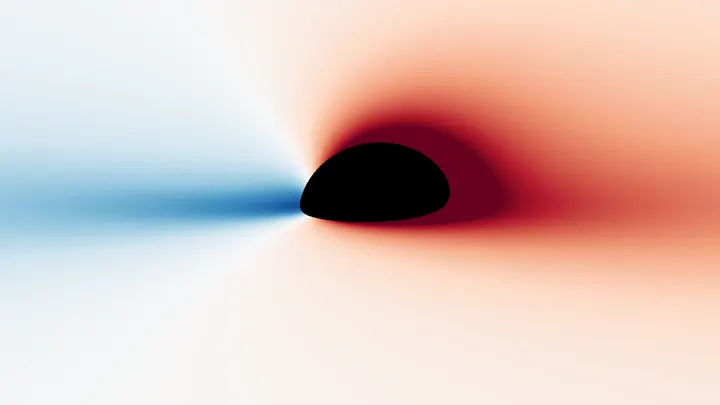
The cosmic detective story began with a quiet flash in the optical band. AT2019wzc slowly brightened and faded like a smoldering ember. But hidden inside was something more energetic — repeating soft X-ray bursts that astronomers call quasi-periodic eruptions.
These eruptions last minutes to hours and repeat every few hours or days.
A bright lantern in thick fog seems dim, while a weak flame in clear air can be seen a kilometer away. A similar oddity baffled astrophysicists almost half a century ago.
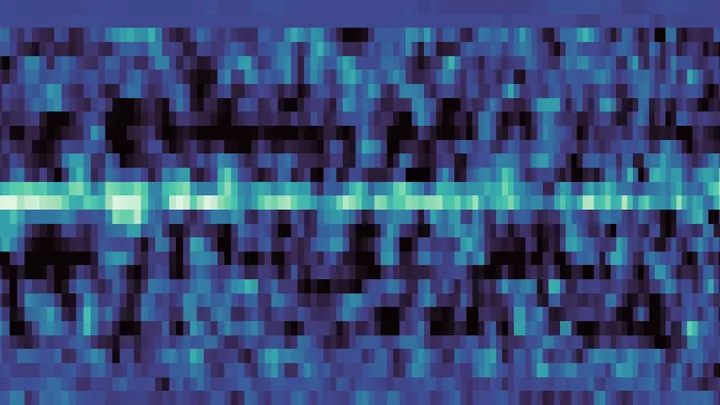
Light from quasar J0744+2052 traveled to us for almost 12 billion years. Along the way, it bumped into hydrogen clouds that snatched individual lines from the spectrum — like a comb sifting through delicate frequencies. Astronomers call this pattern the Lyman-alpha forest in spectroscopy.
Light from distant quasars, breaking through billions of years, leaves a pattern of dark absorption lines on the cosmic film — the spectroscopic Lyman-alpha forest. Each line is like a note in a grand score, written by the hydrogen of the intergalactic medium.
The Universe is a giant concert hall, where instead of walls and balconies, invisible clouds of dark matter float. This architectural ensemble is not static: it refracts and scatters the 'music' rushing through it — gravitational waves from merging black holes.
At the heart of massive galaxies, monstrous gravitational 'cocoons' brew — black holes with billions of solar masses, shrouded in a dense veil of gas and dust. But any metamorphosis requires breaking the shell.
The universe is permeated by invisible mass, dark matter, whose existence was first proposed by Fritz Zwicky in the 1930s, based on his observations of galaxies moving in clusters.
In the heart of a molecular cloud, a massive star is born. Its ultraviolet light ionizes hydrogen, and the cloud flares in the Lyman-alpha line. But for the photon, this flare is not liberation but imprisonment in a hall of mirrors.
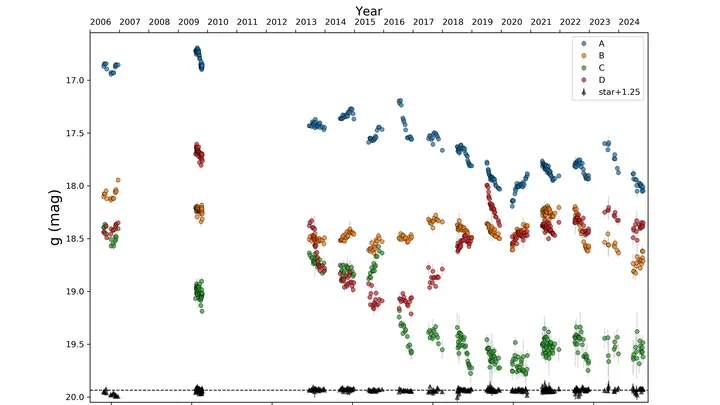
A distant quasar appears as four points of light arranged in a cross. This is how the gravity of a galaxy lying along our line of sight distorts the view: it acts like imperfect glass, multiplying the image. Each point is the same object, but its light travels different paths.
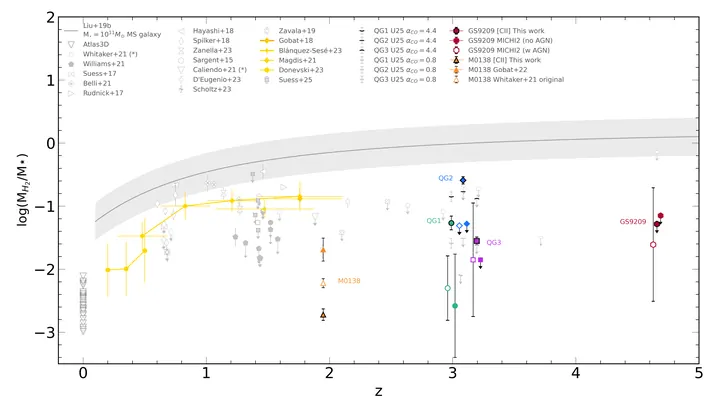
Five galaxies that long ago stopped igniting new stars look like houses with darkened windows. But the ALMA radio telescope and the James Webb Space Telescope peered inside and saw that in these 'sleeping' houses, a fire still smolders.
At the center of galaxy PDS 456 shines a quasar — a black hole devouring gas that glows brighter than hundreds of billions of stars. The X-ray telescope XRISM peered into this light and saw a picket fence of dark bands, like shadows cast by a fence at sunset.
Light from a distant galaxy traveled to us for 13.4 billion years. The James Webb Space Telescope caught it and split it into colors. The spectrum shows a bright hydrogen line, like a fingerprint saying that galaxy GS-z13-1-LA is actively forming stars.
Young hot stars inside the galaxy act like floodlights.
If a supermassive black hole lives at the center of a galaxy, it heats the infalling gas to incredible temperatures. That gas glows, and we see it as a quasar — the brightest beacon in the universe. But how do you measure the size of the light source itself?
A giant cosmic funnel sucks in gas from its surroundings. But not all of that gas falls in — some is spat back out, like splashes from boiling water. That's exactly what the ultraluminous X-ray source NGC 5204 X-1 does: a compact object (likely a black hole) feeds so voraciously that the excess escapes in powerful jets.
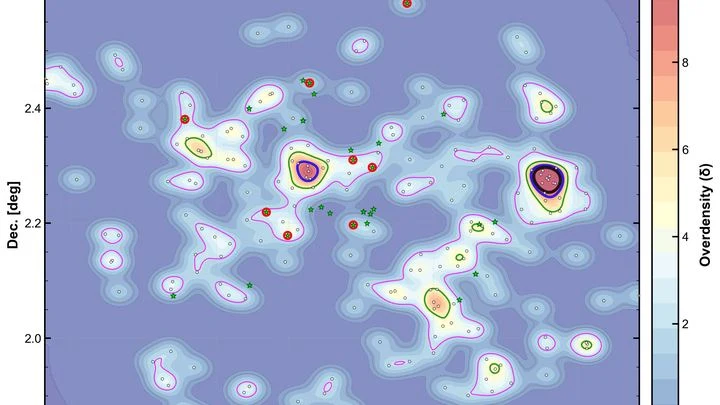
In the vast COSMOS field, where telescopes scrutinize thousands of distant galaxies, a special group stands out: four clumps of young galaxies spread over a patch of sky the size of several full moons. The main clump is so dense that it contains four times as many galaxies as the average across the sky.
In the first moments after the Big Bang, the universe was a hot soup of particles. Among them could have been neutrinos — very light and nearly elusive particles. Some of them might have been 'sterile': they barely interact with the rest of matter, like a quiet guest at a loud party.
In December 2024, quasar PG 1211+143 found itself in the crosshairs of two X-ray observatories at once: the spectrometers on XRISM and XMM-Newton observed it simultaneously. A quasar is the extremely bright core of a distant galaxy, where a supermassive black hole is accreting surrounding gas.
Light from the hottest young stars usually cannot leave its galaxy: hydrogen absorbs it, like a thick curtain blocking a sunbeam. But sometimes the curtain parts, and ultraviolet photons burst into intergalactic space.