Conducting a Thousand Cameras for the Sharpest Telescope
When an orchestra of thousands of musicians plays in harmony, the credit goes not only to each player's talent but also to the invisible work of the conductor.
The Large Sky Area Multi-Object Fiber Spectroscopic Telescope, a Chinese survey telescope.LAMOST (Large Sky Area Multi-Object Fiber Spectroscopic Telescope) is a Chinese astronomical facility that simultaneously captures spectra of up to 4,000 celestial objects in a single exposure. It is a reflecting Schmidt telescope with a 4-meter aperture and an unusually wide 5-degree field of view, enabling massive spectroscopic surveys of stars, galaxies, and quasars. Its primary mission is to map the Milky Way's stellar populations and probe the large-scale structure of the universe.
LAMOST was proposed in the 1990s, built by the Chinese Academy of Sciences, and began regular survey operations in 2012. It has since released millions of stellar spectra, becoming one of the most productive spectroscopic surveys in the world.
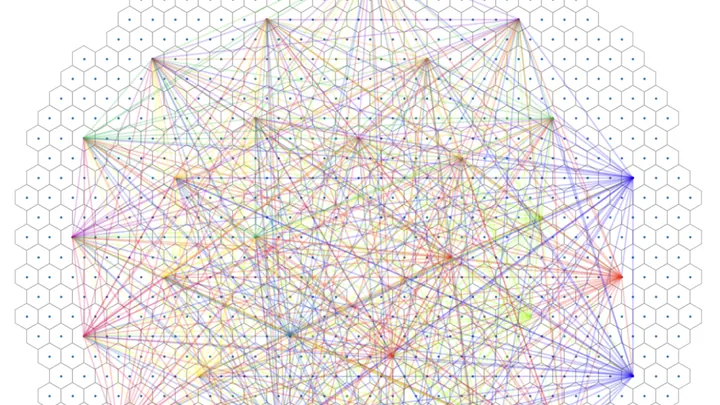
LAMOST uses a novel design: a correcting mirror at the front and a spherical primary mirror at the back, with 4,000 optical fibers positioned by robotic actuators at the focal plane. Each fiber feeds light from a target star or galaxy into a spectrograph, which disperses the light into its component wavelengths. The resulting spectra reveal radial velocities, chemical compositions, temperatures, and distances, allowing astronomers to construct three-dimensional maps of the sky.
LAMOST data are used to study stellar evolution, identify rare objects like metal-poor stars and white dwarfs, and constrain models of galaxy formation and dark matter distribution.
LAMOST's 4,000 fibers are positioned by small robotic arms that can reconfigure the entire plate in about 10 minutes, allowing the telescope to switch targets rapidly between exposures.